It was one of those unexpected, revelatory moments ─ when one least expects it, the world stops and reality shifts ever so slightly, never to be quite the same again.
“Electricity is variable.”
The speaker was Romita Biswas, technical lead and adviser for Electrify DC, a home electrification advocacy group, welcoming a roomful of clean tech folks to a distributed energy resources (DER) showcase at the Healthy Homes Fair in Washington, D.C., on March 21. What she was talking about, Biswas told me during a subsequent online interview, are the essential physical characteristics of electricity.
“Electricity is just the movement of free electrons … something that relies on motion,” she said. It is not this smooth, unchanging thing flowing into our home outlets but electrons buzzing back and forth across a narrow, but still variable band of frequencies, all of which we are constantly trying to control.
The electric power industry in the U.S. has been built on the concept that reliable electricity can’t be variable; that any power ─ like solar and wind ─ that is less than 24/7 firm and dispatchable is unreliable and, therefore, less valuable.
But Biswas challenges us to imagine a different kind of electric power system, one that takes advantage of electricity’s inherent variability. “Let’s choose when we consume electricity. Let’s say we want to consume it at a lower price,” she said.
The subtext ─ at least at Healthy Homes ─ was that a system built around variability could provide flexibility and affordability in the production and consumption of electricity, and the technologies to deliver both are available.

In January, I wrote a Livewire column predicting 2026 would be the year of flexibility. Three months in, flexibility has become an industry buzz word, but I’m concerned it could be co-opted ─ assimilated into regulatory frameworks ─ amid rising panic about demand growth, high electric bills and the midterm elections.
On the plus side, President Donald Trump’s war in Iran has upended traditional arguments that fossil fuels are the most reliable, secure and cost-effective source of energy ─ for electricity and transportation. Data centers and their appetite for electrons continue to disrupt the regulatory and business frameworks of utilities.
We are past silver bullets and simple solutions. Distributed energy resources ─ especially solar, wind and storage ─ are emerging as smarter options on all counts, and flexibility is the key to optimizing their value and accelerating interconnection.
The focus so far in 2026 has been primarily on data centers and an emerging imperative pretty much everyone agrees on ─ gigawatt-guzzling large loads must pay for or bring their own power. A bit of election-year grandstanding, Trump’s Ratepayer Protection Pledge is an attempt to claim credit for innovations already emerging from data centers, states and utilities themselves.
A new report from Latitude Media notes that 25 utilities across 18 states have developed new rate structures specifically for data centers, 18 of which were filed with or approved by their respective utility commissions in 2024 and 2025.
But ensuring data centers pony up for the power they need is unlikely to provide long-term protection from residential rate increases. In addition to their data center initiatives, investor-owned utilities across the country are increasing their capital spending on new power plants, poles and wires ─ investments they can put into their rate base to justify subsequent requests for rate increases.
(On April 1, Heatmap and the Massachusetts Institute of Technology unveiled their new Electricity Price Hub, a user-friendly website where you can find how much utility bills in any part of the country, down to the ZIP codes, have changed over the past five years. The average bill for my utility, Pepco Maryland, jumped 16.5% over the past year and is up a whopping 60.5% since 2020 ─ and yes, we’re in PJM.)
Mainstreaming Flexibility
Industry efforts to mainstream flexibility within existing frameworks can be seen in the various efforts focused on quantifying large-load curtailment in ways that align with how utilities, grid operators and regulators evaluate different resources; that is, making it something they can deal with.
The Nicholas Institute for Energy, Environment & Sustainability at Duke University kicked off industry discussions on flexibility with its February 2025 report, suggesting that if data centers curtailed their energy use even .25%, they could open up space on the grid for 76 GW of new demand.
Their latest report, issued in March 2026, takes the next step, calling on state regulators to develop official definitions of flexible large loads “based on a set of enforceable curtailment commitments meeting specific technical requirements.”
As spelled out in the report, the four must-have commitments would include:
-
- being voluntary;
- being part of the interconnection process, or a condition of retail service;
- being long term, to support system planning; and
- guaranteeing curtailment across a set of minimum parameters, including the percent of total demand to be curtailed, response times, length of individual curtailments and total hours of availability per year.
For example, to qualify as a flexible large load, a data center might have to commit to curtailing 50% of its total demand within 5 to 10 minutes. Individual curtailments could last up to four hours and be available at least 2% of the time.
Ensuring such commitments are long term and made up front ─ as part of interconnection or retail service ─ would “ensure that [they are] relevant to the assessment of what infrastructure (distribution, transmission and capacity) is necessary,” the report says. “The avoidance of infrastructure needs is what insulates existing customers from affordability and reliability impacts.”
The Electric Power Research Institute uses much the same curtailment parameters in its FlexMOSAIC initiative, unveiled March 23 at CERAWeek in Houston, the fossil fuel industry’s premier annual conference. Aimed at cutting “time to power” for data centers ─ how quickly they can get the power they need to get online ─ EPRI describes FlexM as a “technology‑neutral way to describe and evaluate large load flexibility, based on power system requirements — such as congestion relief, peak reduction, balancing and frequency response.”
The result of cross-industry collaboration ─ with NERC, CAISO, MISO, SPP, NVIDIA, Google and Meta on board, along with a pile of utilities ─ the goal here is “a shared language and transparent performance expectations,” according to a technical overview of the initiative.
A website provides hypothetical examples of the different kinds or combinations of flexibility that might be needed to ensure timely interconnection in the face of rare or frequent “energy scarcity events,” long-duration scarcity events and any grid events requiring fast response.
Of course, quantifying flexibility is essential if it is to be properly valued and compensated. The risk is that utilities, grid operators, and state and federal regulators might appear to support flexibility but set such rigorous requirements or standards that few if any projects would be able to qualify, allowing these gatekeepers to claim flexibility isn’t feasible.
According to the Latitude Media report, none of the data center rates enacted or in the works thus far incorporate flexibility.
Super-smart Plug and Play
More to the point, Trump’s support for data centers bringing their own power assumes the power brought most likely will be large-scale and either nuclear or fossil fueled. When the Department of Energy announced $1.9 billion in funding for transmission upgrades and expansion, any projects that would benefit solar or wind energy were specifically prohibited.
But as was made abundantly clear at the Healthy Homes Fair, flexible, distributed technologies have a vital role to play in boosting grid reliability and affordability and, again, are ready and available.
The big buzz at the event was plug-and-play, smart technologies, like home energy management systems that work with existing electrical panels, so pricey upgrades are not required for installing electric vehicle chargers or induction stoves.
Jane Chen, cofounder and CEO of Stepwise Electric, sees homes and the neighborhood poles and wires that serve them as the electricity system’s “last mile” delivery network and “problem child,” driving peak demand and grid congestion.
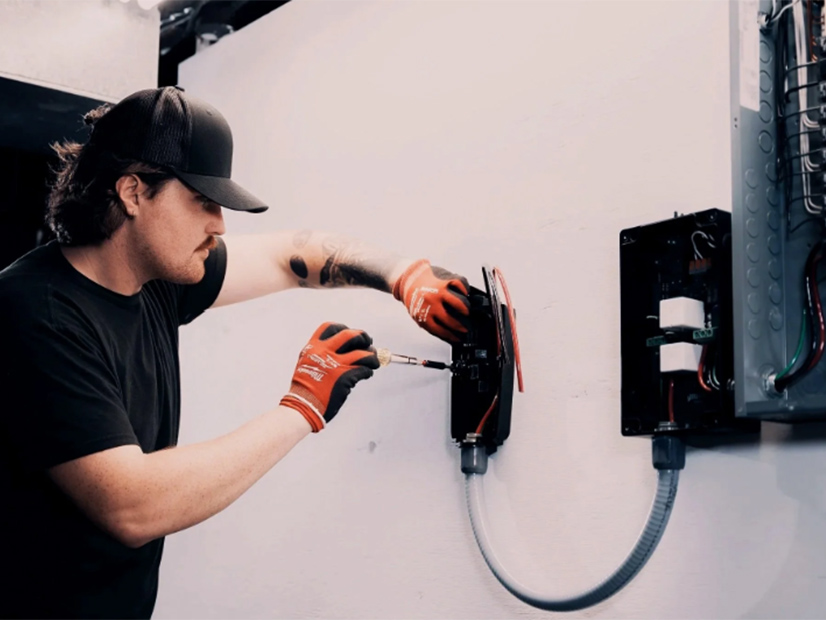
The Stepwise product, called Tap, literally is a black box an electrician connects to an existing electrical panel in a few hours. It monitors and manages the electricity use of appliances and can respond to utility signals at times of high demand.
For example, it can turn down or briefly turn off certain appliances ─ such as an EV charger or heat pump water heater ─ to help ease stress on the grid while keeping the rest of a house operating normally.
Elastic Energy’s ER01 is an even smaller black box that doesn’t even need to be connected to an electric panel and can turn any home or business into a grid asset, according to CEO Ben Hilborn.
The box, which is a router, connects to home equipment ─ via Wi-Fi, Ethernet or LTE-M ─ and enrolls them in any appropriate utility demand management programs so they can use electricity efficiently and cost effectively “in real time, based on real pricing signals,” Hilborn said.
Breaking down the silos between how these assets get compensated “is one of the last true remaining unlocks” to achieving an “equitable grid for everyone,” he said.
In both cases, the black boxes allow for aggregation of distributed technologies and coordination with the local distribution systems.
Adding batteries to home appliances ─ such as Copper’s plug-in induction stoves ─ is another trend aimed at shifting and managing demand. The stoves can operate off grid, storing enough electricity to cook six meals, or 76 grilled cheese sandwiches, in the event of a power outage, according to Joshua Land, the company’s founder and head of strategic partnerships.
‘Get it Done’
The message is that flexibility is itself variable and multidimensional ─ we need it top-down and bottom-up ─ and smart, distributed technologies are the enablers. The challenge ahead is to accelerate commercialization and cut upfront costs. The households that could benefit most from the cost savings that clean, distributed technologies provide are frequently those that can least afford them.
A December 2025 report from Rewiring America argues that beyond bringing their own power, hyperscalers could open up more capacity on the grid ─ enough to meet all their demand growth ─ with strategic funding for home upgrades, such as solar, storage and heat pumps.
As is often the case, Google is leading the industry. On March 20, the company announced it will power a new data center in Michigan with 2.7 GW of solar power, advanced grid technologies and demand flexibility, plus will provide $10 million to fund home weatherization and energy efficiency upgrades in local communities. Another data center it is developing in Minnesota will include $50 million for smaller, distribution-level storage projects, along with 1.9 GW of utility-scale solar, wind and long-duration energy storage.
But beyond funding, we will need to make fundamental changes in utility industry regulation at the state level, said former FERC Commissioner Allison Clements, speaking at Healthy Homes.
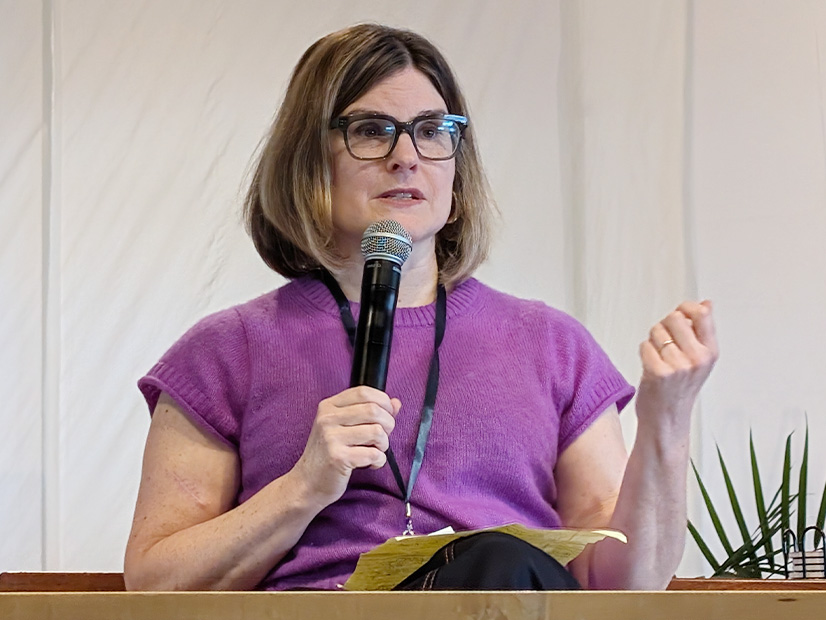
The legacy U.S. grid, built out in the 20th century, is no longer “built for purpose” in our 21st-century digital economy, Clements said.
“If ever there was a time to take advantage of DER technology … it is right now,” she said. “We have an opportunity to make these things work, and if we don’t do it right now, we’re not going to get it done.”
Clements called for a new focus on “community power … [that] has the ability to reduce the amount of expensive power that your communities need to purchase, that your utility needs to purchase on your behalf.”
She also rejected the industry’s “technical, wonky, electricity regulatory language. … It hasn’t worked.”
Rather, like Biswas, she challenged people to “think about what it really means to make changes. Don’t accept that just because we’ve been really bad at it for 25 years, that that’s the way it has to be, because it doesn’t.”