Washington state has relaunched rulemaking that will pave the way for linking the state’s cap-and-trade program with the already-linked programs of California and Quebec.
The new rulemaking will replace previous linkage rulemaking for Washington’s cap-and-invest program, which is the state’s name for cap-and-trade. The latest rulemaking will cover a wider range of topics, the Washington Department of Ecology announced March 31.
The earlier rulemaking started in April 2024. The Department of Ecology held public meetings and released draft rules July 1. Comments and information gathered during the previous linkage rulemaking will be used as part of the new rulemaking, the department said.
The potential rule changes will help Washington’s cap-and-invest program align with cap-and-trade programs in California and Quebec, although a new rule won’t create a linkage among the programs on its own.
In cap-and-trade programs, major greenhouse gas emitters must buy allowances that correspond to the amount of their emissions; the state also imposes an emissions cap that decreases over time. The state may use proceeds from allowance auctions to fund climate projects.
Linking carbon markets of multiple jurisdictions allows for joint allowance auctions, a common allowance price and trading of allowances between jurisdictions. With a larger pool of buyers and sellers, the linked markets generally have more consistent pricing and fewer price swings, the Department of Ecology said.
California and Quebec linked their cap-and-trade programs in 2014. Washington launched its cap-and-invest program in January 2023, and last year, the state legislature passed Senate Bill 6058, intended to facilitate the linkage with the California-Quebec market.
“We believe linkage will strengthen our respective efforts to fight climate change and reduce air pollution, while also encouraging more governments to adopt scalable, market-based climate policies in the future,” the three jurisdictions said in a joint statement issued in September.
Topics Covered
The new Washington state rulemaking involves changes to two rules: the Climate Commitment Act Program Rule and Reporting of Emissions of Greenhouse Gases Rule.
The previous rulemaking considered a range of topics, including compliance period length, program registration requirements and allowance purchase limits.
Electricity sector topics included reporting for electric power entities, coverage for imported electricity from unspecified sources, participation requirements for federal power marketing administrations and greenhouse gas emissions reporting methods.
Additional topics will be considered in the new rulemaking, including:
imported electricity associated with centralized electricity markets;
the amount of allowances allocated at no cost to electric utilities that must be consigned to auction during the second compliance period; and
adoption of allowance budgets for the second compliance period (2027-2030) to ensure that emissions reductions are aligned with the state’s greenhouse gas emissions limits for 2030, 2040 and 2050.
The rulemaking topics may continue to evolve, the Department of Ecology noted, as California and Quebec work on potential changes to their cap-and-trade regulations. And legislation enacted in Washington state this year could prompt further rule changes.
The department will hold public meetings for the new rulemaking this spring through fall. The department expects to release a proposed rule early next year and adopt rule changes in summer 2026. An environmental justice assessment will also be conducted as part of the rulemaking.
The department previously projected that a linkage agreement could be in place in 2026, with linked markets beginning to operate in 2026 or 2027.
CAISO’s 2024/25 draft transmission plan recommends 31 new projects at an estimated cost of $4.8 billion, slanting heavily toward reliability needs.
The plan is based on California Public Utilities Commission forecasts projecting the state must add more than 76 GW of new capacity by 2039, the ISO said in the draft.
“This reflects greenhouse gas reduction goals and load growth, including the potential for increased electrification occurring in other sectors of the economy, most notably in transportation and the building industry,” CAISO wrote.
The new capacity needs include 30 GW of solar generation spread throughout the state, 7 GW of in-state wind resources in existing wind development regions, and more than 4.5 GW of offshore wind in the Morro Bay and Humboldt call areas.
The plan also factors in the need to import an additional 9 GW of wind energy from Idaho, Wyoming and New Mexico, which will require “enhancing corridors from the ISO border in southeastern Nevada and from western Arizona into California load centers.”
The plan additionally considers the transmission access needs of co-located battery storage projects across California, as well as for standalone projects close to major load centers in the Los Angeles Basin, the Greater Bay Area and San Diego.
“Our draft plan reflects the ISO’s proactive approach to transmission planning and underscores our ongoing collaboration with local, state and regional partners to ensure California has the necessary infrastructure to deliver clean energy reliably and cost-effectively to consumers,” Neil Millar, CAISO vice president for transmission planning and infrastructure development, said in a statement.
The ISO noted some of the projects would use grid-enhancing technologies.
Mostly Reliability
Twenty-eight reliability-driven projects account for nearly all the proposed spending, at roughly $4.56 billion.
“While the resource planning needs have not increased materially from those reflected in last year’s transmission plan, the increased rate of load growth reflected in the most recent load forecast associated with building and other electrification, data center growth and transportation electrification results in significant reliability-driven needs in this year’s transmission plan,” the plan says.
The 2024/25 plan assumes the state’s peak demand will increase at a 1.53% yearly rate, compared with a 0.99% forecasted growth rate in the previous plan. Peak demand in the Greater Bay Area now is expected to grow by 2.14% annually (up from 1.22%), translating into a 2,000-MW increase in the region’s 2035 peak load forecast, “with most of the growth coming from electrification of the transportation and building sectors of the state’s economy and an anticipated increase in data centers associated with artificial intelligence.” (See Data Centers Contribute to 60% Increase in San Jose Load Forecast.)
The Bay Area would host the priciest reliability projects in the plan, including Pacific Gas and Electric’s North Oakland ($1.13 billion) and Greater Bay 500-kV transmission ($700 million) reinforcement projects. San Diego Gas & Electric’s Downtown Reliability reinforcement project comes in third at $500 million.
Three policy-driven projects would entail about $289.5 million in spending.
All three recommended policy projects are in PG&E’s territory, including two in Fresno and one in the North Coast/North Bay local area. “They are needed to meet the renewable generation requirements established in the CPUC-developed renewable generation portfolios,” the ISO said.
CAISO said the plan identified no economically driven projects, representing those that would reduce costs for ratepayers but are not needed for reliability.
The ISO said the 31 recommended projects “represent significant investments that are phased in over lead times of up to eight to 10 years, which are reasonable for some of the projects to be completed.”
Costs would translate into about 0.5 cents/kWh over the life of the projects and will be phased in as lines come into service, the ISO said.
CAISO will hold an April 15 public stakeholder call on the draft plan and is taking comments through April 29. The ISO’s Board of Governors is expected to vote on the plan at its May meeting.
Negotiations on what could have become the first floating offshore wind array in the U.S. have halted amid the uncertainty that has gripped the country’s offshore wind industry.
The Maine Public Utilities Commission on March 28 granted the request of Pine Tree Offshore Wind to suspend talks on a contract to support construction of a research project with up to 12 turbines with a capacity of up to 144 MW.
The move is the latest setback for the state of Maine’s long-running ambitions to exploit the windy waters off its coast for environmental and economic benefit through installation of wind turbines and creation of a new commercial/industrial sector:
The depth of the Gulf of Maine dictates that floating turbines be used there, and floating wind technology still is in development.
The first-ever Gulf of Maine commercial lease auction was a lackluster affair, with four of the eight offered lease areas drawing just $22 million in combined winning bids and the other four going unsold. (See Gulf of Maine OSW Auction Results in Four Leases Worth $21.9M.)
And of course, Donald Trump was elected president on a platform that included halting offshore wind development. Pine Tree is only the latest of several developers to pause their efforts in U.S. waters amid Trump’s efforts to follow through on his campaign pledge.
The state of Maine requested the research lease in October 2021 and designated Pine Tree as its operator. The U.S. Bureau of Ocean Energy Management executed the research lease (OCS-A 0553) in August 2024. (See Maine Approved for Floating Wind Research Lease.)
The zone totals nearly 15,000 acres roughly 28 nautical miles southeast of Portland.
The Maine PUC opened the docket (Case 2022-00100) for consideration of Pine Tree’s contract in April 2022. In December 2024, Pine Tree requested and received an extension to March 31, 2025, of the deadline to submit a proposed contract supporting the offshore wind research array.
The negotiations apparently were fruitless: Pine Tree subsequently requested they be suspended “due to recent shifts in the energy landscape that have in particular caused uncertainty in the offshore wind industry.”
On March 28, the PUC approved the request for suspension, finding that “good cause exists” and noting that no objections were raised by the other negotiating parties: the governor’s Energy Office, the Office of the Public Advocate, Central Maine Power and Versant Power.
The suspension will continue until Pine Tree requests that negotiations resume.
California Gov. Gavin Newsom has suspended environmental laws to accelerate the undergrounding and hardening of utility equipment in communities ravaged by the Los Angeles wildfires.
Newsom’s executive order removes requirements under the California Environmental Quality Act and the California Coastal Act in an effort to speed up “the rebuilding of utility and telecommunication infrastructure, including the undergrounding of equipment,” according to a March 27 news release.
A previous executive order similarly suspended the environmental laws and applied to infrastructure damaged in the wildfires. However, that order was limited, and projects to move equipment underground or upgrade existing infrastructure may not qualify under the previous suspension, the most recent order stated.
“We are determined to rebuild Altadena, Malibu and Pacific Palisades stronger and more resilient than before,” Newsom said in a statement. “Speeding up the pace that we rebuild our utility systems will help get survivors back home faster and prevent future fires.”
In a Feb. 27 letter, Newsom urged Southern California Edison and Los Angeles Department of Water and Power to develop plans by the end of March on how the utilities can rebuild safer and resilient electric infrastructure, including by placing electric distribution infrastructure underground.
Jeff Monford, a spokesperson for SCE, told RTO Insider the utility appreciates “Gov. Newsom’s action to help expedite permitting so the fire-damaged communities can rebuild stronger. We look forward to continuing our work with federal, state and local officials to shorten permitting times under this executive order.”
SCE already has launched efforts to underground several miles of lines in Altadena and Pacific Palisades, “and some sections of the grid will be completed in a few months,” Monford said.
Monford would not share specific cost information but noted that undergrounding costs significantly more than building the grid with power poles.
“There’s a lot going on in these burn areas, and the expedited permitting, siting and permitting that the governor’s order will allow will certainly help move that along,” he added.
Local utility Pasadena Water and Power, which operates in the Altadena region that was devastated following the Eaton fire, said in an email that “nothing in the orders change any policy direction and capital projects that we have planned.”
The Eaton Fire began shortly after 6 p.m. Jan. 7 and burned more than 14,000 acres and killed 17 people. The deadly fire engulfed parts of the Altadena community, with thousands of structures either damaged or destroyed, according to Cal Fire.
The Pacific Palisades fire burned 23,448 acres, destroyed 6,837 structures and killed 12 people.
SCE faces several lawsuits, alleging the utility’s lines started the Eaton fire. SCE has said it is investigating possible links between its equipment and the fire. (See SCE Probes Link Between Equipment and Eaton Fire.)
The utility previously acknowledged its equipment may have sparked the Hurst Fire, which burned roughly 799 acres and damaged two homes. There were no reports of fatalities or injuries associated with the fire. SCE said it is cooperating with a Los Angeles Fire Department investigation.
The Tennessee Valley Authority board of directors announced it will elevate COO Don Moul to become the fourth CEO of the federal utility.
The promotion further positions TVA for a nuclear-dominant future. Moul previously served as a chief nuclear officer and senior nuclear reactor operator, among other primarily nuclear roles at American Electric Power, Duquesne Light Co., FirstEnergy, GPU Nuclear Corp. and Public Service Electric & Gas.
Moul, who has 38 years of experience in the power industry, replaces outgoing CEO Jeff Lyash, who also has an extensive background in nuclear operations. (See TVA CEO Jeff Lyash Announces Plans to Retire.) The appointment becomes effective April 9 and makes Moul the second TVA COO to earn a CEO promotion. TVA’s first CEO, Tom Kilgore, also was COO before Congress established the CEO position in 2005.
Before joining TVA in mid-2021, Moul was executive vice president and chief nuclear officer at NextEra Energy, where he oversaw operations at seven units as well as decommissioning of the Duane Arnold Energy Center.
Announcement After Senator Criticism, Board Member Dismissal
Moul’s advancement follows Sens. Marsha Blackburn and Bill Hagerty, both Republicans of Tennessee, authoring a March 20 op-ed in POWER Magazine calling for the next TVA leader to lead the “nation’s nuclear energy revival” and fall in step with President Donald Trump’s vision for more nuclear power.
The senators criticized the utility’s leadership and board for moving too slowly on nuclear development and said they were concerned “TVA’s next CEO would be hired from within.”
TVA holds the country’s only early site permit for small modular reactor (SMR) construction at its Clinch River Nuclear Site in Oak Ridge, Tenn. U.S. Energy Secretary Chris Wright and Hagerty toured the site in mid-March. While TVA’s board authorized $350 million in 2024 to explore nuclear solutions, it has not yet voted to approve an SMR at the site. Lyash has said TVA eventually aims to build a fleet of SMRs in its footprint.
“The presidentially appointed, Senate-confirmed, TVA board of directors lacks the talent, experience and gravitas to meet a challenge that clearly requires visionary industrial leaders. The group looks more like a collection of political operatives than visionary industrial leaders,” Blackburn and Hagerty wrote.
A week later, TVA board member L. Michelle Moore, an appointee of former President Joe Biden, was fired at the direction of Trump, according to a Securities and Exchange Commission report. The Trump administration has not provided a reason for Moore’s termination. In a statement, TVA said its board members serve at the pleasure of the president.
Moore’s term would have expired on May 18, 2026. The Southern Alliance for Clean Energy called the firing a “hyper-partisan action.”
The board currently has five members and four vacancies.
TVA Underscores Nuclear in Announcement
In a press release on Moul’s hiring, TVA focused on its nuclear advancements. It said under Moul’s leadership, “TVA is a national leader in driving advanced nuclear technologies forward.”
“Don is ready to be the hand guiding TVA in a time of rapid change and growth, and he will continue to propel TVA’s nuclear leadership,” Lyash said. “In his role as COO, he has led the development of next-generation nuclear technologies and has a deep knowledge and appreciation for nuclear power — the most reliable power the world’s ever known.” Lyash also said TVA hired Moul four years ago “with succession planning in mind.”
Moul said he expected his transition to be “seamless” for TVA.
“We’re in a period of growth like we’ve not seen before, and to meet that growth, we are making one of the largest capital investments in our history,” Moul said. “TVA needs a steady hand right now. I will build on the momentum that Jeff and our team have created — making sure we continue to invest in new generation, strengthen our grid and enhance system reliability.”
Moul told the Knoxville News Sentinel the board conducted an internal and external search for a new CEO before they offered him the job after a series of interviews. TVA confirmed that the offer was extended on March 25 and predated Moore’s termination.
Board Chair Joe Ritch said the board search was exhaustive.
“The TVA board took a structured, deliberative approach to CEO succession — evaluating a strong slate of both internal and external candidates,” Ritch said in a statement to RTO Insider. “The board evaluated multiple search firms, reviewing in detail their process for candidate identification and assessment, ultimately selecting a firm with deep experience and expertise in the energy industry. The board also leveraged a third-party leadership assessment firm and an independent compensation consultant.”
Lyash is set to retire as the highest-paid federal employee, making $10.5 million in total compensation over 2024.
FERC plans to rule on ISO-NE’s compliance proposal for Order 2023 on or before April 4, the commission announced in a short notice March 31 (ER24-2009, ER24-2007).
The announcement came on the date of a key deadline for ISO-NE’s compliance timeline after repeated requests for rapid action by state officials and generation developers.
ISO-NE initially requested FERC accept its compliance proposal with an effective date of Aug. 12, 2024. The RTO suspended its work implementing its proposal in October 2024 because of the lack of a ruling from FERC. (See With FERC Inaction, ISO-NE Delays Order 2023 Implementation.)
Some stakeholders have expressed particular concern about the fate of ISO-NE’s proposed transitional capacity network resource (CNR) group study, which is intended to enable late-stage projects with complete system impact studies to achieve capacity interconnection rights.
In its original filing, ISO-NE wrote that the transitional CNR study, set to occur prior to the transitional cluster study (which would include all other interconnection requests), “avoids the need to include these requests in the transitional cluster study, thereby creating efficiencies by reducing the number of requests included in that study.”
ISO-NE said it would need an order by the end of March to align the transitional CNR study with the 2025 Interim Reconfiguration Auction Qualification process, which includes a show-of-interest submission deadline at the end of April. But in late March, ISO-NE told stakeholders it likely would not be able to proceed with the transitional CNR study. (See ISO-NE to Reopen Queue as it Continues to Wait on Ruling from FERC.)
In response to FERC’s announcement, an ISO-NE spokesperson said the RTO will assess its options once the order is issued.
ISO-NE also confirmed it reopened the interconnection queue April 1. The queue had been closed since June 13, 2024, which is the RTO’s proposed deadline for projects to have a valid interconnection request to participate in the transitional cluster.
It is unclear if projects that enter the queue after this date will be eligible for the cluster, and ISO-NE has said it “cannot guarantee the treatment of [interconnection requests] submitted after the June 13, 2024, eligibility date.”
Alex Lawton of Advanced Energy United said FERC’s announcement “has given us renewed hope that the ISO can reverse course and proceed with the transitional CNR group study as previously planned. Should the FERC order largely accept the compliance filing, we are confident the ISO will explore how to proceed in a manner that causes the fewest delays and resembles our stakeholder-supported original plan as much as possible.”
NERC’s Interregional Transfer Capability Study represents “a crucial input in development of a modern, reliable, grid” despite its limited congressional mandate and time frame, the agency said in responding to comments on the report March 25.
NERC filed the ITCS with FERC in November 2024 as directed by the Fiscal Responsibility Act of 2023. In accordance with Congress’ order, the study outlined current transfer capabilities across the U.S. grid, recommendations for prudent additions that could strengthen grid reliability, and recommendations to meet and maintain total transfer capability (AD25-4).
After the public comment period ordered by the FRA, FERC will submit recommendations for statutory changes, if any, to Congress.
The ERO’s recommendations included 35 GW of additional transfer capability across FERC’s planning regions, with more than 14 GW in ERCOT across the SPP-South connection and two entirely new connections. (See NERC Releases Final ITCS Draft Installments.) This suggestion prompted a comment from ERCOT, which pointed out that about 32 GW of solar and wind resources have come online in Texas since Winter Storm Uri in 2021 and said NERC’s analysis may not have fully accounted for these additions.
“The nameplate capacity these resources have added to the ERCOT system is more than double the 14 GW of interregional transmission the ITCS recommends for the ERCOT region,” ERCOT said. “The ITCS’ attempt to account for future resource growth on the ERCOT system likely underestimates the resource additions that will actually occur as ERCOT continues to commission new resources at a record pace, connecting over 12 GW of new generation in 2024 alone, on top of the 7 GW connected in 2023.”
ERCOT also cautioned that the ITCS “may be overly optimistic” in its expectations for the proposed transmission expansions, noting that “generation resources must still be available to provide power … over those transmission lines.”
The ISO said market incentives, which the ITCS did not take into account, “are an indispensable part of energy adequacy and future generation growth [and] are actively being examined and refined in the ERCOT region.”
In response, NERC said it recognizes the potential impact of market mechanisms on energy adequacy, although they were not a part of the ITCS. In addition, the ERO acknowledged that the effect of “connections such as ERCOT to” SERC Southeast — mentioned in the report — needed more study than Congress allotted time for. It pointed out the report contains a chapter with areas for future study to understand the relationship between transfer capability and grid reliability.
NERC also replied to a comment from the Eastern Interconnection Planning Collaborative, an association of 18 planning authorities from the Eastern and Central U.S., which argued for expanding the ITCS by “adding credit for transmission products and plans” and warned against using the study “as a metric for determining prudent additions.” (See EIPC: Transmission Studies Need More ‘Granularity’.)
The ERO observed that such a change “would have exceeded the scope of the” FRA and might even have usurped FERC’s responsibility to recommend regulatory action. However, NERC said it would continue separately to highlight the issues raised by EIPC and would urge policymakers and industry to take them under consideration.
Finally, NERC pushed back on a comment from sponsors of the South Carolina Regional Transmission Planning Process and the Southeastern Regional Transmission Planning Process, which between them comprise a number of utilities, including Dominion Energy South Carolina, Santee Cooper, Associated Electric Cooperative and Duke Energy. The SCRTP and SERTP sponsors claimed that while NERC facilitated stakeholder engagement during the first phase of analysis, for the most part the ERO could not engage stakeholders during the second phase “due to time constraints.”
NERC countered this assertion, saying it had engaged in outreach at every stage, including “consulting with transmitting utilities and other stakeholders” in the Southeast. The ERO also emphasized that its consultation process for the second phase of analysis consisted of multiple steps that continued through more than half of 2024, and that the ITCS Advisory Group of grid stakeholders “included two representatives from the Southeastern U.S.”
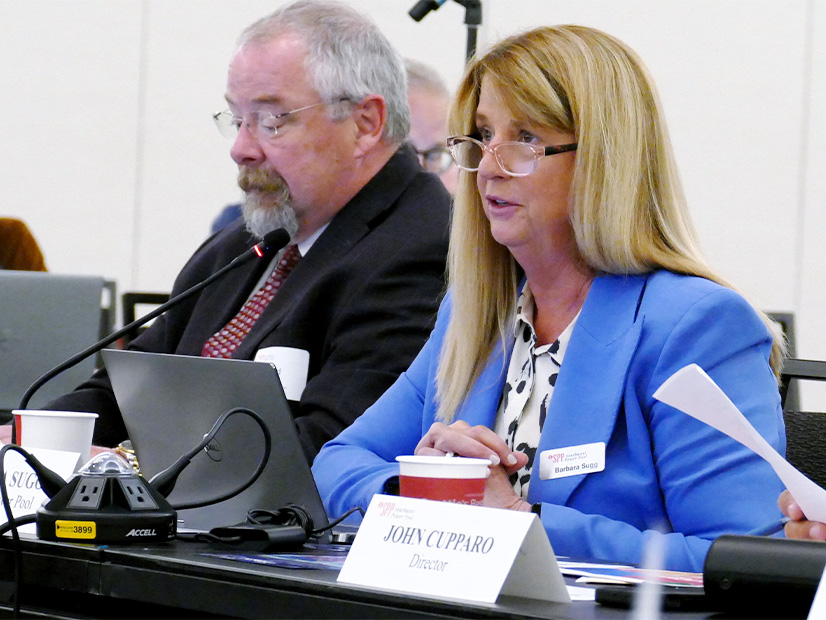
AUSTIN, Texas — Having ascended to the top of her profession as SPP’s CEO, which she left March 31, Barbara Sugg presents the image of a very accomplished woman who is confident of her abilities.
Sugg served as SPP’s chief executive for five years and also was the first woman to serve as a fulltime leader of a North American RTO or ISO. She guided the grid operator through a pandemic at the outset of her tenure, and she kept SPP’s sights on establishing markets in the Western Interconnection. For that, the Gulf Coast Power Association (GCPA) has named an award after Sugg and MISO’s Clair Moeller that celebrates excellence, innovative strategies, influential contributions, unwavering enthusiasm and dedication to their work.
A 39-year veteran of the industry, Sugg founded and developed the Leadership Foundation for Women, a nonprofit that seeks to equip women for career success. A “proud Ragin’ Cajun” despite her many years in Little Rock, Ark., she also makes a mean gumbo that is the hit of her 200-person nonprofit dinners. “Real gumbo doesn’t really exist in Arkansas unless it came out of my kitchen,” she said.
Despite all that, Sugg battles with imposter syndrome. It is defined as a psychological phenomenon characterized by persistent feelings of inadequacy, fraudulence and self-doubt, despite evidence of one’s accomplishments. Individuals with imposter syndrome often chalk up their successes to luck or external factors, rather than their own abilities.
And that’s Barbara Sugg.
“The only place I don’t have imposter syndrome is at home, where everyone loves me unconditionally,” she told her audience during a November 2024 keynote address to the GCPA emPOWERing Women Leadership Conference. Sugg initially was reluctant to have media coverage of her speech, saying the topic was very personal to her. In the end, she relented.
“The thing about imposter syndrome, it isn’t just present at work. I’ve only realized this in the last couple of days,” Sugg said during her keynote. Referencing her foundation’s gumbo dinners, she said, “Every year, without fail, I’m thinking, ‘I hope they like it. I hope they feel it was worth their donation. I don’t know if they’ll donate again.’
“Why do we do this to ourselves?” she said before asking her listeners to stand up if they were their own worst critic. Many did.
“I just needed to get some reassurance because I have said for years that I’m my own worst critic. I criticize my cooking; I criticize my work; I criticize how I presented. I promise you I will criticize myself later today for this presentation,” Sugg said. “I am my own worst critic. You are your own worst critic. So why are you so worried about everybody else’s criticism? You give yourself more criticism than anybody else is ever going to give you.
“I wish someone had told me that 20 years ago, because it’s so true. I so much fear the criticism of other people that it can be paralyzing unless I can say, ‘You know what? That’s just a voice. It’s just a voice that’s trying to keep me safe, because if I don’t take the risk, I can’t fail.’ Nobody else is ever going to judge me as harshly as I’m going to judge myself. So cut yourself some slack. Stop fearing other people’s judgment.”
Sugg’s comments were met with a standing ovation. “Thank you so much,” one woman said. “I didn’t know I needed your speech until it happened.”
“I felt good about the reception I got from the audience at GCPA,” she told RTO Insider. “Apparently, the keynote right after lunch started with, ‘I also got a promotion today. I’m the president of the Barbara Sugg fan club.’”
During a Q&A after her speech, Sugg was asked how she was approaching retirement. She said she had been going through different emotions about leaving an organization she had been with since 1997.
“Leaving is a big deal, and in my position, not many people leave on their own terms,” she said. “I have a lot of emotions about leaving because I care very deeply for our employees. So, my latest analogy — because I love a good analogy — is that I’ve put my family up for adoption, but I don’t get to pick the new parents. It’s an open adoption so I can still check in on them [and] make sure everybody’s doing okay.”
Sugg told her questioner she believes a work culture that feels like family is “tremendously valuable.”
“When you feel like you’re working with family, you and they will do anything for you. You need help? People are there for you. The competition in the workplace can be very challenging. It creates all kinds of insecurities around you … but to have people that feel like family, that you care about and they care about you, that makes going to work a whole lot better.”
It wasn’t always that way for Sugg. She said no one during her childhood told her she was smart, kind or important. “What a difference that would have made for me throughout my life and my own confidence.”
Sugg found her computer science classes in college to be hard and herself to be dependent on her classmates. She said everyone is dependent on each other within their own “tribe” in school. Sugg’s first job was a disaster: the “first and worst situation I ever saw with women being ugly to other women.” That included her female manager, who would dress her down in front of others.
“I’ve tried to unravel why she was that way, but it just fed that voice in my head that I wasn’t good enough, because here’s this woman yelling at me, telling me I’m not good enough,” Sugg said.
Fortunately for her, she was recruited to the Louisiana Energy and Power Authority by the person she had replaced — “She probably knew she needed to rescue me,” she said — and that led her to SPP and an IT department with about 10 people.
“I loved solving problems, especially with technology. I loved helping people understand how things worked,” Sugg said.
She recalled the day her boss came into her office and told her IT employees tend to fall into one of two tracks.
“‘They’re either on the technical track, where they’re great at solving problems and providing solutions and technology and support, or they’re in the managerial track, where they’re leading people.’ With every fiber of my being, I looked at him, and I said, ‘Well, I totally see myself on that technical track.’ He closed his eyes and he shook his head.
“I can remember it like it was yesterday. At the time, I was insulted because what he had just told me is, ‘You’re not good enough to be technical, therefore you probably belong in the managerial track.’ That’s what I heard. Now, how crazy is that?”
As it turned out, Sugg’s manager knew better. He surprised her by promoting her into management. However, Sugg’s inner voice said, “Unearned. Undeserved.” Sugg continued moving up the corporate ladder, attributing it to luck.
“These were not jobs I was applying for. I was just trying to be the best I could be in the job I was in,” she said. The voice in her head said, “You don’t know anything about this job.”
Still, SPP board members would suggest to Sugg from time to time that she consider applying to be CEO. Nick Brown, the only chief executive most staffers had known at the time, is going to retire at some point, they would tell her.
“I was like, ‘No, I don’t think so.’ I had this image that the CEO is this amazing person that has all this knowledge and well, most of them have really big egos to go along with that knowledge,” she said. “They carry themselves a certain way, and they look a certain way. I thought, ‘That is definitely not me,’ because I look in the mirror and think, ‘You don’t know what you’re doing. You’re not very smart. You’re not very good at this.’”
Sugg said she did not work on her resume from the time she joined SPP in 1997 until she eventually put her name in the hat for the CEO job in 2019. Two events helped quiet her inner voice. She read a book that stressed the importance of “knowing what you don’t know,” and she hired a coach who taught her the power of self-awareness.
“Knowing what you don’t know is not about becoming an expert at those things. The key is just knowing what you don’t know because I can have a lot of confidence about what I do know,” said Sugg, who places sticky notes around her home and office inscribed with “KWYDK.”
“If your self-awareness is high, you can almost step back from a situation and watch it from above, and then you can use that ability to step back from it, to be intentional about what you do next,” she said. “I learned a lot about self-awareness. I learned I started getting a lot more comfortable about being confident in what I knew and being OK with what I don’t know, because I have this awareness about what I don’t know, and I know who knows it. I don’t need to be the expert at these things.”
Having taken a new outlook on life, Sugg applied for the CEO job under one condition: “That I can be me.” During her interview, she detailed what she was great at and listed the things she didn’t know.
“‘If you need the CEO to be great at these things, please don’t pick me.’ I actually said that in the interview,” Sugg said. “I was so confident about the type of leader that I would be and confident about the type of expertise that I didn’t have, but who knew who had it and how to empower them to be successful in those roles. That was refreshing to the Board of Directors, and lo and behold, I got lucky again.” (See Sugg Prepares to Take ‘Dream Job’ at SPP.)
And now, five years later, Sugg enters retirement. She plans to take care of her elderly mother, spend more time with her two grandchildren and explore the “deep blue sea” with her husband. She has been feted by SPP staff and delivered her final president’s report to the board.
“I remain convinced that our expansion into the Western Interconnection and the desire that so many Western entities have to look to SPP for their market services will absolutely provide massive value to SPP in the long run,” she told stakeholders in January. “I look forward to watching those successes from the sidelines.”
Concluding her November speech at the GCPA conference, Sugg told her audience that 2025 will be SPP’s biggest year ever.
“If you really want to know what drives me, it’s making a difference in the lives of other people,” she said in an email. “I’ve been telling people that I feel like I’m running out of time to make a difference, but then … aren’t we all?
Several state legislatures within the PJM footprint are considering bills that would mandate public utilities report every vote they cast at the RTO, with some also requiring a description of how those actions would benefit ratepayers.
Maryland Del. Lorig Charkoudian (D) said she believes there is widespread interest in expanding transparency as capacity costs sharply increase and PJM proposes major transmission expansions and costly reliability-must-run (RMR) agreements with generation owners. Charkoudian has proposed legislation in the past three sessions that would require public utilities to submit annual reports detailing their votes.
Charkoudian said when utilities that are granted a monopoly in exchange for acting in the public interest are voting on those topics at PJM, it is imperative that state legislators and regulators have insight to ensure they are upholding their end of the deal.
“I think that for a very long time, most people’s eyes would glaze over when you talked about PJM. It is legitimately hard enough to understand energy policy in the state … and also talking about an RTO with 13 states and a governance process that as far as I can tell is purposely obfuscated,” she said. “I’ve spent a lot of time trying to figure out how we engage … given that PJM acts as a shadow government.”
By requiring that utilities report to the Public Service Commission, Charkoudian said the legislation avoids the jurisdictional issues that would come with trying to put requirements on a federally regulated RTO.
Exelon argued that the legislation could conflict with FERC jurisdiction over PJM and cause administrative burdens, given that PJM holds more than 400 stakeholder meetings annually.
In an announcement of his co-sponsorship of HB-782, Pennsylvania Rep. Christopher Rabb (D) said PJM’s practice of not recording votes taken at its lower committees — those outside of the Markets and Reliability and Members committees — can allow damaging policies to advance before voting becomes public. The legislation would require utilities to disclose their votes to the Public Utility Commission with a description of how that action is in the public interest.
“Decisions by PJM and its members (the utilities) directly impact our commonwealth’s transition to clean energy and the cost of electricity. Allowing these secret votes with no accountability is akin to the fox guarding the hen house,” Rabb said. “The people have a right to know about the decisions that are being made behind closed doors — especially as those decisions impact our policies and people’s paychecks.”
RTO spokesperson Dan Lockwood said “PJM disagrees completely with this assessment and operates an open and transparent stakeholder process.”
He pointed to a fact sheet detailing PJM’s stakeholder process, including how votes taken at the Members Committee are recorded and minutes are taken at all meetings. Aggregated results are posted for lower committees, while task forces and working groups may take nonbinding polls.
In comments on a FERC investigation, PJM said there are several pathways to bolster the ability for large consumers to benefit from co-locating with generators.
“What PJM and the industry need now is commission guidance on a path forward based on the record developed in this proceeding,” the RTO wrote in its March 24 response to the investigation into whether the RTO’s tariff can accommodate co-location without compromising reliability or consumer rates (EL25-49).
The investigation was opened in February after FERC rejected an agreement between Amazon Web Services and Talen Energy to expand a data center co-located with the Susquehanna nuclear plant in Pennsylvania, by modifying the generator’s interconnection service agreement to reduce its output to PJM. (See FERC Launches Rulemaking on Thorny Issues Involving Data Center Co-location.)
PJM’s comments laid out three approaches to co-locating load already permissible under the tariff and outlined five more that could be developed to recognize more possible configurations or limitations imposed by state laws.
The existing options cover arrangements where the load is co-located but not sharing a point of interconnection (POI) with the generator; shared POIs where the load is metered separately from the generator; and behind the meter (BTM) generation.
For data centers and the sorts of large consumers now pursuing co-location, PJM said the first two options are preferable because of the high reliability they carry, with the generation retaining its capacity status and the load paying for ancillary service and network integration transmission service (NITS) charges.
Having the load in front of the generator’s meter avoids relying on protective schemes that could fail; provides the consumer with more stable service; makes any curtailment management simpler to implement; and allows for more “comprehensive and holistic” system planning, PJM argued.
The BTM approach was designed for smaller loads with a proportional amount of on-site generation, which is capped by the tariff. Due to the inability to ensure reserves to cover the BTM resource, it can’t be given capacity status, and the load must procure capacity and NITS equal to its net consumption during coincident peaks.
Options 4 and 5 could apply to configurations where the load is behind a protective mechanism to prevent the consumer from drawing energy from the grid if the generator goes offline. The latter also allows the load to request permission to use PJM’s system as a backup.
The two are the only options that allow co-located load to avoid being designated PJM network load and allocated NITS and capacity costs. Ancillary service charges still would apply on the grounds that the generator benefits from network characteristics such as regulation, black start and reactive capability that inherently pass through to the load.
The generator also would be assigned any network upgrade costs associated with its output being reduced. Both are considered “less preferred” by PJM due to the risk of the protective schemes misoperating, causing the load to receive energy from the grid. PJM wrote that there was an event in November 2023 during which Susquehanna had an unplanned outage, and the load appears to have remained online and taken service from the grid.
Requiring ancillary service charges for co-located load was a sticking point for stakeholders considering several proposals for revising the RTO’s rules in 2023, along with jurisdictional questions about whether the load receives wholesale or retail energy.
The Markets and Reliability Committee ultimately rejected an Exelon-sponsored proposal that would have metered the generator and load separately, while allowing the generator to offer its full accredited capacity to PJM and requiring the load to pay for a capacity commitment through load serving entity charges. (See “Proposed Rules for Generation with Co-located Load Rejected,” PJM MRC Briefs: Oct. 25, 2023.)
“Ancillary services pass through transmission lines, not the air. Therefore, cost causation principles appear to support allocating co-located arrangements ancillary service costs (at a minimum),” PJM wrote. “Further, simple netting may not capture the costs ‘caused’ by co-located data center arrangements. Indeed, it is possible that such arrangements (depending on how they are structured) could avoid all costs because they would always net to zero (meaning the entire data center load is supplied by the co-located generator).”
Option 6 seeks to incentivize large loads coming onto the grid to bring their own generation by expediting interconnection studies for co-located resources. The generation still would be responsible for its own interconnection costs, and the load would be allocated NITS, energy and capacity charges.
Option 7 would allow co-located load to reduce its capacity obligation by committing to curtailing when requested by PJM in advance of anticipated emergency procedures. The load would not be included in the load forecast, and it would receive less priority to service from PJM, while the generator would be able to offer its capacity to PJM.
Building on existing demand response rules, Option 8 envisions changes to federal and state environmental rules around backup generation to allow the load to remain online when the co-located generator is required to serve PJM load by expanding the number of hours that reciprocating internal combustion engines can operate.
While broad changes to the capacity market design are not necessary in PJM’s perspective, it said some configurations might require new exceptions to the requirement that capacity resources offer into the energy market. Non-network load cannot be supplied by committed capacity, so for a resource holding a commitment to be dedicated to co-located load, it would need to request for its capacity status to be revoked. That process requires either a FERC order or approval from PJM and the Independent Market Monitor following a determination there would be no market power implications.
“Simply put, absent commission guidance to the contrary and PJM authorization, PJM cannot be in competition with non-capacity backed co-located loads for the output of a capacity resource. PJM cannot be simultaneously responsible for ensuring the energy needs of the PJM region and unsure whether a capacity resource will decide to serve PJM loads or co-located loads. Sellers should not be afforded the economic choice of following through on capacity commitments or incurring capacity resource deficiency charges and/or non-performance charges,” PJM wrote.
Jurisdictional questions also remain, with PJM arguing that some states grant exclusive franchises to public utilities that could prevent co-located load from accepting service from any entity other than the local utility. In some cases, there could be a regulatory gap where FERC does not hold jurisdiction over non-wholesale electric sales and states only regulate transactions where a sale is to the public. The comments noted the residual nature of the RTO’s capacity market and said there’s an opportunity to explore how bilateral transactions could fit into the co-location paradigm.
“State law regulatory particulars may, in certain instances, determine whether particular co-location arrangements will be regulated by the states or permitted by states with a franchised public utility model. As such, the propriety of the co-location arrangements proposed … are subject to different state law requirements that could disqualify certain options,” PJM wrote.