Search
December 5, 2025

Michigan PSC Approves Special Data Center Rate Terms for Consumers Energy

The Michigan Public Service Commission has approved tailored rate provisions between Consumers Energy and energy-intensive load customers.

Clean energy groups commended the commission’s efforts to protect consumers but were critical of the Nov. 6 ruling’s lack of directives that large loads meet Michigan’s clean energy standard of 80% by 2035 and 100% by 2040.

The new provisions apply to customers with loads of at least 100 MW. Contracts would contain a five-year ramp-up period to full service and a 15-year term thereafter. The contract’s minimum billing demand requirement would have customers paying for on-peak demand, transmission demand and maximum demand charges based on 80% of their contracted capacity, regardless of actual usage. If customers want to exit the contract early, they must pay a fee equal to their minimum billing demand multiplied by the number of remaining months in the contract (U-21859).

The PSC said its decision attempts to simultaneously take advantage of economic opportunities while making sure large load customers cover the costs required to serve them. It said it believed its order would ensure “adequate guardrails” to avoid socializing data center costs and would prevent other customers from picking up the tab on stranded costs if anticipated loads fail to materialize.

Contracts would extend automatically in five-year increments and require four years’ notice to terminate.

The order requires prospective customers to pay an administrative fee to Consumers for worker hours spent studying and drawing up plans to serve the customer.

“These requirements are meant to ensure large load customers remain in service long enough that they will contribute significantly to new and embedded costs while also giving Consumers time to plan for unprecedented changes to its overall load,” the PSC said in a press release accompanying the order.

The new terms allow a large load customer to seek a one-time capacity reduction of no more than 10%, with a four-year written notice. Requests for reductions larger than 10% will have to go through commission approval. Consumers can suspend service to the customer if its usage begins to exceed contracted capacity by 1 MW or more.

However, the commission did not prescribe a specific rate design, leaving that for future rate cases Consumers brings forward. Instead, the PSC directed Consumers to propose six different cost-of-service study and rate design proposals “meant to analyze large load customers’ impact on rates and their contribution to interconnection costs, which will be used to set the rate for these customers going forward,” the PSC said.

The commissioners said large load customers can expect to be categorized under a separate rate class using a different cost allocation. They told Consumers to file ex parte cases for each large load customer to show that costs wrought by them aren’t bankrolled by other customers.

Consumers is further obliged to make annual reports to the commission containing data on large loads, their demand and energy use, changes in their capacity requirements and possible exit fees.

Finally, the commission held off on ordering further stipulations to mitigate large load customers’ effect on integrated resource planning and the state’s renewable and clean energy standards. The PSC said those matters were best handled in separate, ongoing proceedings before it.

Prior to the PSC’s order, Consumers had only its general primary demand (GPD) rate as its default terms of service, with the largest customer under the GPD at 28 MW. The original GPD uses a minimum on-peak billing demand of 60% based on previous summer use with a one-year minimum contract.

Consumers currently serves just one customer larger than 100 MW through a special rate established by the state legislature.

In testimony, Jim Dauphinais, counsel for the Association of Businesses Advocating Tariff Equity, said Consumers has received inquiries for new data center projects totaling 15 GW, with a half dozen of the inquiries for 900 MW or more for an individual customer. Dauphinais said discovery in the commission’s proceeding showed that Consumers contacted a local transmission owner over a 2.65-GW addition and was told the needed transmission investment to accommodate the extra demand would range from $730 million to $780 million.

Dauphinais testified that Consumers risked entangling its existing customers in subsidizing large loads unless it was held to strict consumer protections and annual reporting.

Consumers’ peak total demand is 7 GW. It announced in late July that it had reached an agreement to supply power to a data center of up to 1 GW for an unnamed developer.

Environmental advocates said that while the commission addressed the threat of higher bills, it didn’t shut down the possibility that data centers would undercut Michigan’s clean energy goals.

“This ruling is an important first step towards protecting Michiganders from the energy costs of data centers and the speculative rush that’s threatening to drive up our already high costs of electricity and deplete our water supply. We cannot afford to continue building high-cost gas or running expensive, dirty and old coal plants just to feed the data center rush. We expect regulators and our utilities to prioritize the use of cleaner, cheaper renewable energy to benefit all Michiganders,” Elayne Coleman, director of the Sierra Club’s Michigan chapter, said in a statement following the ruling.

The Michigan Environmental Council, Natural Resources Defense Council, Sierra Club and Citizens Utility Board of Michigan intervened in the case, arguing for 90% capacity payments instead of 80% under the new service terms. The group was represented by Earthjustice and Troposphere Legal.

“When data centers arrive, they typically bring the threat of higher utility bills and too often the undermining of clean energy goals. Today’s ruling is an important step towards reducing the risk of the former but, unfortunately, fails to address the latter,” said Shannon Fisk, director of state power sector advocacy at Earthjustice.

Fisk said she was encouraged the commission protected consumers against stranded asset costs and vowed to continue fighting to ensure data centers are supplied by clean energy “rather than dirty fossil fuels.”

Derrell Slaughter, a Michigan-based policy director at the NRDC, said that while the PSC’s order “makes strides on customer protection,” it fell short of compliance with Michigan’s clean energy standards.

“Without guardrails from the Public Service Commission order, it creates uncertainty about whether these large new customers will be powered by clean energy and ultimately help Michigan meet its clean energy goals,” Slaughter said.

How Rising Wildfire Risks Are Rewiring the Future of Power Systems

A drone shot follows wind blowing through tinder-dry grass to transmission lines that clank ominously in the Sierra Nevada foothills. The opening scene of Apple TV+’s The Lost Bus is not subtle: The electric utility is painted as the villain behind the fire the down-on-his-luck school bus driver hero has to overcome.

Dej Knuckey

The movie was based on the real-life tragedy that unfolded when a 97-year-old suspension hook (C-hook) broke, causing a transmission line to fall and spark a fire that took lives, destroyed 18,000 structures and nearly wiped Paradise, Calif., off the map. The 2018 Camp Fire forever harmed the public’s trust. In a rare criminal case against a corporation, Pacific Gas and Electric pleaded guilty to 84 counts of involuntary manslaughter.

Since then, there have been many other massive wildfires throughout the United States, most notably in Hawaii and California. Some have been blamed directly on utilities, such as the Maui fire that destroyed Lahaina. The Palisades and Eaton fires in early 2025 in California caused an estimated $28 billion to $35 billion of insured property losses, the highest wildfire loss estimate yet in the U.S.

Grid operators and utilities no longer can afford to view climate-change-fueled wildfire risk as merely an environmental or safety issue. It’s a systemic reliability, financial and governance challenge. And it has implications for operations, investment strategy and long-term planning.

This is the third in a series of how extreme climate events affect the grid, following previous features on extreme heat and extreme precipitation.

The Climate-wildfire-electricity Nexus

While fires always have been a risk, multiple studies conclude climate change has “led to an increase in wildfire season length, wildfire frequency and burned area,” according to EPA.

The science is straightforward: Higher temperatures and longer dry seasons pull moisture out of vegetation, making it easier to burn. Precipitation that may end a drought also can create excessive growth in grasses and undergrowth, adding fuel for future fires.

Climate change also causes an increase in lightning strikes, the main natural cause of wildfires, responsible for 15% of wildfires and 60% of acres burned. That risk will continue to grow: Each 1-degree Celsius increase in global temperature increases lightning strikes by about 12%.

Grid operators and utilities have double exposure to the increasingly fire-prone environment: Grid assets can cause fires and be damaged by them.

There’s also a feedback loop when it comes to liability, particularly for investor-owned utilities, according to a report from Stanford University’s Climate and Energy Policy Program (CEPP).

“Because the economic damages from a single catastrophic wildfire can reach into the billions of dollars, the possibility that a utility could be found liable for a fire as a result of its infrastructure causing an initial ignition creates serious financial challenges for utilities,” the report said. “This makes IOUs riskier investments, which, in turn, makes it more difficult and expensive for them to access the capital needed to build infrastructure.”

Oregon PUC Chair Letha Tawney said liability fears impede data-sharing that could help the industry better understand the root causes of fires. (See Retribution Fears Impede Wildfire Mitigation, FERC Conference Speakers Say.)

Three Lines of Defense for Wildfire Risk Management

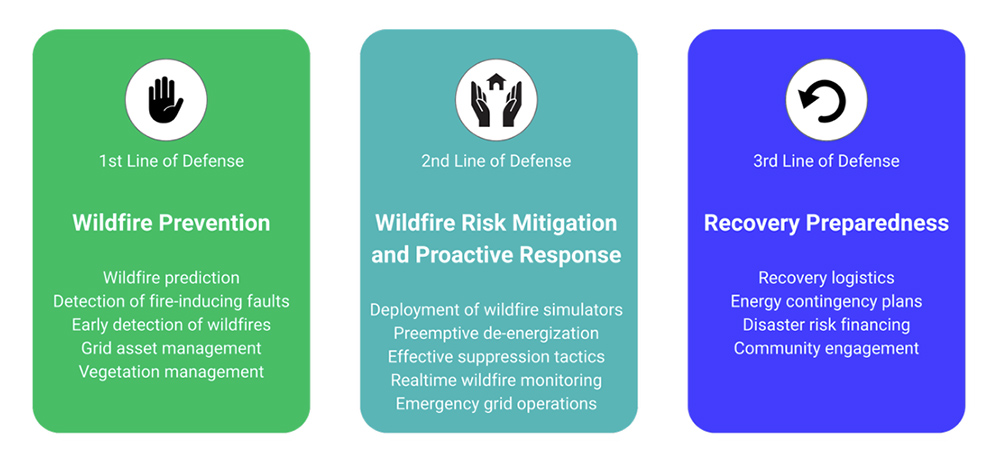
One approach to wildfire risk is to think about preventive measures, proactive response when fires happen and post-fire recovery. An IEEE paper defined these three lines of defense: “The first line of defense focuses on strategies to prevent wildfires from occurring in the first place.” It includes prediction, detection and vegetation management.

IEEE’s Three Lines of Defense for Wildfire Risk Management in Electric Power Grids | IEEE

“The second line of defense is focused on mitigation strategies and proactive response to minimize hazardous impacts of wildfires on the power system and its surrounding natural and built environment, should a wildfire spark.” This includes modeling active fires to predict their path and de-energizing lines ahead of the fire’s spread.

“Finally, if a wildfire sparks and spreads, we need a third line of defense that is focused on resilience-building measures and recovery preparedness so the system can bounce back to its pre-wildfire condition as quickly as possible without suffering devastating losses.”

This includes not only immediate temporary support, but also investing in resilient rebuilding, such as how PG&E is installing distribution lines underground as it rebuilds Paradise, Calif.

Playing Defense in an Offensive Environment

Utilities, particularly those in the West and Southwest, are taking action, particularly on the first line of defense. For example, PG&E conducts aerial line inspections using LiDAR to identify trees that need trimming. Utilities are hardening lines, replacing aged components and undergrounding selective circuits, an expensive process. In 2023, PG&E lowered the cost of its undergrounding program from $4 million per mile to less than $3 million per mile.

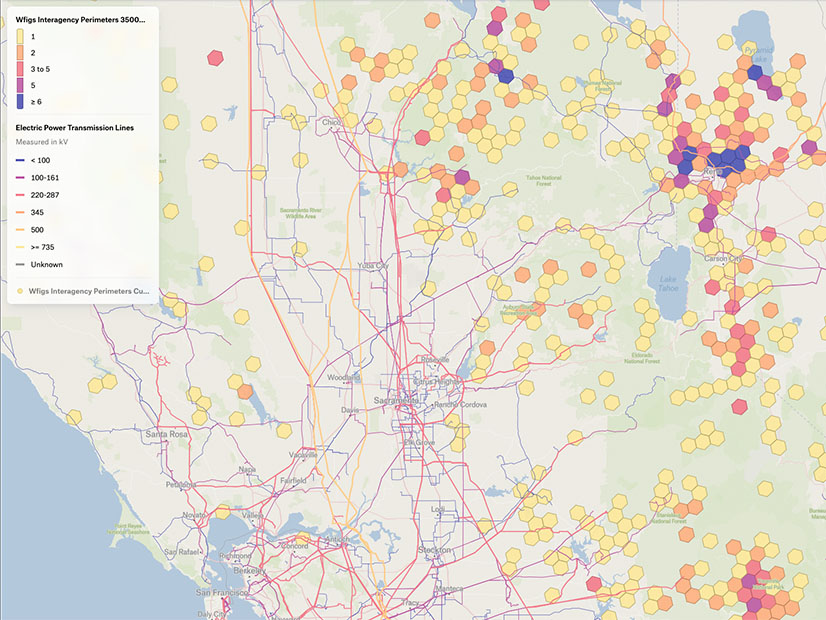
Mapping transmission lines against historic wildfire locations may help utilities plan. | Felt and National Interagency Fire Center data

On dry, windy days with high fire risk, utilities can preemptively power down lines. Public safety power shutoffs (PSPS) may lower risk but create public backlash when they stretch into days. It’s an example of how utilities must juggle tradeoffs between safety and reliability, as well as liability and service continuity.

Technology is helping to both monitor and manage the grid’s wildfire risk, with solutions ranging from pole-based monitoring, such as Gridware, to overhead line sensors, like those from Sentient Energy, as well as hardened components from hardware suppliers like ABB and Eaton.

Fires also complicate forecasting load and, where there are lots of solar assets, generation. “Wildfire smoke causes wiggling in the PV power output, which has the potential to impact the frequency stability of the grid,” a research paper found.

Some utilities have tried to get ahead of the financial risks, too. For example, the three largest California IOUs have started a California Wildfire Fund, with a $3 charge each month for account holders; however, the massive 2025 fires will drain funds earlier than expected. A group of policy experts proposed a national wildfire fund to spread risk across states.

While these approaches are needed, many are reactive and localized, focused on risk reduction, not system transformation.

Operating in the Heat of the Moment

When a wildfire starts, utilities must decide whether and where to power down the transmission and distribution lines. In the 2025 Altadena fires in the Los Angeles area, Southern California Edison (SCE) was criticized for powering down only four of the 12 circuits in the community.

Technology can give utilities and emergency services real-time fire monitoring and precise modeling of where and how fast the fire is likely to spread, based on satellite monitoring feeding into models that account for topography, wind, vegetation cover and more. OroraTech’s map of the spread of part of the Eaton fire shows how sophisticated this modeling has become.

Communication between grid operators and emergency services is critical, but often challenging, during a fire. The Associated Press reported that during the 2023 Lahaina wildfires on Maui, dispatchers, the local fire department and the utility, Hawaiian Electric Co., had significant difficulty coordinating. The culprits? Failing cellular networks, downed towers and separate radio channels.

Toward Climate-adjusted Grid Architecture

Utilities in areas with wildfire risk must treat that risk as a fundamental design parameter, in the same way they plan for load growth or changing generation mix.

There are questions for asset siting: Should critical lines or substations even be in fire zones? And for resilience planning: How should fire exposure be reflected in reliability metrics such as SAIDI and SAIFI? And for investment frameworks: How should regulators support preemptive resilience spending, not just post-event recovery?

The goal should be a climate-adjusted grid architecture with distributed, flexible and modular systems that can operate safely in fire-prone regions. Software, sensors and hardware solutions need to be designed to make a grid that can fail safely or self-isolate.

As remote communities consider their future resilience, the “grid edge” shifts. The main hospital in Paradise, for example, was rebuilt with an islandable 1-MWh energy storage and 425-kW solar microgrid to protect against PSPS and outages. Grid-attached microgrids and stand-alone systems should be explored for remote communities, a strategy that has worked in fire-prone remote areas in Australia, where removing the connection to the grid reduces fire risk for grid and off-grid customers.

The changing insurance and finance landscape will constrain the buildout of climate-adjusted grid architecture: Utilities are facing harder capital environments due to fire risk exposure.

From Centralized Risk to Distributed Resilience

To achieve a grid that is less likely to cause fires and more able to react to and rebuild resiliently after, there are policy levers at federal and state levels that can help.

While the federal government has reduced incentives for many types of renewables, utilities should lobby to reinstate incentives that support distributed resilience investments.

At the state level, regulators need to assess nontraditional infrastructure investments with an eye on their lifetime value, especially given that the value may be measured in not only homes but also lives saved. The gnarliest issue for regulators is how to balance cost recovery for proactive adaptation while keeping utility bills reasonable.

The Fire Next Time

Wildfire risk is reshaping the grid faster than most planning cycles can adapt. Yet for utilities and grid operators, rebuilding better after fires and getting ahead of future fires is not optional, it’s essential. Without moving from reactive defense to proactive resilience, the grid’s assets and their owners’ financial health will be at risk.

To mitigate wildfire risk and minimize future liability, utilities need to integrate climate risk — from fires, floods and storms — into every capital and operational decision. As the industry adapts to these risks, there are opportunities to develop innovative business models centered on resilience as a service. There also is a need to build cross-sector partnerships to facilitate smooth coordination with first responder groups on the ground when fires happen.

Wildfire is a risk no one wants, but it’s a reality that no longer is a seasonal hazard. Industry leaders who shift their organization’s mindsets from “compliance operators” to “resilience stewards” will be best positioned to survive in this new era.

Power Play Columnist Dej Knuckey is a climate and energy writer with decades of industry experience. 

Duke Paper Lays out How FERC Can Make Flexibility for Large Loads Reality

FERC can make large load flexibility a reality through the implementation of the Department of Energy’s Advance Notice of Proposed Rulemaking on large load interconnections, according to a recent policy paper published by Duke University’s Nicholas Institute for Energy, Environment & Sustainability (RM26-4).

The paper — “How DOE’s Proposed Large Load Interconnection Process Could Unlock the Benefits of Load Flexibility” — was authored by a group of lawyers from Roselle, a firm “focused on the energy transition,” and former FERC Commissioner Allison Clements, now with 804 Advisory.

The Nicholas Institute produced a paper on data centers and load flexibility earlier in 2025 that found just 0.5% flexibility could unlock nearly 100 GW of headroom for new data centers. (See US Grid Has Flexible ‘Headroom’ for Data Center Demand Growth.)

The ANOPR mentions flexibility as one way to increase speed to market. The paper is meant to flesh out the details of what FERC can do in the rulemaking to make its use widespread, Roselle partner and co-author Sam Walsh said in an interview Nov. 7.

“There are huge benefits potentially from these kinds of flexibility commitments, [and there are] benefits in terms of speed to power, because if you commit to a flexible operation, there may be fewer needs for upgrades [and] less capacity that needs to be procured,” Walsh said. “It’s kind of easier for the interconnecting transmission owner to bring you onto the grid, and so the whole thing should be able to be achievable on a faster timeline.”

Flexibility from large loads means other ratepayers will not be on the hook for as many upgrades as would be required by data centers and others requiring firm service at peak demand times, he added.

“What we tried to do in the paper is start to kind of roll up our sleeves. … DOE is opening the door to, No. 1, creating a new rule that asserts jurisdiction over large loads interconnecting to the transmission system,” Walsh said. “And No. 2, it is urging that load flexibility, curtailability, to be part of that. Then what are they going to actually need to do in this rulemaking to make it happen?”

The paper noted the ANOPR will set up a jurisdictional battle over interconnection of customers, which historically has been left to the states. The National Association of Regulatory Utility Commissioners is debating a resolution at its Annual Meeting on that jurisdiction issue. The meeting, which began Nov. 9 in Seattle, will conclude just over a week before the first round of comments are due Nov. 21. (See Energy Secretary Asks FERC to Assert Jurisdiction over Large Load Interconnections.)

Data centers can offer flexibility in several ways, such as by cutting energy use at the sites themselves, sending compute to another site or using on-site resources. Those can include backup diesel, which comes with issues around air permits, and co-located generation and or batteries.

“Energy supply resources may also be located adjacent to (but not behind the meter of) load, integrating with load to provide joint value (reducing net capacity market impacts for the combined load-supply pair and, largely, the transmission impact), but otherwise operating independently,” the paper says. “Data center developers have indicated that these types of arrangements are often more commercially workable than the fully integrated energy park model.”

Commitments to flexibility can be temporary on behalf of large loads so they can connect to the grid before the five years on average it takes to build a new generator or the transmission grid and distribution system are fully upgraded. Or it could be a permanent commitment.

“Both can provide value to customers: Bridge flexibility can accelerate site energization, defer major upgrades and help ensure affordability and reliability in the near term, while permanent flexibility supports enduring grid optimization,” the paper says.

FERC needs to work through several issues to make large load flexibility a reality, including rules around how often data centers would be expected to curtail and what notice they get, Walsh said.

“Similarly, if you’re going to enable flexibility to reduce upgrades, you need to have a study process that incorporates that,” he added.

Interconnection studies now take a customer’s largest load and assume it will fall on the hours that the grid is most stressed, but that will not be the case with flexible loads, Walsh said. “They would need to build in these flexibility commitments into the modeling in order to see … what upgrades might be needed and might not be needed if they operate flexibly.”

In regions with capacity markets, large loads should be eligible for at least some kind of discount, allowing them to be non-capacity-backed loads, as PJM originally proposed, Walsh said. (See PJM Drops Non-capacity Backed Load, Shifts Focus to Resource Queue, PRD.) The loads themselves will need to face requirements so that they actually curtail when that is needed, he added.

The paper argues that “FERC could consider requiring transmission providers to offer non-firm network transmission service. Such an offering would allow a greater array of hybrid facility and adjacent load-supply arrangements to facilitate additional speed-to-power benefits, perhaps using technical approaches and business models we cannot currently foresee. As more load connects to the system and load interconnection studies more frequently identify network upgrades, such service arrangements could be valuable tools in providing speed to power.”

It points to ERCOT’s “connect and manage” approach to interconnecting generators as a possible model, as it has helped the Texas market achieve faster interconnections than others.

Flexibility can help hybrid resources work, Walsh said. The ANOPR discusses such arrangements and indicates pairing supply and demand could be one way to offer hyperscale customers speed to market.

“What we’re talking about really is kind of vital to the success of hybrid resources,” Walsh said. “If you get into the paper, we talk a fair bit about making sure that flexible loads and hybrid resources have access to non-firm, injection and withdrawal rights. We think that’s really critical. There are very few data center operators that don’t also want grid access. Even if they have a co-located generator, they want grid access to ensure their uptime.”

MISO Installs Former Bonneville Executive to Board

MISO is adding Bonneville Power Administration’s former chief operating officer to its Board of Directors and welcoming back two term-limited directors in 2026 after collecting membership votes.

MISO members approved three-year terms for board incumbents Todd Raba and Barbara Krumsiek alongside Joel Cook, BPA’s former COO and senior vice president of transmission services. (See MISO Board Set to Add Bonneville Power Exec, Keep 2 Existing Members.) New terms begin Jan. 1, 2026.

Joel Cook | Bonneville Power Administration

Cook departed Bonneville in February when he took up the federal Office of Personnel Management’s buyout offer.

Incumbents Raba and Krumsiek are relying on a special waiver of MISO’s rules that allows them to serve a fourth, three-year term. Ordinarily, MISO board members are limited to three terms. This year, MISO’s Nominating Committee — comprised of three board members not up for re-election and two MISO stakeholders — recommended the use of waivers to prevent a potential 33% turnover on the board. MISO’s board is comprised of nine independent directors and MISO CEO John Bear.

Longtime board member H.B. “Trip” Doggett is vacating the seat Cook will take over. Doggett’s final official duties will be during MISO Board Week in December.

MISO membership voted electronically throughout October on the trio of candidates. MISO’s board elections require preselected candidates to receive a majority of votes in support among membership. MISO members can vote for, against or abstain from selecting any of the candidates.

Twenty-five percent of MISO membership (39 members in 2025) must vote in order to establish a quorum. MISO will release more details concerning the vote at its annual meeting Dec. 11, part of Board Week in Indianapolis.

“As MISO faces growing complexities and dynamic changes, the continuity of directors Raba and Krumsiek provides a source of strategic leadership and momentum that is critically important,” MISO CEO John Bear said in a press release. “We also welcome the new insights and perspectives from Director-elect Cook. His experience in the electric power industry will be beneficial to MISO and its members.”

Board Chair Raba thanked Doggett for his service. “His deep experience, insights and professionalism have been immeasurable during a period of extensive transformation,” Raba said.

ISO-NE Forecasts Minimal Shortfall Risk for Upcoming Winter

ISO-NE’s probabilistic modeling indicates there is minimal risk of shortfall in the upcoming winter, COO Vamsi Chadalavada told the NEPOOL Participants Committee on Nov. 6.

The risk levels identified by ISO-NE’s Probabilistic Energy Adequacy Tool are well below the duration and magnitude metrics recently established by the RTO in its Regional Energy Shortfall Threshold (REST). (See ISO-NE Proceeding with Shortfall Threshold After Positive Feedback.)

The REST shortfall metrics are calculated based on the 0.25%, 21-day model cases with the greatest shortfall risk. These extreme model cases averaged a 0.1% shortfall magnitude and a 0.7-hour shortfall duration for the upcoming winter, well shy of the 3% magnitude and 18-hours criteria that would need to be exceeded to violate the REST.

Chadalavada said ISO-NE is confident it can maintain grid reliability even in the worst-case scenarios.

“The worst-case 21-day energy shortfall quantities result from a low probability combination of several uncertainties,” including low LNG and fuel oil inventories, low import levels and high levels of unexpected outages, Chadalavada said.

“In the worst cases, energy shortfall begins on Day 14 or later, thus allowing time for additional actions,” he said. “ISO expects that in the event of a forecasted energy shortfall, market-based incentives will encourage relief in the form of market response, including additional fuel replenishment.”

If ISO-NE’s 21-day forecast indicates a shortfall is likely, the RTO would have access to other emergency measures, including limiting exports, scheduling imports, seeking waivers to air permit limits and conservation appeals, he said.

Seasonal weather forecasting shows a 33 to 40% probability of above-average temperatures for southern New England, and equal changes for above average and below average temperatures in northern New England, Chadalavada said.

He said ISO-NE anticipates the tanks at the Saint John LNG terminal being full, and he added that generators with large fuel oil storage capabilities have indicated “that pre-winter replenishment is underway and supply chains are expected to be strong with adequate supply available.”

Operations Report

Energy market value totaled $429 million in October, up significantly from $350 million in October 2024, ISO-NE reported. Ancillary market value totaled nearly $17 million, more than double the $8 million total in the prior October.

ISO-NE recorded its first monthly net export in 13 years in October, Chadalavada noted.

The low import levels appear to be driven by continued drought conditions and low reservoir levels in Québec and also may be affected by Hydro-Québec’s looming baseload export commitments associated with the New England Clean Energy Connect and Champlain Hudson Power Express transmission projects.

Hydro-Québec has said it is managing its reservoir levels to ensure it will have enough power to meet these commitments. ISO-NE expects NECEC to be in service this upcoming winter. (See Drought, Climate Drive Uncertainty on New England Imports from Québec.)

Permits for Trump-Favored Gas Pipeline Approved by N.Y. and N.J.

ALBANY — The state of New York has reversed course and issued a critical water-quality permit for a proposed natural gas pipeline off the coast of New York City.

The New York Department of Environmental Conservation’s approval Nov. 7 reverses the state’s three previous denials. Hours later, New Jersey’s Department of Environmental Protection issued water quality and other environmental certifications for the same project.

The permit approvals come after public fights over offshore wind, gas pipelines and congestion pricing between Gov. Kathy Hochul (D) and President Donald Trump.

“Today’s decision is a complete reversal from their previous determinations to reject the exact same pipeline over threats to New York’s water quality,” said Mark Izeman, senior attorney for the Natural Resources Defense Council. “The proposal is the same. The law is the same. The only thing that’s changed is the politics.”

In an emailed statement, Hochul said she stood by the DEC’s decision.

“While I have expressed an openness to natural gas, I have also been crystal clear that all proposed projects must be reviewed impartially by the required agencies to determine compliance with state and federal laws,” Hochul wrote. “I am comfortable that in approving the permits, including a water quality certification, for the NESE application, the DEC did just that.”

The Northeast Supply Enhancement (NESE) project would carry natural gas 24 miles from New Jersey into New York City and Long Island across Raritan Bay. It is an expansion of Williams Cos.’ massive, nationwide gas pipeline system operated by the Transcontinental Gas Pipeline Co.

In the permit approval announcement, DEC said another project, the 124-mile Constitution Pipeline, would not move ahead. The department said Constitution Pipeline Co. withdrew its application for permits. The Constitution Pipeline was planned to cross New York into New England and was controversial with locals and many New York elected officials.

Chad Zamarin, CEO of Williams, told Politico the company was “proud” NESE was moving forward and that the company planned continue working on the Constitution project. The company revived both pipelines after receiving public support from the Trump administration.

“As governor, a top priority is making sure the lights and heat stay on for all New Yorkers as we face potential energy shortages downstate as soon as next summer,” Hochul said in an emailed statement. “We need to govern in reality.”

Trump took to Truth Social days earlier to support NESE and Constitution.

“Gov. Kathy Hochul of New York state is killing the entire region with energy prices that are out of control and expected to triple because she can’t get an upstate and separately Long Island pipeline built,” Trump wrote before condemning New York City’s congestion pricing tolls.

Earlier in 2025, the president publicly feuded with the governor over the denial of pipeline permits and offshore wind. The president moved to stop construction on Empire Wind 1 but reversed course after claiming to reach a deal with Hochul in May. (See BOEM Lifts Stop-work Order on Empire Wind.) The White House claims Hochul “caved” on natural gas while the governor’s office denies any deal was reached.

Anshul Gupta, policy and research director for New Yorkers for Clean Power, said in an emailed statement that shortly after Trump and Hochul reached an agreement, the New York State Public Service Commission found a reliability need for the NESE.

“The reasons that the PSC gave in its rushed determination of NESE’s reliability need are transparently concocted to justify the project,” Gupta wrote. “It’s a remarkable coincidence that this so-called reliability need happens to exactly meet the 400,000 Dt/day capacity of a project that was proposed more than five years ago.”

The Independent Power Producers of New York praised the decision, saying it affirmed that natural gas is a crucial resource in maintaining the reliability and safety of the New York grid. IPPNY noted that 90% of electricity generated in the city is from natural gas and oil.

“I commend the DEC for recognizing that natural gas will continue to play a key role in the state’s energy future,” IPPNY CEO Gavin Donohue said in an emailed statement. “Until zero-emissions dispatchable resources … have been identified and developed, natural gas will remain a necessary transitional component of New York’s fuel mix.”

Izeman said he’s preparing to fight the permit in court. The NRDC, Earthjustice and other groups had challenged FERC’s greenlighting of the pipeline in federal appeals court at the end of October. In an emailed statement, Earthjustice called the approval “shameful.”

SPP Board Approves 2025 ITP with 4 765-kV Projects

LITTLE ROCK, Ark. — It took almost two months of stakeholder meetings, outreach and education, working group discussions, staff modeling and everyone’s consternation over affordability before SPP’s Board of Directors approved a 2025 Integrated Transmission Plan (ITP) designed to keep pace with accelerating load growth and ensure grid reliability.

The ITP’s portfolio includes four 765-kV projects that total 949 miles and are part of a planned 765-kV backbone, along with 46 other proposals approved for construction permits. It also comes with an $8.6 billion price tag, eclipsing the record 2024 ITP that had SPP’s first 765-kV project and a $7.65 billion cost. (See SPP Board Approves $7.65B ITP, Delays Contentious Issue.)

SPP says the 10-year ITP assessment shows the portfolio is necessary to ensure the grid is ready for future demand, citing industrial electrification, manufacturing onshoring and economic development forecasts that show the grid at its limits. The grid operator is projecting a 25% increase in demand by 2030 for its 14-state footprint and a near doubling of its peak load (56 GW) in 10 years.

The portfolio has regional benefit-to-cost ratios between 12:1 and 18:1, the highest in the RTO’s planning history.

Still, with memories fresh over a recent cost-estimate increase for SPP’s first 765-kV project, members expressed concerns over the portfolio’s expense. The board in September approved a revised cost estimate of $3.62 billion, up from an original projection of $1.69 billion in February, for Southwestern Public Service’s 765-kV project in the 2024 ITP. (See SPP Board Approves 765-kV Project’s Increased Cost.)

“It’s really hard for us at a local level to talk about affordability when the metrics in the report are region-wide. The only thing our customers see in their [bills] is their rates going up,” Evergy’s Denise Buffington said during the Nov. 4 discussion.

“We have the job over the next 12 months, probably 10 months, to go to our legislature and our governor and our customers and explain to them why 765 is important,” she added, asking for “a little grace” and time to advocate about why the 2025 ITP is the right long-term solution. “We have to get the metrics down to a local level.”

Name tents pop up as discussion begins on the 2025 ITP. | © RTO Insider 

Buffington’s message and those of other members were received by the board.

“As a board, we recognize that we’re making decisions that will significantly impact every homeowner and business in SPP,” board Chair Ray Hepper said as the meeting ground on through the lunch hour. “Reliability and affordability are a really delicate balance, and we strive to do our best in making that balance, thinking like every dollar we are approving is our own dollar. We also recognize that economic development for this region and attracting new loads that can serve our national interests is a key driver for a cost-effective system that will support growth in this critical time.”

SPP Mitigation Measures

To help ease concerns, SPP staff filed a memo with the board and the Members Committee outlining their measures to mitigate risks related to the viability and cost of 765-kV projects in the 2025 ITP. The measures will apply to 765-kV projects that receive a conditional construction permit or a request for proposals. They include SPP’s commitment to analyze the proposed 765-kV overlay analysis within the 2026 ITP assessment.

Hepper then added his own requirements for SPP so the board can fulfill its oversight responsibility and help “assure that only appropriate costs for new transmission are incurred.”

“Our goal is a reliable, cost-effective transmission system that will serve the region for years to come,” he said.

Board Chair Ray Hepper (center) explains next steps as SPP CEO Lanny Nickell (left) and director Stuart Solomon listen. | © RTO Insider 

Hepper directed staff to file quarterly reports with the board should there be any changes that could affect approved projects in the 2025 ITP or any future assessments. He earned a commitment from COO Antoine Lucas to work through the stakeholder process and complete the 765-kV overlay analysis as part of the 2026 ITP and determine whether further mitigation actions or changes are needed.

Finally, he ordered staff to bring to the February board meeting a plan to expedite and improve the competitive project process, including a plan to improve the evaluation of RFPs.

“You’ve created a set of off-ramps and on-ramps for projects, which makes a lot of sense because things change relative to forecasts,” director Steve Wright said.

The Members Committee’s advisory vote passed 17-3, with three abstentions. Electric Cooperatives of Arkansas, Nebraska Public Power District and Omaha Public Power District voted against the measure.

The portfolio the board approved began as an $18.1 billion package of projects that staff identified to meet 10-year reliability and economic needs. It was whittled down by deferring about $7 billion in projects without near-term needs or that could be “further optimized” within the 2026 ITP, and again by deferring two economic 765-kV projects and their $2.6 billion costs, reducing the package to its final total.

The 2025 ITP does not include another $1 billion in zonal planning criteria projects submitted for study by members.

Most deferred projects will be further evaluated in the 2026 ITP as SPP continues to study a 765-kV backbone. It says a single 765-kV line can carry four times the power of a 345-kV line, using less land and losing less energy over long distances. That makes 765-kV a more efficient, cost-effective and forward-looking solution for a growing grid, staff said.

“We’re building today for the demands of tomorrow,” Casey Cathey, the RTO’s engineering vice president, said.

Stacey Burbure, AEP | © RTO Insider 

Stacey Burbure, American Electric Power’s lead for transmission business development and joint ventures, applauded SPP’s decision to move forward with its 765-kV overlay. She noted AEP’s service territory includes some of the poorest parts of Appalachia, where the company has some of its more than 2,000 miles of 765-kV infrastructure.

“It’s our baby. This was the most efficient and effective way for us to serve our customers, and it remains a very effective tool in the bucket for every RTO,” Burbure said. “This is a tool that folks are turning to to solve the issues that confront us, regardless of which RTO you’re in. Is this the right outcome for SPP as a region? I think the answer is obvious. It’s yes.”

Matt Pawlowski, vice president of development for NextEra Energy Transmission, pointed out that the portfolio includes two 765-kV legs on either side of the footprint, but no road connecting the two highways. While NextEra supports the $8.6 billion ITP, it would have preferred the $11.1 billion package, he said.

“Without a connector, the systems on either side of those lines are going to be overloaded,” Pawlowksi said. “We are going to have reliability issues. If we don’t address it with the two economic projects, I think we’re really missing out.”

He said if the two economic projects are again deferred, SPP will face the danger of getting behind an “entire queue of projects in the supply chain.”

“If you defer these projects, you are totally kidding yourself. You are not going to build these projects by 2030 plus, 2035 probably at best,” Pawlowski said. “So what is preventing us from looking at those two projects and improving them as a region when staff has already said that they’re needed?”

The discussion will continue in February when the board gathers again in Little Rock for its first quarterly meeting of 2026. Hepper, who prefers to have people around the table debating issues, has canceled the original virtual scheduled meeting to further discuss in person 765-kV lines and the competitive project process.

“We are going to have some very significant decisions to talk over,” he said.

SPP Introduces CARE Team

SPP has introduced another acronym to its lexicon with the creation of the Cost Control and Allocation Review and Evaluation (CARE) Team. The cross-functional body will review, evaluate, assess and recommend refinements or alternatives to current transmission cost controls and cost-allocation methodology.

Wright and Kayla Hahn, the Missouri Public Service Commission’s chair, will co-chair the 15-person team and have already met once to discuss CARE’s scope. It has been asked to deliver a final report in August 2026.

Other members will include independent director Stuart Solomon, commissioners Chuck Hutchinson (Nebraska), Justin Tate (Arkansas) and Kathleen Jackson (Texas), and state regulatory staffers Jon Thurber (South Dakota), Jason Chaplin (Oklahoma) and Justin Grady (Kansas). Members from the Members Committee and the Strategic Planning Committee will be added later.

“The idea was, ‘Let’s get this conversation happening. Let’s have a conversation between the groups within SPP that have the organizational responsibility for allocation and cost control,’” said New Mexico Commissioner Pat O’Connell, the Regional State Committee’s president.

“So, to me, just getting all those folks together to have this conversation by itself is valuable,” he said. “I am also confident that SPP works to deliver good results, so that the recommendations will be also valuable and impactful.”

FERC Accepts 2026 ERO Budgets, Approves Waiver

FERC has approved the 2026 business plans and budgets for NERC, the regional entities and the Western Interconnection Regional Advisory Body, along with allowing the Midwest Reliability Organization, Northeast Power Coordinating Council and SERC Reliability to tap their reserves to reduce next year’s assessments.

NERC’s Board of Trustees approved the business plans and budgets at its August meeting in Calgary; the ERO filed the documents with the commission later that month. (See Trustees: NERC ‘Front and Center’ Addressing Reliability Challenges.)

Commissioners accepted the budgets in an Oct. 30 filing (RR25-5). Chair Laura Swett and Commissioner David LaCerte, sworn in Oct. 20 and Oct. 27, respectively, did not participate in the decision.

NERC’s budget for 2026 is $129 million, up $5.6 million from its 2025 budget. This includes planned spending in both the U.S. and Canada, as well as $45 million for the Electricity Information Sharing and Analysis Center, up $1.4 million from the prior year. The E-ISAC budget increase reflects rising contractor and consultant costs and the addition of three positions in the areas of stakeholder engagement, security operations and intelligence functions.

Most funding for NERC’s activities comes from its assessment, which load-serving entities pay to support the ERO’s work. NERC’s 2026 assessment is to rise by $5.3 million to $114 million; this figure comprises $103 million from U.S. entities and $11 million from Canada.

The difference between the budget and the assessment will be made up with funding from other sources, including third-party funding for the E-ISAC’s Cyber Risk Information Sharing Program, the System Operator Certification and Credential Maintenance program and the E-ISAC’s partnership with the Downstream Natural Gas ISAC.

NERC CEO Jim Robb said in May that the organization is approaching 2026 as a “bridge year” between the previous three-year plan, which will conclude at the end of 2025, and a new three-year plan, to begin in 2027. (See 2026 to be ‘Bridge Year’ for NERC Budget.) Robb said the uncertainty introduced since the beginning of President Donald Trump’s second term, along with ongoing efforts such as the ERO’s work on modernizing its standards development process, made long-term planning “a fool’s errand at this point in time.”

RE Budgets, Assessments to Rise

The total planned ERO budget, including NERC, the REs and WIRAB, comes to $321 million, up from $304 million in 2025. Assessments for all entities are $290 million, up from $271 million the year before; $260 million of the total assessments for 2026 is allocated to U.S. entities.

NERC asked for, and FERC approved, an exception to Section 1107.2 of the ERO’s Rules of Procedure. The section states that funds received by NERC or REs from penalties assessed in the U.S. must be used to offset the collecting entity’s budget for the subsequent fiscal year if received by July 1, or for the second subsequent fiscal year if received on or after July 1.

The exception granted by FERC allows MRO, NPCC and SERC to deposit penalty monies received before July 1, 2025, into their assessment stabilization reserves, rather than apply them to the REs’ 2026 budgets. FERC will also permit the organizations to use penalties collected before July 1, 2024, and still held in their ASRs to reduce the 2026 assessments.

As a result of FERC’s decision, NPCC will deposit $210,000 collected in penalties between July 1, 2024, and June 30, 2025, into its ASR and withdraw $500,000 from the reserve. SERC will deposit $1.5 million in penalties into its ASR and release $2.5 million from the ASR. MRO will deposit $24,000 in penalties and release $1.6 million.

Incoming ISO-NE CEO Chadalavada Outlines Multiyear Roadmap

BOSTON — Incoming ISO-NE CEO Vamsi Chadalavada emphasized the importance of innovation and a forward-looking approach to prepare for the future grid in his remarks at the RTO’s annual open board meeting.

Discussing the RTO’s 2027-2030 road map, Chadalavada said ISO-NE must continue to lay the groundwork for the incorporation of increasing amounts of inverter-based generation, storage, retail demand resources, grid-enhancing technologies and increasingly advanced software.

“It’s really important for the ISO not to be a barrier” for the incorporation of new technologies on the grid, said Chadalavada, who has served as COO since 2008. He added that he remains “very mindful that our core mission is to maintain reliability through efficient wholesale markets.”

Chadalavada, who will replace Gordon van Welie as CEO in 2026, joined ISO-NE in 2005. (See Retiring ISO-NE CEO van Welie Reflects on 25 Years at the RTO.) The change in leadership comes at a critical point for the RTO, which faces the simultaneous, interrelated challenges of accelerating load growth and increasing levels of intermittent renewable generation.

With demand and supply likely to become increasingly variable, ISO-NE is working to develop “a foundation of new probabilistic forecasts to manage grid uncertainties,” he noted.

Earlier in 2025, ISO-NE announced its plans to develop a “dynamic, real-time probabilistic forecast of the system’s energy ramping needs,” which could be used to determine how much reserves the RTO procures on a given day. These changes are aimed at more efficiently managing operational uncertainties, ISO-NE has said.

“Everything we do has to make sure that the existing grid is optimized to the greatest extent possible,” Chadalavada said. “We don’t want to wait for the day when we have 25 GW of inverter-based resources; we want to lay the groundwork now.”

Chadalavada also said ISO-NE likely will increase its investment in artificial intelligence to help speed up the development of several initiatives. Citing one example, he said ISO-NE operating guides can take an “extraordinary amount of time” to develop, and the RTO hopes to put “innovation and AI to great use” to expedite these processes.

He said speeding up markets or operations projects at ISO-NE should have a positive effect on innovation within the wholesale markets. He also stressed the importance of integrating the RTO’s internal models, studies and processes.

“To address operational uncertainties over the coming years, ISO markets and operations initiatives will be tightly interwoven, in practice and purpose,” he said.

Also speaking at the Nov. 5 meeting, van Welie reflected on his long tenure leading the RTO. He said the implementation of wholesale markets has had widespread positive effects, including attracting more investment, reducing consumer costs and lowering emissions.

“One of the big points of these markets was to have the risk of investments stay with investors, rather than be passed onto consumers,” he said.

He also said the region has benefited significantly from forward-looking transmission investments that enabled gas generators to replace dirtier and less efficient coal and oil resources, and ultimately “gave us the foundation for introducing the first grid-scale renewables onto the fleet.”

He expressed optimism that ISO-NE’s ongoing Longer-term Transmission Planning procurement “is going to help us open a path into Maine, where there is a lot of land-based wind potential.”

Van Welie said he is disappointed that demand-side resources have not advanced as quickly as he hoped but that these resources will be a critical component of the future grid.

Community organizer Mireille Bejjani addresses the ISO-NE Board of Directors. | © RTO Insider

Several members of the public spoke at the meeting, emphasizing the urgency of decarbonizing to minimize the effects of manmade climate change and urging the RTO to take bolder steps to help cut emissions.

“The window for preventing the worst climate outcomes is rapidly closing,” said Lilly Worthley, a member of Fix the Grid.

The group, which is supported by climate and environmental organizations, distributed a statement that included a series of recommendations aimed at increasing ISO-NE’s accountability to the public. It called on the RTO to:

    • improve its community engagement processes;
    • add state representation to the Board of Directors;
    • increase opportunities for public participation; and
    • add climate and affordability priorities to its mission statement.

Activists applauded some of the steps taken in recent years by ISO-NE, including the establishment of the annual open board meeting, the creation of a community affairs policy adviser position and the RTO’s advocacy for offshore wind at the federal level.

But more work needs to be done to increase transparency, accessibility and accountability, Fix the Grid wrote in its statement.

“We believe the upcoming leadership transition provides a real opportunity for a new chapter at ISO-NE, to steer the region toward a cleaner, more just energy future,” the group said.

Congress Continues Work on Permitting, but Passing a Bill Faces Major Obstacles

WASHINGTON — Permitting legislation still is being developed on Capitol Hill, but the government shutdown and the Trump administration’s actions against clean energy projects in Democratic-led states could stop it from happening this Congress.

The Conservative Energy Network (CEN) and Grid Action held a “fly-in” Nov. 5, in which state officials, business leaders and experts held more than 35 meetings with members of Congress and senior staff to push for permitting reform legislation. The meetings included those with members of the House Energy and Commerce, House Natural Resources, Senate Environment and Public Works, and Senate Energy and Natural Resources committees.

“Our permitting system makes it impossible to do things in a reasonable time frame,” Rep. Mariannette Miller-Meeks (R-Iowa) said at a press conference hosted by CEN. “And the government, whether it be local, state or federal, is often standing in the way of the market meeting the needs, especially the needs for increased energy demand.”

Congress has been working on the issue for years, and the fact that major infrastructure like transmission can take the better part of two decades to build shows change is needed, as Americans pay more for energy than they would otherwise, she added. Miller-Meeks supports the SPEED and Reliability Act, which would amend the National Environmental Policy Act to speed up agencies’ review of infrastructure projects. (See Permitting Hearing Shows Tricky Politics of Getting a Bill Passed.)

“We have an urgent, growing demand, and the question is whether Congress will act decisively or [continue] to tinker around the margins,” Miller-Meeks said.

Asked about the biggest obstacle to legislation in 2025, Miller-Meeks blamed the government shutdown “created by the Democrats,” which officially became the longest in history on the day of the press conference.

Speaking on a webinar hosted by Americans for a Clean Energy Grid (ACEG) in October, Rep. Sean Casten (D-Ill.) noted that Democrats have a different road block for bipartisan legislation.

“The currency of trust is so low when the White House is refusing to even honor existing congressionally mandated spending [and] congressionally mandated legislation,” Casten said. Talking about compromising on permitting legislation now is “a little bit like compromising with somebody who just robbed your house and is saying ‘you can trust me this time.’”

While that issue has cut the probability of legislation for now, Congress still can work on developing good policy for “when that door next opens,” Casten said.

When it comes to the grid, the issue has less to do with permitting and more to do with the right economic incentives, he argued.

“That sounds crazy,” he said. “You’d never know that if you read all the talking heads, or if you looked at the legislation going through Congress.” But regulated utilities can build rate-based generation and get it connected to their systems, and the natural gas industry has no problem getting pipelines built despite environmental risks that are arguably bigger than those of high-voltage transmission, he argued.

“The truth is, we have a profit problem,” Casten said. “The way that our energy markets are structured, we do not have an incentive to deploy cheap energy. And it comes from the fact that if you are an incumbent in the electricity sector, you lose money if a competitor builds a system on your grid that can underprice you.”

Casten said he did not blame utilities because they were following the incentives, so the goal for any legislation should be to change them. The Cheap Energy Act, which he introduced with Rep. Mike Levin (D-Calif.), aims to do that. (See Federal Energy Policy News Roundup: House Bills and DOE Returns $13B.)

“How should we rethink the way that electricity markets are structured so that we don’t wind up in a situation where every single person who deploys a zero-marginal-cost generator doesn’t essentially eat their own investment thesis?” Casten said. “Because, after all, if everybody built renewable power plants and our whole grid was served with renewables, the marginal price of power would be zero, and consumers would win, but there’d be no incentive to build anything. That’s not some innate flaw. It’s just a problem with the way that we’ve regulated the structure. We fix that.”

As both a policy and political matter, any permitting legislation needs to be technology neutral, Bill Parsons, Berkshire Hathaway Energy vice president of federal legislative affairs, said on the ACEG webinar.

“Now, some people will say, ‘Well, as long as the reforms to NEPA and other permitting statutes apply to everything, then that’s tech neutral,’” Parsons said. “I think we do need to go a bit further here. There’s going to need to be a transmission title.”

BHE supported the Energy Permitting Reform Act of 2024 from former Sen. Joe Manchin (I-W.Va.) and Sen. John Barrasso (R-Wyo.). That could be a starting point for a future permitting deal, he said.

“I think we make a mistake when we get overly binary about the policy choices here, and it’s either the status quo or a complete federal takeover of transmission,” Parsons said. “That’s a false choice. There is an opportunity to hive off a very limited number of high-priority national lines, describe them objectively, so people can understand ahead of time what qualifies and what doesn’t for consideration at FERC.”

The National Governors Association weighed in on the permitting debate recently, releasing a bipartisan proposal headed by NGA Chair and Oklahoma Gov. Kevin Stitt (R) and Pennsylvania Gov. Josh Shapiro (D).

“This isn’t a Republican or [Democratic] issue. Every American needs to heat their home and power their vehicle,” Stitt said in a statement. “As the demand for energy rises as we bring new technologies and AI online, we need to complete energy infrastructure projects in a faster, more efficient way.”

The governors’ proposal includes reforms for FERC that would have it create a National Interest Designation Process that lets a transmission facility be declared in the national interest after the hearing and consideration of several factors and consultation with the states. Groups of states could nominate National Interest Electric Lines.

FERC would get greater flexibility to allocate the costs of interstate and offshore transmission lines among all beneficiaries.

The governors also want changes to ISO/RTO governance, including giving states, or organizations of states, “jump ball” or complementary filing rights at FERC. ISO/RTOs would be required to improve interregional planning and more robustly consider states’ alternative planning options.

Another legal change would be to require ISO/RTOs to process interconnection requests for generation and storage within six months of an initial application.