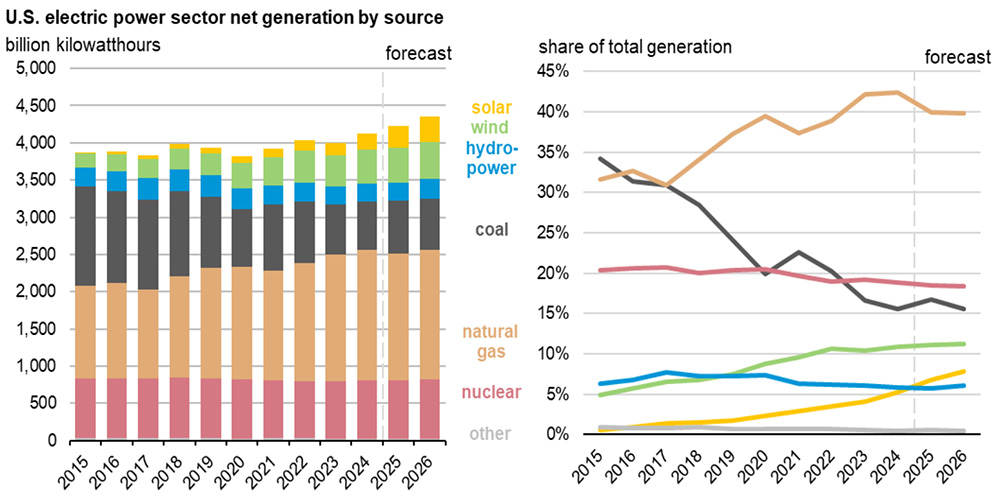
The U.S. Energy Information Administration is boosting its estimate of national power generation growth to 2.3% this year and 3% next year.
The details are reported in the September Short Term Energy Outlook the agency issued Sept. 9. In the outlook published in January, it had forecast an average of 1.5% growth in 2025 and 2026.
EIA said the increase is from a colder-than-expected start to 2025 and load growth assessments by ERCOT and PJM. The latter had the largest amount of generation of any region in 2024: 873 billion kWh. It is expected to have 904 billion in 2025 and 946 billion in 2026.
ERCOT is forecast to have the largest increase in generation, from 459 billion kWh in 2024 to 560 billion in 2026 — a 22% jump.
The January STEO forecast only 499 billion kWh in ERCOT in 2026 and only 902 billion kWh for PJM.
The predictions for all other grid regions are nearly the same in the September report as in the January report.
To meet this rising demand, utility-scale solar generation is expected to increase 33% this year over 2024, the most of any technology, and then 19% in 2026.
Natural gas generation is expected to be 3% lower in 2025 than in 2024 because of sharply higher gas prices, but it still will be the largest source of electricity by a wide margin, providing 1,698 billion kWh, or 40% of the country’s electricity.
Coal-fired generation is expected to be 9% higher this year than last — the first year-over-year increase for coal since 2021. The 2024-2025 decrease in gas and increase in coal both are approximately 61 billion kWh.
The U.S. Energy Information Administration expects significantly more solar and coal power generation in 2025 than in 2024 from increases in installed solar capacity and increases in natural gas prices that make coal more attractive. | EIA
Small increases also are forecast in 2025 for wind power (4%) and hydropower (2%). Together with solar, this puts renewable energy at 25% of U.S. electricity generation in 2025 and 26% in 2026, compared with 23% in 2024.
Nuclear fission is expected to produce only slightly more power in 2025 than in 2024 but 2% more in 2026, thanks to the anticipated restart of the Palisades Nuclear Plant in Michigan.
The average price per kilowatt-hour is projected to increase from 16.48 cents in 2024 to 17.22 cents in 2025 and 17.9 cents in 2026 for residential customers; 12.85 to 13.36 and 13.5 cents for commercial customers; and 8.15 to 8.49 to 8.54 cents for industrial customers.
Nationwide average electricity prices for the three classes are projected to be 13.53 cents/kWh this year and 13.79 cents next year. The West South Central region — Texas, Oklahoma, Arkansas and Louisiana — retains the lowest average in 2025, at 9.87 cents/kWh, and New England remains highest, at 25.12 cents.
The Northwest Power and Conservation Council has provided more details regarding how its ninth power plan will consider new federal policies that could affect the buildout of new resources and transmission.
The council will consider two priority scenarios to build the plan’s model, including a changing hydro operations scenario and a new resource and transmission risk scenario, the latter of which was discussed during the Sept. 9 meeting.
“This is exploring a range of uncertainty or risk … related to the region’s ability to build new resources and transmission,” Jennifer Light, director of power planning at NWPCC, said during the meeting.
The resource and transmission risk scenario includes six sensitivities:
Constrained new resources.
Changing transmission availability.
Changing technology costs.
Limited short-duration storage availability.
Slower demand-side resource availability.
Evolving federal policy landscape.
These sensitivities are intended to help the council get a better understanding of the availability of resources under certain circumstances.
When council staff first started developing the sensitivities at the beginning of 2025, President Donald Trump had yet to target tax incentives for renewables under the Inflation Reduction Act. (See NWPCC Considers Trump, Data Centers in Regional Power Plan.)
Council staff anticipate the administration will remove amendments to the Clean Air Act that imposed stricter requirements on the buildout of new natural gas resources.
Five of the sensitivities originally were modeled with the tax credits and gas requirements in mind, and the evolving federal landscape scenario considered what would happen if those were removed.
“Well, now we’re flipping that around a bit,” Light said.
Since those clean energy incentives and gas requirements no longer are relevant, council staff have removed them from the bulk of their modeling. Instead, those are tacked on to the federal landscape scenario, which assumes the credits will return in 2030, Light explained.
“Why are we proposing doing that? Well, the IRA gives us a set of assumptions we can use,” Light said. “We’ve already started using them. So, it wouldn’t make sense to come up with different tax credits now, and I think that’d just be a lot of work and a lot of guessing, not necessarily getting us any more precise than using IRA assumptions that they come back.”
The council is required under the Northwest Power Act “to develop a plan to ensure an adequate, efficient, economical and reliable power supply for the region,” according to its website. NWPCC publishes a plan every five years, and the goal is to have a draft ninth power plan done by July 2026 and a final version by the end of that year. (See NWPCC’s Initial Demand Forecast Sees Sharp Growth for Northwest.)
“If there is another administration down the road that wants to bring stuff in, it’s not necessarily going to look identical to the Inflation Reduction Act,” Light said. “But it is a set of policies that we have that we can use as a basis for assumptions that feels just as good as making a guess. And I think it will give us directionally useful information.”
California lawmakers on Sept. 10 shifted the legislation designed to transition governance of CAISO’s markets to an independent “regional organization” (RO) into a different bill: AB 825.
The “new” bill replaces SB 540, which sought to implement the West-Wide Governance Pathways Initiative’s plan to create a regional organization (RO) to oversee CAISO’s Western Energy Imbalance Market and soon-to-be-launched Extended Day-Ahead Market — and authorize the ISO to participate in the RO.
The move is the product of considerable legislative maneuvering over the past week. AB 825, which passed out of the Senate Appropriations Committee on Aug. 29 and is poised for a full Senate vote, previously was an “energy affordability” bill intended to limit the rate impact of utility investments in transmission infrastructure needed to prevent wildfires and meet California’s clean energy goals. Those provisions have been removed from AB 825, which has been renamed “Independent System Operator: independent regional organization” to reflect its new purpose.
The new version of AB 825 importantly strips out a controversial provision added to the original version of SB 540 that would have authorized a new Regional Energy Market Oversight Council to force CAISO and the state’s investor-owned utilities to withdraw from a regional energy market if it found participation no longer served the interests of the state. The amendment prompted many of SB 540’s backers to pull their support in July. (See Calif. Pathways Bill Delayed After Orgs Withdraw Support, While Newsom Signals Backing for Effort.)
Sponsored by Assemblymember Cotti Petrie-Norris and Sen. Josh Becker, AB 825 “would authorize the ISO and the electrical corporations that are participating transmission owners whose transmission systems are operated by the ISO to use voluntary energy markets governed by an independent regional organization, only if specified requirements are satisfied.”
The 13 requirements outlined in the bill largely align with the principles and plans set out by the Pathways Initiative during its “Step 2” process for designing the new independent RO.
Among them is a guarantee that the RO will be a nonprofit whose governance documents and FERC-approved tariff include provisions “to respect the authority of each state that has a load-serving entity or balancing authority participating in the market to set its own procurement, resource adequacy, environmental, reliability and other public interest policies and exercise oversight over its regulated entities.”
Another requirement calls for the RO’s governing board to maintain a public policy committee of the governing board “that engages with states, local power authorities and federal power marketing administrations about potential impacts to state, local or federal policies before it approves a tariff change” for filing with FERC.
The bill would require CAISO to continue to operate its energy markets “subject to the market rules determined by the independent regional organization as accepted by” FERC. The bill would also require that the RO “provide greenhouse gas emissions information and protocols sufficient to enable compliance with the requirements of any state agency.”
The legislation also stipulates that the RO’s tariff provide “a procedure for unilateral withdrawal from the independent regional organization’s energy markets by any participant on their own accord, or as required by an applicable regulatory authority or state statute, with reasonable prior notice and without any penalties, unreasonable costs or further discretionary approvals.”
The bill would authorize the ISO to implement tariff changes needed to transfer its governance to the RO and join the entity on or after Jan. 1, 2028.
Renewed Support
Sources close to the Pathways process have expressed confidence about the prospects for the AB 825, telling RTO Insider the bill appears to have the approval of the Assembly, Senate and Gov. Gavin Newsom.
“As we move toward achieving California’s 100% clean energy goals, we must look at every opportunity to reduce costs, improve reliability and cut emissions,” Sen. Becker said in a press release. “AB 825 strikes that balance by unlocking the benefits of a regional energy market while safeguarding California’s public policy priorities. This is a win-win for California families, our economy and our climate future.”
Becker’s release said the amended AB 825 includes “rigorous annual legislative oversight by relevant California legislative policy committees to ensure the new market operates in line with California’s clean energy and reliability goals” and “provides strong protections for state authority, including California’s right to withdraw at any time if participation ceases to benefit the state.”
“We got it done :-),” Becker said in a more unvarnished comment responding to a post on LinkedIn.
“California decision-makers, including Governor Newsom, see the value of a regional market and are committed to seeing this through,” Leah Rubin Shen, managing director of Advanced Energy United, said in a statement. “The fact that the fixed SB 540 language has now been amended into the Assembly’s former energy affordability package, AB 825, is a positive step forward. It shows a strong commitment toward a Western market that delivers on what California and the rest of the West need the most, more affordable and reliable power.”
The Environmental Defense Fund and Natural Resources Defense Council, which both pulled their support from the amended version of SB 540, voiced their support for the new bill in a joint statement.
“With state leaders rightly focused on making California more affordable, the choice on AB 825 is simple. We can’t keep the lights on or fight climate change alone,” said Katelyn Roedner Sutter, EDF’s California state director. “By passing this bill this year, lawmakers will keep power bills in check while expanding clean electricity access and preventing blackouts.”
“Building a 100% clean energy economy the cheapest and fastest way possible starts with passing AB 825,” said Victoria Rome, NRDC’s senior director of California affairs. “Right now, we generate more clean power than ever, but we are not able to use all of it efficiently. This bill is a chance for California to lead a broader transition to cheaper clean power by working with our neighbors across the West.”
The latest version of AB 825 is still subject to a California legislative requirement that an amended version of a bill be in print for 72 hours before it can become eligible for a full floor vote in either house. The timing of the release of the final bill means a vote can’t be taken ahead of the legislature’s scheduled Sept. 12 recess. Becker’s office confirmed lawmakers will extend the session to vote on the bill Sept. 13 — a Saturday.
Entities should be “prepared to discuss internal controls at [a] deeper level” during compliance audits and show regional entity staff how they plan to address reliability risks, members of a NERC task force said in a webinar hosted by the Texas Reliability Entity.
Speaking in the regular Talk with Texas RE webinar Sept. 9, William Braun, Texas Reliability Entity’s senior risk assessment analyst, and Molly Elliott, senior technical analyst for oversight planning at WECC, discussed the importance of internal controls for registered entities and how the ERO’s thinking on the issue has evolved in recent years.
Elliott is co-chair, and Braun is a member, of the Internal Controls Task Force, an organization comprising members from NERC and all six REs. The group includes auditors, risk practitioners, managers and others “from either an audit or risk discipline,” Elliott said.
The purpose of internal controls is to anticipate and address risks that could affect the compliance of a registered entity, along with risks that do not necessarily affect compliance but could impact the entity’s reliability. The ERO considers internal controls a useful index for a registered entity’s overall level of risk, Braun said, with strong internal controls indicating a less risky environment and a less developed regime correlated with higher risk. He added that “well defined internal controls give us predictability about the future.”
The goal of the ICTF is to ensure that REs “understand internal controls and their contributions to mitigating risk to the [electric grid] the same way,” Elliott said. The task force is working on a public-facing guide to internal controls, as well as a handbook for auditors. While each region likely will establish its own approach to examining entities’ internal controls, the plan is for all to follow the same basic strategy.
Noting that “most [entities] have room for improvement” in their internal controls, Braun and Elliott held up the COSO model — named for its developer, the Committee of Sponsoring Organizations of the Treadway Commission — as a useful guide for upgrades. The model is found in the Government Accounting Office’s Green Book, which presents standards for internal control in the federal government.
The model is presented as a cube, with one face representing five components of internal control: control environment, risk assessment, control activities, information and communication, and monitoring. These components operate across the four levels of organizational structure presented on the second face: function, operating unit, division and entity. The last face includes operations, reporting and compliance, the objectives the entity aims to meet through its internal controls.
Elliott called the COSO model “a very helpful guide [that] fits in well with our audit approach,” which uses government auditing standards found in the GAO’s Yellow Book. But she emphasized that the purpose of an internal controls program is not just “making a regional entity happy.” A robust set of internal controls can ensure an entity is meeting its business objectives beyond compliance. It also can enhance internal communications and external relationships, particularly with regulators that can see the improvements.
“Information and communication is a key component of the Green Book model, and our entities tell us that they have improved relationships between compliance and operations, and they found the different business units are more aware of how their work affects others in the organization and vice versa when they put in an intentional controls program,” Elliott said. “An entity [that’s] been successful in reducing reliability and security risk may [also] see less frequent monitoring [or] smaller scope or less in-depth audits.”
Permitting reform legislation is starting to move through Congress, with a key House committee holding a hearing and supporters lobbying legislators, though actually passing a bill is tough in any political climate.
The House Natural Resources Committee is holding a hearing Sept. 10 to take testimony on three pieces of legislation: H.R. 573, H.R. 4503 and H.R. 4776.
The e-Permit Act (H.R. 4503) is a bipartisan bill introduced by Reps. Dusty Johnson (R-S.D.) and Scott Peters (D-Calif.), the latter of whom has supported major overhauls of transmission rules. The bill would require the government to use new technology to speed up permitting. (See Hickenlooper and Peters Introduce BIG WIRES Act.)
Committee Chair Bruce Westerman (R-Ark.) and Rep. Jared Golden (D-Maine) introduced the SPEED Act (H.R. 4776) that would change the National Environmental Policy Act in order to streamline the permitting process by shortening timelines, simplifying analyses and limiting litigation.
Last session a Senate effort on permitting reform, championed by former Sen. Joe Manchin (I-W. Va.) and Sen. John Barrasso (R-Wyo.), fell short. Energy and Natural Resources Committee Chair Mike Lee (R-Utah) said at the committee’s recent FERC confirmation hearing that he would like to make another attempt at legislation this Congress. (See Lame Duke Permitting Push Fails; Manchin Blames House GOP Leaders.)
“Assuming you’re confirmed, I look forward to working with both of you on prioritizing permanent reform,” Lee said at the hearing Sept. 4. “Sen. Barrasso and others have referred to that effort today, and it’s priority I look forward to working with both of you on, as FERC has an important role in the permitting process for the areas we’ve discussed.”
The Senate Environment and Public Works Committee is engaged in a bipartisan process to develop reforms, which its chair, Sen. Shelley Moore Capito (R-W.Va.), explained in a floor speech in late July where she referenced working with Ranking Member Sheldon Whitehouse (D-R.I.).
“Right now, we have the momentum, I believe, needed to deliver meaningful and lasting reforms to the environmental review and permitting process, and I believe this is an unprecedented opportunity and something we can truly accomplish,” Capito said in the speech. “I do believe, and … Sen. Whitehouse and I know this well, that there are areas of strong disagreement in this area between the two of us, and what we’re going to try to do is to find those areas of like-thinking that move the process along. No matter how difficult it might be, this is the only way we get a permanent solution, so we don’t see the swings of the environmental process that we’ve seen over the last few years.”
Those are not the only committees that might have to weigh in on a complete permitting system overhaul, Arnab Datta, director of infrastructure policy for the Institute for Progress, said on a webinar hosted by the R Street Institute on Sept. 9. Manchin and Barrasso were able to make some headway last year, but the ENR Committee’s remit does not cover NEPA or judicial reforms.
“You run into some of these political/congressional dynamics that can also make it quite difficult to get to comprehensive reform,” Datta said.
Capito and Whitehouse’s efforts are promising this Congress, he said, but hopefully something more comprehensive can get passed.
A big part of the recent change in the politics around permitting is that laws like NEPA were passed when major polluting facilities were being built regularly, which drove support from environmentalists, Bipartisan Policy Center Vice President for Energy Xan Fishman said on the webinar.
“That process for issuing the permit went from something that was fairly simple — didn’t take a whole lot of time; didn’t take a whole lot of staff work at an agency — to something that took years and years and years, and the environmental review documents ballooned into hundreds of pages, or more than 1,000 pages,” Fishman said. “And as it happened over time, the types of projects that people tried to build also started to change.”
The bureaucratic delays started to impact clean energy projects that environmentalists support and see as needed to combat climate change, and they started supporting permitting reforms. But just because they support reforms now does not mean they agree with all the other supporters on what that means.
“It means different things to different people, right?” Datta said. “So … on the more hardcore environmental left, it means, ‘Make it easier to build rooftop solar,’ and that’s it. And then you can move a little bit over, and it starts to include new types of emissions-free energy; in other cases, maybe it’s tech neutral.”
Emily Domenech, executive director of the White House’s Federal Permitting Improvement Steering Council, said on the webinar that she would welcome some congressional updates to her organization’s 10-year-old governing statute.
“We’re treating the symptoms, not the cause, of our permitting challenges, with the function of the permitting council,” Domenech said. “So, we serve as the ‘Sherpas’ for large projects going through federal permitting.”
Projects need to be worth at least $200 million, must come from one of 19 sectors that cover the gamut of major infrastructure including energy and data centers and must trigger the NEPA review process, which the council helps them get through as quickly as possible. The projects reviewed by the council can change by administration, with Domenech noting that it is reviewing 40 mining projects; only one was before it when Donald Trump returned to office.
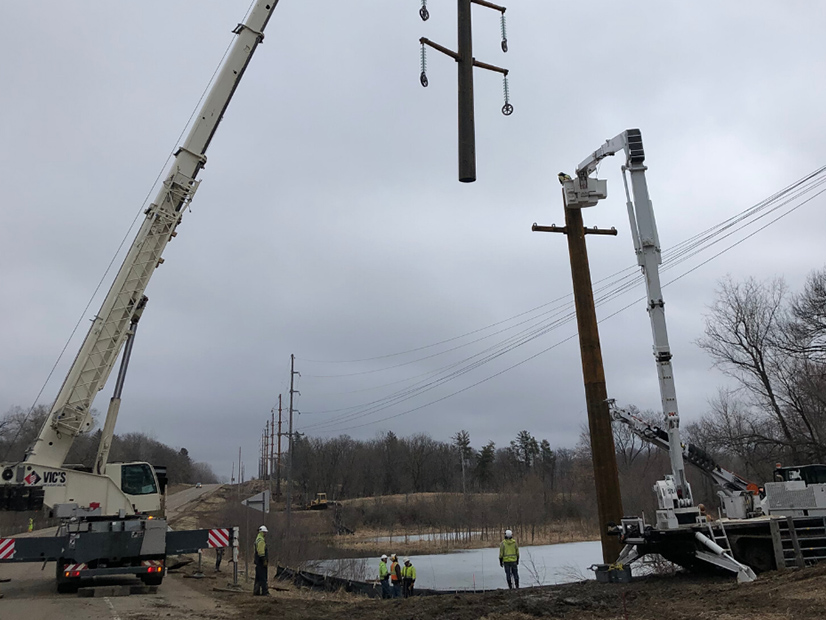
Great River Energy line construction in 2020 | Great River Energy
Domenech said she hoped Congress will improve the situation and praised the House Natural Resources Committee’s work on permitting legislation.
“We always love the opportunity to work with Congress to give us more authorities and get more things done, but really, this administration’s approach has been about using the council’s authority to the fullest extent,” she added.
Support for permitting reform is coming from the outside, with a broad coalition of trade groups headed by the U.S. Chamber of Commerce sending a letter to congressional leadership. Other signatories include the American Council on Renewable Energy, Electric Power Supply Association and the National Rural Electric Cooperative Association.
The letter argues for legislation that ensures predictability in the permitting process, makes it more efficient and transparent and ensures that all relevant stakeholders are informed in time to comment on the process.
“A modernized permitting system will help us build smarter, faster and more sustainably; we just need a system that keeps pace with our ambition,” the letter says. “We urge Congress to work across the aisle to enact durable legislation this fall that reflects the urgency and opportunity before us.”
Another letter headlined by the Industrial Energy Consumers of America, with more than 70 other manufacturing groups, urged Congress to enact permitting legislation as well, with a focus on expanding natural gas pipelines to minimize curtailments.
“No one is more impacted by inadequate natural gas pipeline capacity than the manufacturing sector,” the letter says. “Under state end-use curtailment plans, when there is insufficient supply to serve the residential consumer or for electricity generation, natural gas service to manufacturing companies is curtailed — there is a mandatory reduction of natural gas supply. The frequency of curtailment rates is increasing annually and comes at significant costs and disruption to manufacturing supply chains that also include materials for national security.”
Controlled Thermal Resources has taken a step forward on its plans to build a 500-MW geothermal energy plant in California’s Lithium Valley, where it is eyeing co-location of manufacturing or data centers.
CTR announced Sept. 9 that it is partnering on the geothermal project with Baker Hughes, an energy technology company. Baker Hughes will supply high-temperature drilling technologies, power systems and digital field services.
The project location is near the Salton Sea in the Imperial Valley region of Southern California — an area that’s been dubbed Lithium Valley. Not only is the region a known geothermal resource area, but brines produced there during geothermal electricity generation have been found to be rich sources of lithium.
CTR’s Hell’s Kitchen project is a combination of advanced geothermal power generation and critical minerals extraction.
The goal for Stage 1 of the project is 50 MW of geothermal energy and 25,000 metric tons per year of lithium hydroxide.
Interconnection Delay Bypass
From there, geothermal generation will be expanded in stages, up to an additional 500 MW. The expansion will support hyperscale data center growth and advanced battery manufacturing “with the capacity to accommodate behind-the-meter, direct-source baseload power, bypassing grid interconnection delays,” CTR CEO Rod Colwell said in a July project update.
“Hyperscale data center and AI demands are surging, but they cannot run on intermittent renewables,” Colwell said in a statement. “The Hell’s Kitchen project will provide 500 MW of baseload energy to meet this demand.”
Maria Claudia Borras, chief growth and experience officer at Baker Hughes, called the 500 MW geothermal plant “one of the largest baseload renewable energy projects in the United States.”
Commenting on the CTR project, California Gov. Gavin Newsom said the state “continues to build more clean energy, faster.”
“Together with partners like Controlled Thermal Resources, we’re advancing a vision for Lithium Valley that promises to become a global source of critical minerals while also powering a new economic boom for the region,” Newsom said in a statement.
The CTR campus is one piece of Imperial County’s Lithium Valley Specific Plan. When finalized, the plan will provide a framework across 51,000 acres for clean energy, advanced manufacturing and data centers.
Also in Lithium Valley, data center developer CalEthos is planning a 315-acre campus for clean energy-powered data centers.
CTR is close to making a final investment decision on Stage 1 of the Hell’s Kitchen project, and construction could start in 2026, a company spokesperson told RTO Insider.
CTR has a 40-MW power purchase agreement with the Imperial Irrigation District as well as lithium supply agreements with major U.S. auto manufacturers.
As for the 500-MW geothermal project, CTR plans to build it in 50- to 100-MW increments. The first stages may be complete in the late 2020s, the company said.
Federal Policy Shifts
The buildout for CTR’s Lithium Valley campus includes several co-location sites, according to conceptual plans. The co-location sites could accommodate hyperscale data centers, precursor cathode active material production or battery manufacturing, according to the spokesperson.
Permitting work also is under way. In June, Hell’s Kitchen formally received a Fast-41 Covered Project designation. FAST-41 is an initiative to streamline federal permitting through a predictable and transparent process.
CTR’s plans also may get a boost from recent shifts in federal policy.
The One Big Beautiful Bill Act directs incentives and funding toward projects “that can deliver domestic baseload energy security, critical minerals, manufacturing capacity and supply chain resilience,” Colwell said in his July update.
CTR recently took part in a series of high-level meetings in Washington, D.C. Colwell said the meetings “confirmed CTR’s alignment with national priorities.”
A three-judge panel of the D.C. Circuit Court of Appeals on Sept. 9 upheld its decision to side with FERC over whether a solar plant in Montana is a qualifying facility under the Public Utility Regulatory Policies Act without relying on Chevron deference.
The Supreme Court had remanded the initial decision in July 2024, after it had ended the Chevron doctrine in Loper Bright Enterprises v. Raimondo. (See PURPA Case Offers FERC Early Glimpse of Post-Chevron World.) Under the doctrine, courts would defer to regulatory agencies in their administration of a law as long as their decision-making was reasonably explained.
In Solar Energy Industries Association v. FERC, the D.C. Circuit still sided with the commission that the Broadview facility, with 160 MW of nameplate capacity, is a QF. The solar plant includes a 50-MWdc battery, limiting the power that actually flows to the grid to PURPA’s 80-MW maximum, FERC found.
FERC has consistently defined power production capacity as the amount of power a facility can ship to the grid. Petitioners in the case, including NorthWestern Energy, argued it should be applied to the nameplate capacity.
Initially, the court sided with FERC under the Chevron precedent, but in the decision issued Sept. 9, it concluded under Loper Bright that power production capacity should be defined as the amount of power that can be sent to the grid.
“That reading accounts for all the facility’s components working together, not just the maximum capacity of one subcomponent, and it appropriately focuses on grid-usable AC power,” the court said. “Because the Broadview inverters’ maximum output capacity at any given time is 80 MW of AC power, the entire facility’s send-out capacity is capped at that level consistent with FERC’s decision to certify it as a small power production facility.”
The generator is linking to the grid through NorthWestern’s transmission system. The utility filed an objection to its certification at FERC along with the Edison Electric Institute. In a September 2020 order, FERC initially denied the certification, finding that the relevant capacity was the 160 MW of solar.
Broadview sought rehearing, and in March 2021 (soon after President Joe Biden took office), FERC reversed course and granted it QF status under PURPA.
FERC rejected arguments from EEI that the setup was designed to “game” PURPA’s power production capacity limit. The facility’s design enables a higher capacity factor, achieving its maximum 80-MW output about 35 to 40% of the time, with FERC finding that a permissible use of technology to boost its capacity factor while remaining under PURPA’s limit.
After the D.C. Circuit sided with FERC in 2023, EEI and NorthWestern sought Supreme Court review. The high court granted the petition without deciding the merits, vacating the earlier decision based on the Loper Bright decision. On remand, the circuit court followed the Supreme Court’s directive to exercise its independent judgment in deciding whether the agency had acted within its statutory authority.
“We hold that a small power production facility’s ‘power production capacity’ refers to its maximum net output of AC power to the electrical grid at any given point in time,” the court said. “Because the amount of power the Broadview facility can send out to the grid is limited by its inverters to 80 MW, it qualifies as a small power production facility under PURPA.”
Based on the law’s text, “facility” applies to all components as they function together, which includes the inverters and their 80-MW limit. The power production capacity rule refers to a “facility” rather than a particular subcomponent, such as a generator.
“The only grid-usable form of electric energy the facility produces is AC power,” the court said. “The most natural reading of ‘power production capacity’ of the facility, then, is the amount of AC power that the overall facility transmits to the electrical grid.”
An apparently routine rate incentive request from a MISO transmission developer who has yet to be assigned a project turned into a debate between FERC commissioners over capital structures in ratemaking (ER25-2312).
Midcontinent Grid Solutions (MGS) Iowa — a subsidiary formed by MGS to bid on MISO competitive transmission projects in the state — approached FERC for a 9.98% base return on equity, a 50 basis-point adder for participation in an RTO, regulatory asset treatment to recover its pre-commercial and start-up costs later, and a hypothetical capital structure of 60% equity and 40% debt until it establishes long-term debt.
The company has not yet been awarded any competitive projects in MISO.
FERC’s resulting Sept. 8 ruling allowed MGS Iowa the incentives, with the caveat that it include the cost of its actual short-term debt from construction financing in initial debt costs in its formula rate for the period when it has yet to acquire long-term debt. The commission also allowed the company to use the depreciation rates of its affiliate, Transource Wisconsin, until it has its own facilities to glean historical data.
The 60/40 equity-to-debt split was a point of contention among commissioners.
Commissioner Judy Chang dissented from the order, arguing that hypothetical capital structures in which equity skews higher can cost ratepayers more and should be evaluated more closely.
“The capital structure used in ratemaking affects the size of the overall revenue requirement by impacting the return on rate base, depreciation and even income tax allowance for the life of the project,” Chang wrote. “These components then flow into the resulting rates. The relationship between the assumed capital structure and rates therefore presents a direct impact to ratepayers: the higher the assumed equity component of an applicant’s capital structure (without changing the corresponding return on equity), the greater the potential rate impact for customers.”
Chang said MGS Iowa did not support its requested capital structure and only cited past commission precedent granting the same figures for other companies. She said FERC’s past decisions should not automatically validate MGS Iowa’s request.
She pointed out that while FERC has accepted developers’ request for 60% equity with “minimal support,” it also has applied greater scrutiny, evidenced by its recent order concerning Valley Link Transmission Maryland.
FERC generally allows up to 60% equity share. But in May, it rejected Valley Link’s proposed 60% equity/40% debt hypothetical capital structure, with the Maryland Office of People’s Counsel arguing the proposed ROE was too high and would transfer risk to ratepayers (EL25-77).
“The commission should not perpetuate an error simply because it has approved a similar structure in the past for other entities,” Chang concluded. “Accordingly, I would reject MGS Iowa’s proposed capital structure and establish a paper hearing to determine the appropriate hypothetical capital structure.”
Commissioner Lindsay See agreed with Chang that a hypothetical capital structure of 60% equity and 40% debt can “heighten the potential for unjustified rates” and MGS Iowa’s argument was “less than ideal.”
“Future applicants might take note that bringing stronger record support for their chosen hypothetical capital structure could make for a smoother path,” See wrote in a concurrence to the order.
But See said the temporary capital structure is within the bounds of what FERC previously approved and would last only until MGS Iowa attains long-term debt financing with a project placed into service. She also said new transmission is associated with “significant financing risks” and noted that no one objected to the capital structure.
“I cannot overlook how the commission has granted similar requests in similar cases very consistently over the better part of a decade. Regulatory certainty drives stable investments, and we need smart investments to build out the grid now more than ever. Taking a sharp turn from the commission’s nearly unanimous precedent in this area thus gives me pause,” See said.
After years of looking for a buyer, Consumers Energy announced it struck a $13 deal to sell its fleet of 13 hydroelectric dams in Michigan to a Bethesda, Md., private equity firm.
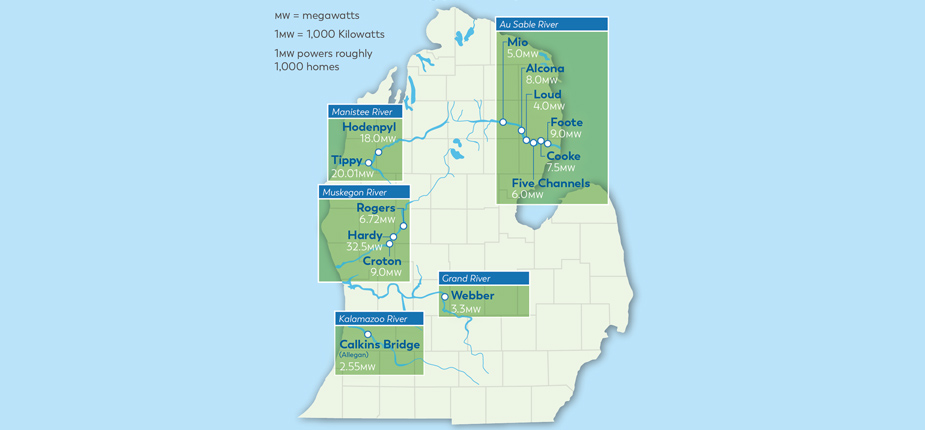
Consumers Energy agreed to sell the collection of century-old dams for $1 apiece to a newly formed subsidiary of Hull Street Energy in a Sept. 9 purchase agreement. The dams are situated on five rivers across Michigan and have a combined installed capacity of 132 MW, though they currently generate only about 50 MW, according to Consumers.
In a release, Consumers said the sale will reduce long-term costs for its customers and ensure the continued safe operation of the dams.
Consumers has long said maintaining the dams is expensive. The dams were built between 1906 and 1935, making the oldest nearly 120 years old. The utility has acknowledged the dams need significant infrastructure upgrades to remain in compliance with FERC licensing requirements. Consumers estimates that maintaining the dams through a new 30- to 50-year licensing period would cost $1.5 billion. It also has said the dams’ hydroelectric output costs nine times more than its other sources of generation.
Hull Street Energy said it has a “long track record of successfully owning and operating hydroelectric facilities” across North America. It said it has acquired and improved 47 hydroelectric assets in the past decade. Many of the facilities are small or midsize run-of-river dams in New England.
The investment firm created subsidiary Confluence Hydro to own and manage the dams and acquire other hydro assets.
“The firm will leverage its extensive experience and capital resources to upgrade the projects, ensuring the facilities can continue to safely deliver reliable, clean energy to Michigan customers and support economic and recreational opportunities critical to local communities for years to come,” Hull Street Energy said in a press release.
Confluence Hydro CEO Ed Quinn emphasized the company’s commitment to dam safety and refurbishment in a statement.
“With decades of experience operating hydro facilities, we are committed to preserving and modernizing these important resources to maximize their contribution to the grid,” Quinn said, adding that Confluence aims to be “a best-in-class hydro company — one that protects communities, supports employees, mitigates risk, and delivers reliable, clean energy for the future.”
Hull Street Energy was founded in 2014.
The 13 dams across Michigan in the sale | Consumers Energy
The sale agreement dictates that Confluence Hydro enter a contract to sell power back to Consumers Energy from the facilities for 30 years. Confluence said it would seek to renew the dams’ federal operating licenses, which begin to expire in 2034.
“We believe a sale of the dams is the best path forward for our customers. This sale balances two important needs: to lower costs for Consumers Energy’s customers while continuing to care for communities that depend on the dams,” said Sri Maddipati, Consumers Energy’s president of electric supply. “After numerous conversations with community members over the last three years to gather insights and feedback, we are confident this sale will preserve the reservoirs that hold the key to economic, recreational and community benefits at each of the dams.”
Consumers Energy hosted local meetings across Michigan on the fate of the dams beginning in 2022 and issued a request for proposals in early 2024. It also hired Lansing, Mich.-based Public Sector Consultants in 2022 to explore the impacts on communities in the event of partial or full dam removals.
The companies expect the transaction to close within 12-18 months pending approval from the Michigan Public Service Commission and FERC for the sale and license transfer for the dams.
Confluence said it plans to hold meetings with employees and affected communities in the coming months. It also said it plans to offer current Consumers Energy hydro employees “equivalent positions” with Confluence.
Bob Stuber, president of the Michigan Hydro Relicensing Coalition, which represents five conservation groups, expressed concern over a private investment firm buying the dams.
Stuber said because the new owner would sell power to Consumers Energy rather than the public, Hull Street cannot be reimbursed for any future investments through the Michigan Public Service Commission, possibly making future capital investments in the dams unattractive.
“Consumers acknowledges that these hydropower projects are marginally economical. It is a well-managed corporation, so it begs the question: If Consumers is challenged to turn a profit from these projects, how will another entity be able to, especially without a cost-recovery mechanism?” Stuber asked in a statement to RTO Insider.
Stuber said there’s also no guarantee Hull Street will continue to meet licensing requirements.
“History has demonstrated that new owners of older hydropower projects in Michigan are not as committed, as shown by the Edenville and Sanford catastrophic dam failures,” Stuber said, referring to Boyce Hydro’s yearslong negligence that caused the collapse of the Edenville and Sanford dams in Mid Michigan in May 2020. In that case, Las Vegas architect Lee Mueller and family members bought the dams to avoid paying taxes on the sale of an Illinois property. (See Michigan Dam with Prolonged Safety Issues Fails; FERC Terminates More Boyce Hydro Licenses.)
The Electric Policy Research Institute and Nuclear Energy Institute have issued an update to the Advanced Reactor Roadmap they launched in 2023.
The update comes after a period of steady progress by the nuclear power industry as well as rapidly increasing interest in and support for it.
In their Sept. 9 announcement, EPRI and NEI said the blueprint could help enable buildout of more than 300 GW of advanced nuclear generation capacity in North America. It identifies completed actions, new priorities and evolving industry needs over the past two years.
“When it comes to new nuclear power, the challenge isn’t demand but being able to build fast enough to meet it,” NEI Executive Director of New Nuclear Marc Nichol said in a news release. “The North American nuclear industry is confident in the ability to rise to the challenge and deliver the reliable, affordable and clean energy needed to power the future.”
The updated roadmap breaks the challenge down into three key issues — regulatory efficiency, technology readiness and project execution — and seven enabling factors to deliver value on a timely schedule: first-mover success, fast followers, regulatory efficiency, siting availability/permitting, indigenous/public engagement, supply chain ramp-up and workforce development.
The update is significantly longer and more detailed than the initial version, and it, too, will evolve with future developments and further stakeholder input.
The 2025 update notes that after the initial roadmap was issued in May 2023:
Vogtle Units 3 and 4, the first new U.S. advanced reactors, began commercial operation.
A host of state and federal policy and regulatory actions have boosted support for nuclear generation.
The sector has seen extensive private investment and agreements for offtake from facilities still in the research and planning phases.
The first small modular reactor in North America was approved for construction in Ontario.
More than 60 other new nuclear projects are being planned in the U.S. and Canada; several have secured regulatory approval; and a handful have begun construction.
Steve Chengelis, EPRI vice president of energy supply, said: “Using the roadmap as a guide, the nuclear industry has made significant strides in areas such as piloting accelerated material qualification projects, advancing workforce training and recruitment, and assessing how construction methods can reduce the risks of new builds.”
The roadmap spells out in detail the expected benefits of widespread deployment of advanced nuclear generation.
It also flags 49 issues posing potential hurdles to advanced nuclear technologies, including:
Risk must be reduced and mitigated to give investors and customers the necessary confidence to be first movers.
Some of the fuels that advanced reactors are being designed around have yet to be demonstrated commercially, and significant public and private investment is needed to get those fuels to market.
Other parts of the supply chain are inadequate, and investment in specialized production to create a supply chain is contingent on certainty of demand.
The construction skillsets the nuclear industry will need are in short supply and in high demand.
There is a collective lack of institutional knowledge, because so little nuclear construction has occurred in the United States in the past 30 years; because much will change from past practice; and because most prospective owner/operators will be new to the field and may lack necessary skills or experience.
But the roadmap also spells out the steps that need to be taken to address these challenges and identifies the key stakeholders who are or will be addressing the various issues.
The Tennessee Valley Authority has been among the early movers in U.S. planning and development of advanced nuclear technology, and it spoke of the value the roadmap has offered over the past two years.
“The roadmap’s collaborative approach has helped unify diverse stakeholders around a common vision for advanced reactor deployment,” Scott Hunnewell, vice president of TVA’s New Nuclear Program, said in the news release. “As a national leader in advancement of new nuclear technologies, we’re proud to contribute to this effort and look forward to continued progress.”