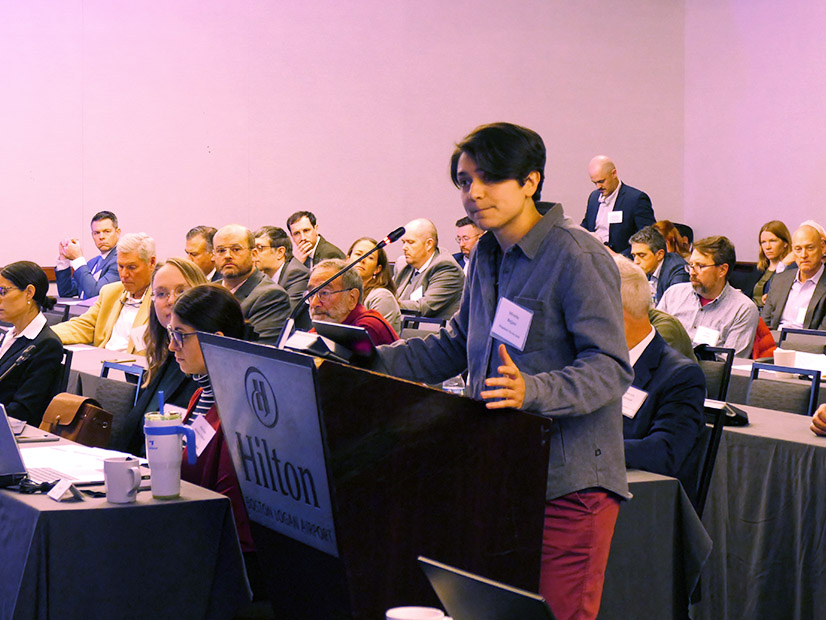
ISO-NE’s probabilistic modeling indicates there is minimal risk of shortfall in the upcoming winter, COO Vamsi Chadalavada told the NEPOOL Participants Committee on Nov. 6.
The risk levels identified by ISO-NE’s Probabilistic Energy Adequacy Tool are well below the duration and magnitude metrics recently established by the RTO in its Regional Energy Shortfall Threshold (REST). (See ISO-NE Proceeding with Shortfall Threshold After Positive Feedback.)
The REST shortfall metrics are calculated based on the 0.25%, 21-day model cases with the greatest shortfall risk. These extreme model cases averaged a 0.1% shortfall magnitude and a 0.7-hour shortfall duration for the upcoming winter, well shy of the 3% magnitude and 18-hours criteria that would need to be exceeded to violate the REST.
Chadalavada said ISO-NE is confident it can maintain grid reliability even in the worst-case scenarios.
“The worst-case 21-day energy shortfall quantities result from a low probability combination of several uncertainties,” including low LNG and fuel oil inventories, low import levels and high levels of unexpected outages, Chadalavada said.
“In the worst cases, energy shortfall begins on Day 14 or later, thus allowing time for additional actions,” he said. “ISO expects that in the event of a forecasted energy shortfall, market-based incentives will encourage relief in the form of market response, including additional fuel replenishment.”
If ISO-NE’s 21-day forecast indicates a shortfall is likely, the RTO would have access to other emergency measures, including limiting exports, scheduling imports, seeking waivers to air permit limits and conservation appeals, he said.
Seasonal weather forecasting shows a 33 to 40% probability of above-average temperatures for southern New England, and equal changes for above average and below average temperatures in northern New England, Chadalavada said.
He said ISO-NE anticipates the tanks at the Saint John LNG terminal being full, and he added that generators with large fuel oil storage capabilities have indicated “that pre-winter replenishment is underway and supply chains are expected to be strong with adequate supply available.”
Operations Report
Energy market value totaled $429 million in October, up significantly from $350 million in October 2024, ISO-NE reported. Ancillary market value totaled nearly $17 million, more than double the $8 million total in the prior October.
ISO-NE recorded its first monthly net export in 13 years in October, Chadalavada noted.
The low import levels appear to be driven by continued drought conditions and low reservoir levels in Québec and also may be affected by Hydro-Québec’s looming baseload export commitments associated with the New England Clean Energy Connect and Champlain Hudson Power Express transmission projects.
ALBANY — The state of New York has reversed course and issued a critical water-quality permit for a proposed natural gas pipeline off the coast of New York City.
The New York Department of Environmental Conservation’s approval Nov. 7 reverses the state’s three previous denials. Hours later, New Jersey’s Department of Environmental Protection issued water quality and other environmental certifications for the same project.
The permit approvals come after public fights over offshore wind, gas pipelines and congestion pricing between Gov. Kathy Hochul (D) and President Donald Trump.
“Today’s decision is a complete reversal from their previous determinations to reject the exact same pipeline over threats to New York’s water quality,” said Mark Izeman, senior attorney for the Natural Resources Defense Council. “The proposal is the same. The law is the same. The only thing that’s changed is the politics.”
In an emailed statement, Hochul said she stood by the DEC’s decision.
“While I have expressed an openness to natural gas, I have also been crystal clear that all proposed projects must be reviewed impartially by the required agencies to determine compliance with state and federal laws,” Hochul wrote. “I am comfortable that in approving the permits, including a water quality certification, for the NESE application, the DEC did just that.”
The Northeast Supply Enhancement (NESE) project would carry natural gas 24 miles from New Jersey into New York City and Long Island across Raritan Bay. It is an expansion of Williams Cos.’ massive, nationwide gas pipeline system operated by the Transcontinental Gas Pipeline Co.
In the permit approval announcement, DEC said another project, the 124-mile Constitution Pipeline, would not move ahead. The department said Constitution Pipeline Co. withdrew its application for permits. The Constitution Pipeline was planned to cross New York into New England and was controversial with locals and many New York elected officials.
Chad Zamarin, CEO of Williams, told Politico the company was “proud” NESE was moving forward and that the company planned continue working on the Constitution project. The company revived both pipelines after receiving public support from the Trump administration.
“As governor, a top priority is making sure the lights and heat stay on for all New Yorkers as we face potential energy shortages downstate as soon as next summer,” Hochul said in an emailed statement. “We need to govern in reality.”
Trump took to Truth Social days earlier to support NESE and Constitution.
“Gov. Kathy Hochul of New York state is killing the entire region with energy prices that are out of control and expected to triple because she can’t get an upstate and separately Long Island pipeline built,” Trump wrote before condemning New York City’s congestion pricing tolls.
Earlier in 2025, the president publicly feuded with the governor over the denial of pipeline permits and offshore wind. The president moved to stop construction on Empire Wind 1 but reversed course after claiming to reach a deal with Hochul in May. (See BOEM Lifts Stop-work Order on Empire Wind.) The White House claims Hochul “caved” on natural gas while the governor’s office denies any deal was reached.
Anshul Gupta, policy and research director for New Yorkers for Clean Power, said in an emailed statement that shortly after Trump and Hochul reached an agreement, the New York State Public Service Commission found a reliability need for the NESE.
“The reasons that the PSC gave in its rushed determination of NESE’s reliability need are transparently concocted to justify the project,” Gupta wrote. “It’s a remarkable coincidence that this so-called reliability need happens to exactly meet the 400,000 Dt/day capacity of a project that was proposed more than five years ago.”
The Independent Power Producers of New York praised the decision, saying it affirmed that natural gas is a crucial resource in maintaining the reliability and safety of the New York grid. IPPNY noted that 90% of electricity generated in the city is from natural gas and oil.
“I commend the DEC for recognizing that natural gas will continue to play a key role in the state’s energy future,” IPPNY CEO Gavin Donohue said in an emailed statement. “Until zero-emissions dispatchable resources … have been identified and developed, natural gas will remain a necessary transitional component of New York’s fuel mix.”
Izeman said he’s preparing to fight the permit in court. The NRDC, Earthjustice and other groups had challenged FERC’s greenlighting of the pipeline in federal appeals court at the end of October. In an emailed statement, Earthjustice called the approval “shameful.”
LITTLE ROCK, Ark. — It took almost two months of stakeholder meetings, outreach and education, working group discussions, staff modeling and everyone’s consternation over affordability before SPP’s Board of Directors approved a 2025 Integrated Transmission Plan (ITP) designed to keep pace with accelerating load growth and ensure grid reliability.
The ITP’s portfolio includes four 765-kV projects that total 949 miles and are part of a planned 765-kV backbone, along with 46 other proposals approved for construction permits. It also comes with an $8.6 billion price tag, eclipsing the record 2024 ITP that had SPP’s first 765-kV project and a $7.65 billion cost. (See SPP Board Approves $7.65B ITP, Delays Contentious Issue.)
SPP says the 10-year ITP assessment shows the portfolio is necessary to ensure the grid is ready for future demand, citing industrial electrification, manufacturing onshoring and economic development forecasts that show the grid at its limits. The grid operator is projecting a 25% increase in demand by 2030 for its 14-state footprint and a near doubling of its peak load (56 GW) in 10 years.
The portfolio has regional benefit-to-cost ratios between 12:1 and 18:1, the highest in the RTO’s planning history.
Still, with memories fresh over a recent cost-estimate increase for SPP’s first 765-kV project, members expressed concerns over the portfolio’s expense. The board in September approved a revised cost estimate of $3.62 billion, up from an original projection of $1.69 billion in February, for Southwestern Public Service’s 765-kV project in the 2024 ITP. (See SPP Board Approves 765-kV Project’s Increased Cost.)
“It’s really hard for us at a local level to talk about affordability when the metrics in the report are region-wide. The only thing our customers see in their [bills] is their rates going up,” Evergy’s Denise Buffington said during the Nov. 4 discussion.
“We have the job over the next 12 months, probably 10 months, to go to our legislature and our governor and our customers and explain to them why 765 is important,” she added, asking for “a little grace” and time to advocate about why the 2025 ITP is the right long-term solution. “We have to get the metrics down to a local level.”
Buffington’s message and those of other members were received by the board.
“As a board, we recognize that we’re making decisions that will significantly impact every homeowner and business in SPP,” board Chair Ray Hepper said as the meeting ground on through the lunch hour. “Reliability and affordability are a really delicate balance, and we strive to do our best in making that balance, thinking like every dollar we are approving is our own dollar. We also recognize that economic development for this region and attracting new loads that can serve our national interests is a key driver for a cost-effective system that will support growth in this critical time.”
SPP Mitigation Measures
To help ease concerns, SPP staff filed a memo with the board and the Members Committee outlining their measures to mitigate risks related to the viability and cost of 765-kV projects in the 2025 ITP. The measures will apply to 765-kV projects that receive a conditional construction permit or a request for proposals. They include SPP’s commitment to analyze the proposed 765-kV overlay analysis within the 2026 ITP assessment.
Hepper then added his own requirements for SPP so the board can fulfill its oversight responsibility and help “assure that only appropriate costs for new transmission are incurred.”
“Our goal is a reliable, cost-effective transmission system that will serve the region for years to come,” he said.
Hepper directed staff to file quarterly reports with the board should there be any changes that could affect approved projects in the 2025 ITP or any future assessments. He earned a commitment from COO Antoine Lucas to work through the stakeholder process and complete the 765-kV overlay analysis as part of the 2026 ITP and determine whether further mitigation actions or changes are needed.
Finally, he ordered staff to bring to the February board meeting a plan to expedite and improve the competitive project process, including a plan to improve the evaluation of RFPs.
“You’ve created a set of off-ramps and on-ramps for projects, which makes a lot of sense because things change relative to forecasts,” director Steve Wright said.
The Members Committee’s advisory vote passed 17-3, with three abstentions. Electric Cooperatives of Arkansas, Nebraska Public Power District and Omaha Public Power District voted against the measure.
The portfolio the board approved began as an $18.1 billion package of projects that staff identified to meet 10-year reliability and economic needs. It was whittled down by deferring about $7 billion in projects without near-term needs or that could be “further optimized” within the 2026 ITP, and again by deferring two economic 765-kV projects and their $2.6 billion costs, reducing the package to its final total.
The 2025 ITP does not include another $1 billion in zonal planning criteria projects submitted for study by members.
Most deferred projects will be further evaluated in the 2026 ITP as SPP continues to study a 765-kV backbone. It says a single 765-kV line can carry four times the power of a 345-kV line, using less land and losing less energy over long distances. That makes 765-kV a more efficient, cost-effective and forward-looking solution for a growing grid, staff said.
“We’re building today for the demands of tomorrow,” Casey Cathey, the RTO’s engineering vice president, said.
Stacey Burbure, American Electric Power’s lead for transmission business development and joint ventures, applauded SPP’s decision to move forward with its 765-kV overlay. She noted AEP’s service territory includes some of the poorest parts of Appalachia, where the company has some of its more than 2,000 miles of 765-kV infrastructure.
“It’s our baby. This was the most efficient and effective way for us to serve our customers, and it remains a very effective tool in the bucket for every RTO,” Burbure said. “This is a tool that folks are turning to to solve the issues that confront us, regardless of which RTO you’re in. Is this the right outcome for SPP as a region? I think the answer is obvious. It’s yes.”
Matt Pawlowski, vice president of development for NextEra Energy Transmission, pointed out that the portfolio includes two 765-kV legs on either side of the footprint, but no road connecting the two highways. While NextEra supports the $8.6 billion ITP, it would have preferred the $11.1 billion package, he said.
“Without a connector, the systems on either side of those lines are going to be overloaded,” Pawlowksi said. “We are going to have reliability issues. If we don’t address it with the two economic projects, I think we’re really missing out.”
He said if the two economic projects are again deferred, SPP will face the danger of getting behind an “entire queue of projects in the supply chain.”
“If you defer these projects, you are totally kidding yourself. You are not going to build these projects by 2030 plus, 2035 probably at best,” Pawlowski said. “So what is preventing us from looking at those two projects and improving them as a region when staff has already said that they’re needed?”
The discussion will continue in February when the board gathers again in Little Rock for its first quarterly meeting of 2026. Hepper, who prefers to have people around the table debating issues, has canceled the original virtual scheduled meeting to further discuss in person 765-kV lines and the competitive project process.
“We are going to have some very significant decisions to talk over,” he said.
SPP Introduces CARE Team
SPP has introduced another acronym to its lexicon with the creation of the Cost Control and Allocation Review and Evaluation (CARE) Team. The cross-functional body will review, evaluate, assess and recommend refinements or alternatives to current transmission cost controls and cost-allocation methodology.
Wright and Kayla Hahn, the Missouri Public Service Commission’s chair, will co-chair the 15-person team and have already met once to discuss CARE’s scope. It has been asked to deliver a final report in August 2026.
Other members will include independent director Stuart Solomon, commissioners Chuck Hutchinson (Nebraska), Justin Tate (Arkansas) and Kathleen Jackson (Texas), and state regulatory staffers Jon Thurber (South Dakota), Jason Chaplin (Oklahoma) and Justin Grady (Kansas). Members from the Members Committee and the Strategic Planning Committee will be added later.
“The idea was, ‘Let’s get this conversation happening. Let’s have a conversation between the groups within SPP that have the organizational responsibility for allocation and cost control,’” said New Mexico Commissioner Pat O’Connell, the Regional State Committee’s president.
“So, to me, just getting all those folks together to have this conversation by itself is valuable,” he said. “I am also confident that SPP works to deliver good results, so that the recommendations will be also valuable and impactful.”
FERC has approved the 2026 business plans and budgets for NERC, the regional entities and the Western Interconnection Regional Advisory Body, along with allowing the Midwest Reliability Organization, Northeast Power Coordinating Council and SERC Reliability to tap their reserves to reduce next year’s assessments.
Commissioners accepted the budgets in an Oct. 30 filing (RR25-5). Chair Laura Swett and Commissioner David LaCerte, sworn in Oct. 20 and Oct. 27, respectively, did not participate in the decision.
NERC’s budget for 2026 is $129 million, up $5.6 million from its 2025 budget. This includes planned spending in both the U.S. and Canada, as well as $45 million for the Electricity Information Sharing and Analysis Center, up $1.4 million from the prior year. The E-ISAC budget increase reflects rising contractor and consultant costs and the addition of three positions in the areas of stakeholder engagement, security operations and intelligence functions.
Most funding for NERC’s activities comes from its assessment, which load-serving entities pay to support the ERO’s work. NERC’s 2026 assessment is to rise by $5.3 million to $114 million; this figure comprises $103 million from U.S. entities and $11 million from Canada.
The difference between the budget and the assessment will be made up with funding from other sources, including third-party funding for the E-ISAC’s Cyber Risk Information Sharing Program, the System Operator Certification and Credential Maintenance program and the E-ISAC’s partnership with the Downstream Natural Gas ISAC.
NERC CEO Jim Robb said in May that the organization is approaching 2026 as a “bridge year” between the previous three-year plan, which will conclude at the end of 2025, and a new three-year plan, to begin in 2027. (See 2026 to be ‘Bridge Year’ for NERC Budget.) Robb said the uncertainty introduced since the beginning of President Donald Trump’s second term, along with ongoing efforts such as the ERO’s work on modernizing its standards development process, made long-term planning “a fool’s errand at this point in time.”
RE Budgets, Assessments to Rise
The total planned ERO budget, including NERC, the REs and WIRAB, comes to $321 million, up from $304 million in 2025. Assessments for all entities are $290 million, up from $271 million the year before; $260 million of the total assessments for 2026 is allocated to U.S. entities.
NERC asked for, and FERC approved, an exception to Section 1107.2 of the ERO’s Rules of Procedure. The section states that funds received by NERC or REs from penalties assessed in the U.S. must be used to offset the collecting entity’s budget for the subsequent fiscal year if received by July 1, or for the second subsequent fiscal year if received on or after July 1.
The exception granted by FERC allows MRO, NPCC and SERC to deposit penalty monies received before July 1, 2025, into their assessment stabilization reserves, rather than apply them to the REs’ 2026 budgets. FERC will also permit the organizations to use penalties collected before July 1, 2024, and still held in their ASRs to reduce the 2026 assessments.
As a result of FERC’s decision, NPCC will deposit $210,000 collected in penalties between July 1, 2024, and June 30, 2025, into its ASR and withdraw $500,000 from the reserve. SERC will deposit $1.5 million in penalties into its ASR and release $2.5 million from the ASR. MRO will deposit $24,000 in penalties and release $1.6 million.
BOSTON — Incoming ISO-NE CEO Vamsi Chadalavada emphasized the importance of innovation and a forward-looking approach to prepare for the future grid in his remarks at the RTO’s annual open board meeting.
Discussing the RTO’s 2027-2030 road map, Chadalavada said ISO-NE must continue to lay the groundwork for the incorporation of increasing amounts of inverter-based generation, storage, retail demand resources, grid-enhancing technologies and increasingly advanced software.
“It’s really important for the ISO not to be a barrier” for the incorporation of new technologies on the grid, said Chadalavada, who has served as COO since 2008. He added that he remains “very mindful that our core mission is to maintain reliability through efficient wholesale markets.”
Chadalavada, who will replace Gordon van Welie as CEO in 2026, joined ISO-NE in 2005. (See Retiring ISO-NE CEO van Welie Reflects on 25 Years at the RTO.) The change in leadership comes at a critical point for the RTO, which faces the simultaneous, interrelated challenges of accelerating load growth and increasing levels of intermittent renewable generation.
With demand and supply likely to become increasingly variable, ISO-NE is working to develop “a foundation of new probabilistic forecasts to manage grid uncertainties,” he noted.
Earlier in 2025, ISO-NE announced its plans to develop a “dynamic, real-time probabilistic forecast of the system’s energy ramping needs,” which could be used to determine how much reserves the RTO procures on a given day. These changes are aimed at more efficiently managing operational uncertainties, ISO-NE has said.
“Everything we do has to make sure that the existing grid is optimized to the greatest extent possible,” Chadalavada said. “We don’t want to wait for the day when we have 25 GW of inverter-based resources; we want to lay the groundwork now.”
Chadalavada also said ISO-NE likely will increase its investment in artificial intelligence to help speed up the development of several initiatives. Citing one example, he said ISO-NE operating guides can take an “extraordinary amount of time” to develop, and the RTO hopes to put “innovation and AI to great use” to expedite these processes.
He said speeding up markets or operations projects at ISO-NE should have a positive effect on innovation within the wholesale markets. He also stressed the importance of integrating the RTO’s internal models, studies and processes.
“To address operational uncertainties over the coming years, ISO markets and operations initiatives will be tightly interwoven, in practice and purpose,” he said.
Also speaking at the Nov. 5 meeting, van Welie reflected on his long tenure leading the RTO. He said the implementation of wholesale markets has had widespread positive effects, including attracting more investment, reducing consumer costs and lowering emissions.
“One of the big points of these markets was to have the risk of investments stay with investors, rather than be passed onto consumers,” he said.
He also said the region has benefited significantly from forward-looking transmission investments that enabled gas generators to replace dirtier and less efficient coal and oil resources, and ultimately “gave us the foundation for introducing the first grid-scale renewables onto the fleet.”
He expressed optimism that ISO-NE’s ongoing Longer-term Transmission Planning procurement “is going to help us open a path into Maine, where there is a lot of land-based wind potential.”
Van Welie said he is disappointed that demand-side resources have not advanced as quickly as he hoped but that these resources will be a critical component of the future grid.
Several members of the public spoke at the meeting, emphasizing the urgency of decarbonizing to minimize the effects of manmade climate change and urging the RTO to take bolder steps to help cut emissions.
“The window for preventing the worst climate outcomes is rapidly closing,” said Lilly Worthley, a member of Fix the Grid.
The group, which is supported by climate and environmental organizations, distributed a statement that included a series of recommendations aimed at increasing ISO-NE’s accountability to the public. It called on the RTO to:
improve its community engagement processes;
add state representation to the Board of Directors;
increase opportunities for public participation; and
add climate and affordability priorities to its mission statement.
Activists applauded some of the steps taken in recent years by ISO-NE, including the establishment of the annual open board meeting, the creation of a community affairs policy adviser position and the RTO’s advocacy for offshore wind at the federal level.
But more work needs to be done to increase transparency, accessibility and accountability, Fix the Grid wrote in its statement.
“We believe the upcoming leadership transition provides a real opportunity for a new chapter at ISO-NE, to steer the region toward a cleaner, more just energy future,” the group said.
WASHINGTON — Permitting legislation still is being developed on Capitol Hill, but the government shutdown and the Trump administration’s actions against clean energy projects in Democratic-led states could stop it from happening this Congress.
The Conservative Energy Network (CEN) and Grid Action held a “fly-in” Nov. 5, in which state officials, business leaders and experts held more than 35 meetings with members of Congress and senior staff to push for permitting reform legislation. The meetings included those with members of the House Energy and Commerce, House Natural Resources, Senate Environment and Public Works, and Senate Energy and Natural Resources committees.
“Our permitting system makes it impossible to do things in a reasonable time frame,” Rep. Mariannette Miller-Meeks (R-Iowa) said at a press conference hosted by CEN. “And the government, whether it be local, state or federal, is often standing in the way of the market meeting the needs, especially the needs for increased energy demand.”
Congress has been working on the issue for years, and the fact that major infrastructure like transmission can take the better part of two decades to build shows change is needed, as Americans pay more for energy than they would otherwise, she added. Miller-Meeks supports the SPEED and Reliability Act, which would amend the National Environmental Policy Act to speed up agencies’ review of infrastructure projects. (See Permitting Hearing Shows Tricky Politics of Getting a Bill Passed.)
“We have an urgent, growing demand, and the question is whether Congress will act decisively or [continue] to tinker around the margins,” Miller-Meeks said.
Asked about the biggest obstacle to legislation in 2025, Miller-Meeks blamed the government shutdown “created by the Democrats,” which officially became the longest in history on the day of the press conference.
Speaking on a webinar hosted by Americans for a Clean Energy Grid (ACEG) in October, Rep. Sean Casten (D-Ill.) noted that Democrats have a different road block for bipartisan legislation.
“The currency of trust is so low when the White House is refusing to even honor existing congressionally mandated spending [and] congressionally mandated legislation,” Casten said. Talking about compromising on permitting legislation now is “a little bit like compromising with somebody who just robbed your house and is saying ‘you can trust me this time.’”
While that issue has cut the probability of legislation for now, Congress still can work on developing good policy for “when that door next opens,” Casten said.
When it comes to the grid, the issue has less to do with permitting and more to do with the right economic incentives, he argued.
“That sounds crazy,” he said. “You’d never know that if you read all the talking heads, or if you looked at the legislation going through Congress.” But regulated utilities can build rate-based generation and get it connected to their systems, and the natural gas industry has no problem getting pipelines built despite environmental risks that are arguably bigger than those of high-voltage transmission, he argued.
“The truth is, we have a profit problem,” Casten said. “The way that our energy markets are structured, we do not have an incentive to deploy cheap energy. And it comes from the fact that if you are an incumbent in the electricity sector, you lose money if a competitor builds a system on your grid that can underprice you.”
Casten said he did not blame utilities because they were following the incentives, so the goal for any legislation should be to change them. The Cheap Energy Act, which he introduced with Rep. Mike Levin (D-Calif.), aims to do that. (See Federal Energy Policy News Roundup: House Bills and DOE Returns $13B.)
“How should we rethink the way that electricity markets are structured so that we don’t wind up in a situation where every single person who deploys a zero-marginal-cost generator doesn’t essentially eat their own investment thesis?” Casten said. “Because, after all, if everybody built renewable power plants and our whole grid was served with renewables, the marginal price of power would be zero, and consumers would win, but there’d be no incentive to build anything. That’s not some innate flaw. It’s just a problem with the way that we’ve regulated the structure. We fix that.”
As both a policy and political matter, any permitting legislation needs to be technology neutral, Bill Parsons, Berkshire Hathaway Energy vice president of federal legislative affairs, said on the ACEG webinar.
“Now, some people will say, ‘Well, as long as the reforms to NEPA and other permitting statutes apply to everything, then that’s tech neutral,’” Parsons said. “I think we do need to go a bit further here. There’s going to need to be a transmission title.”
BHE supported the Energy Permitting Reform Act of 2024 from former Sen. Joe Manchin (I-W.Va.) and Sen. John Barrasso (R-Wyo.). That could be a starting point for a future permitting deal, he said.
“I think we make a mistake when we get overly binary about the policy choices here, and it’s either the status quo or a complete federal takeover of transmission,” Parsons said. “That’s a false choice. There is an opportunity to hive off a very limited number of high-priority national lines, describe them objectively, so people can understand ahead of time what qualifies and what doesn’t for consideration at FERC.”
The National Governors Association weighed in on the permitting debate recently, releasing a bipartisan proposal headed by NGA Chair and Oklahoma Gov. Kevin Stitt (R) and Pennsylvania Gov. Josh Shapiro (D).
“This isn’t a Republican or [Democratic] issue. Every American needs to heat their home and power their vehicle,” Stitt said in a statement. “As the demand for energy rises as we bring new technologies and AI online, we need to complete energy infrastructure projects in a faster, more efficient way.”
The governors’ proposal includes reforms for FERC that would have it create a National Interest Designation Process that lets a transmission facility be declared in the national interest after the hearing and consideration of several factors and consultation with the states. Groups of states could nominate National Interest Electric Lines.
FERC would get greater flexibility to allocate the costs of interstate and offshore transmission lines among all beneficiaries.
The governors also want changes to ISO/RTO governance, including giving states, or organizations of states, “jump ball” or complementary filing rights at FERC. ISO/RTOs would be required to improve interregional planning and more robustly consider states’ alternative planning options.
Another legal change would be to require ISO/RTOs to process interconnection requests for generation and storage within six months of an initial application.
Amazon has filed a complaint with Oregon regulators that accuses PacifiCorp of violating agreements to provide power to four data center campuses in the utility’s service territory.
Amazon Data Services (ADS) filed the complaint Oct. 30 with the Oregon Public Utility Commission, saying it had exhausted “all reasonable efforts for resolution with PacifiCorp.” Amazon said it invested in the data centers based on PacifiCorp’s agreement to provide service.
Amazon is asking the commission to require PacifiCorp to supply the agreed-upon power — or to move the data centers into the territory of another utility that’s willing to provide electricity.
“Despite ADS paying PacifiCorp … under binding contracts, PacifiCorp breached its statutory obligations and contractual duties by failing to supply ADS with the promised power,” Amazon said in the complaint.
In a statement provided to RTO Insider, PacifiCorp said it has been “acting in good faith to serve Amazon’s significant load in a manner that would achieve Amazon’s operational goals while protecting PacifiCorp’s existing customers from increased costs and reliability issues.”
“We are open to ongoing discussions with Amazon to reach a resolution that achieves these goals,” the utility said. “It is PacifiCorp’s policy position to avoid direct and indirect harms between customers. This is consistent with Oregon law, which ensures new data center loads do not jeopardize customer affordability.”
PacifiCorp’s response filing with the PUC is due Nov. 19; the company asked the commission to extend the deadline for filing a response and a potential motion to Dec. 19.
Amazon said it has been working since 2021 to develop four new data center campuses in PacifiCorp territory in Oregon.
For the first campus, called Specialized, PacifiCorp is “supplying significantly less power than promised,” Amazon alleged. A second campus, called Litespeed, hasn’t received any power from PacifiCorp, according to the complaint.
And for two other data center campuses, known as Pivot and Gray, PacifiCorp “has refused to even complete its own standard contracting process,” Amazon contended.
Amazon also accused PacifiCorp of trying to increase Amazon’s costs in the form of a 32.6% “tax gross-up” on capital contributions.
For the Specialized and Litespeed data centers, Amazon and PacifiCorp entered into a series of three agreements. The first two covered preliminary design and engineering work. The third agreement, known as a master electric service and facilities improvements agreement (MESA), required PacifiCorp to complete particular improvements and then deliver power as specified in the contract.
The Gray and Pivot campuses didn’t move beyond the first two agreements with PacifiCorp to a MESA agreement. According to Amazon, PacifiCorp told it to forfeit the contracts for the Specialized and Litespeed campuses if it wants agreements for Gray and Pivot.
The complaint, which was heavily redacted before being filed in the public docket, doesn’t show the amount Amazon has spent on capital improvements and development costs under the contracts with PacifiCorp. It also doesn’t give the exact location of the data centers, other than saying they’re in PacifiCorp territory.
Amazon said the four data centers in its complaint would complement existing data centers in the region. The company’s data center portfolio includes facilities in Morrow and Umatilla counties in Eastern Oregon.
Weather-normalized electricity demand has increased by about 2% this year in Eversource Energy’s service territories in New England, in part due to heating and transportation electrification, CEO Joe Nolan said during the company’s third-quarter earnings call.
Nolan expressed optimism about new transmission opportunities to meet this load growth, along with the potential for a more favorable regulatory environment in Connecticut in the wake of the resignation of Connecticut Public Utilities Regulatory Authority (PURA) Chair Marissa Gillett. (See Escalating Conflict with Utilities Leads to Resignation of Top Conn. Regulator.)
“Load growth in our service territory has started outpacing the impacts of distributed generation such as rooftop solar,” Nolan said on the Nov. 5 call, adding that the company experienced a peak load of more than 12 GW during the summer, its highest peak since 2013. The company’s service territory covers parts of Massachusetts, New Hampshire and Connecticut.
The increasing demand has been “driven primarily by electrification of transportation and heating, decarbonization initiatives from both the public and private sectors, and economic expansion across manufacturing and commercial sectors,” Nolan said.
The observed load growth may be part of a larger trend that experts expect to accelerate into the 2030s. By 2034, ISO-NE forecasts New England’s average annual net load increasing by more than 11% and the average summer peak load increasing by more than 8%, or about 2 GW.
The RTO experienced its highest peak load since 2013 in June 2025, though net load (not normalized to account for weather effects) over the first nine months of 2025 was about equal to 2024 net load over the same period. (See Extreme Heat Triggers Capacity Deficiency in New England.)
“The evolving electric landscape presents a need for numerous transmission projects, such as upgrades linking onshore and offshore wind to load centers, interconnections improving regional reliability and addressing congestion as the generation mix for our region evolves,” Nolan said.
Nolan added that the company expects to spend nearly $2 billion on its electric distribution business and about $1.4 billion on its transmission business in 2025.
A large portion of the company’s transmission spending is associated with asset upgrades, a major concern for New England states and consumer advocates in recent years. According to data published by ISO-NE, Eversource plans to spend about $774 million on asset condition projects expected to come online in 2025. (See More Oversight Needed on Local Transmission Spending in NE, Panel Says.)
Nolan indicated that Eversource responded to ISO-NE’s first longer-term transmission planning (LTTP) solicitation and that LTTP solicitations and land acquisitions at strategic interconnection points could create opportunities to add “billions of dollars to our future investment plans.”
“Each project that we are considering not only supports our growth trajectory, but also deepens our value proposition as a grid innovator,” Nolan said.
ISO-NE’s LTTP solicitation is the first to be run under its new process, which aims to procure transmission solutions to needs identified in long-term planning studies. The first procurement is focused on reducing transmission constraints in Maine and enabling the interconnection of onshore wind in the state.
ISO-NE received six qualified proposals prior to the submission deadline at the end of September, ranging in cost from about $1 billion to $4 billion. (See ISO-NE Reveals 1st Details of Long-term Transmission Proposals.) ISO-NE has not announced which companies submitted proposals.
Regarding the company’s business in Connecticut, Nolan appeared cautiously optimistic about financial opportunities in the state after Gillett resigned in September amid mounting political and legal battles with utilities and Republicans in the state.
“We’re seeing a constructive shift in Connecticut’s regulatory landscape,” Nolan said. “A transparent regulatory process is going to benefit all stakeholders, including our customers, and we are looking forward to getting back to work on Connecticut’s energy goals.”
Also on Nov. 5, PURA approved a rate increase for the Yankee Gas Co., an Eversource subsidiary. The decision authorized a higher revenue requirement for the company than initially outlined in a draft decision authored during Gillett’s tenure.
In the prior week, PURA similarly approved a higher revenue requirement in a United Illuminating rate case relative to a draft decision issued under Gillett’s leadership.
Connecticut Gov. Ned Lamont (D) has nominated four new commissioners to PURA, bringing the total number on the commission to five. However, both decisions were issued by the two remaining active commissioners at the authority, one of whom worked as a lobbyist for United Illuminating as recently as 2024.
While the final decisions appear more favorable to the utilities than the draft decisions, only one of the two commissioners who ruled on these cases is set to be part of the full incoming commission, and the rulings may not give much indication about the regulatory approach of the full incoming commission.
Asked whether the new commission will lead to an improvement in Eversource’s credit rating, Eversource CFO John Moreira said credit rating agencies are “in a wait-and-see mode.”
“They want to see some constructive regulatory outcomes,” Moreira said, adding, “we think that this new commission is focused on working collaboratively with all the utilities.”
IESO will begin allowing corporate energy buyers to purchase power from off-site renewable generators next spring, giving loads another way to reduce their Global Adjustment (GA) charges.
The new policy will be effective for the 2026/27 base period (May 2026-April 2027) for determining loads’ GA charges.
The C-PPA framework allows participants in the Industrial Conservation Initiative (ICI) to sign “virtual” power purchase agreements with renewable generators — defined as wind, water, biomass, biogas, biofuel, solar or geothermal — located anywhere in Ontario.
Before the June rule change by the Ministry of Energy and Mines (Regulation 429/04), the ICI program allowed only on-site PPAs, in which electricity is generated and consumed at the same location, behind the meter. ICI is designed to reduce large electricity users’ consumption during peak hours.
The revised regulation will help large consumers reduce their electricity costs and meet clean energy goals, while providing an additional revenue source for generators and supporting new generation investment, IESO said in an engagement session outlining the program Nov. 4.
Potential Global Adjustment Savings
C-PPAs handle financial settlements separately from the physical delivery of electricity, with the generator’s output offsetting the consumer’s demand during peak periods.
ICI participants that cut their usage during the top five peak hours over a 12-month base period (the peak demand factor) can significantly reduce their GA charges. The GA funds new grid infrastructure as well as maintenance and conservation programs.
Eligible Loads
ICI participants, called “Class A” customers, include:
manufacturing and industrial loads, including greenhouses, with an average monthly maximum hourly demand between 500 kW and 1 MW;
customers with an average monthly maximum hourly demand between 1 and 5 MW, which can opt in to the program; and
customers with an average monthly maximum hourly demand greater than 5 MW, which are automatically entered into the ICI program unless they opt out.
Generator Eligibility
The program allows participation by generators and customers that are distribution-connected if they are registered as a market participant and settled in the IESO market.
New generation facilities are eligible to participate if they have a municipal resolution of support and are not located on Prime Agricultural Land.
C-PPA transactions must be settled through the IESO market.
‘Stacking’ OK
The new rules allow generating facilities and customers to “stack” multiple PPAs. But they limit the “eligible” electricity under the program to that which has not already been paid for or committed (“compensated” electricity), such as that procured through IESO contracts.
IESO’s Keigan Buck (left) and Greg Moore | IESO
“The fundamental principle is that the regulation does not permit double recovery,” IESO’s Keigan Buck said. “A given unit of electricity can be either eligible electricity or compensated electricity. [It] cannot be both.”
‘Eligible’ Electricity
Generators must deliver to the IESO grid or distribution system “some volume” of eligible electricity in each hour of the base period without using temporary storage.
“Based on the IESO’s current interpretation, we understand the regulation’s requirement for generators to deliver … any non-zero amount of energy — essentially any volume above 0 MWh,” IESO spokesman Michael Dodsworth said.
The rules provide exceptions to the delivery requirement for facility outages, insufficient wind or sunlight, compliance with IESO dispatch instructions or circumstances beyond the generator’s control, such as delivery constraints.
Next Steps
IESO is accepting feedback until Nov. 18 at engagement@ieso.ca. It plans to post final documents on the program in December or January.
The C-PPA submission window opens Feb. 1, 2026, and closes March 30. Submissions must be sent by email to corporateppa@ieso.ca.
“We strongly encourage submitting early within the window, because some of the timelines are quite tight for approval of the documents, and it may require some back and forth between proponents and the IESO,” the ISO’s Greg Moore said.
WECC expects two regions to be under elevated risk as the West heads into the winter, with staff saying a prolonged weather event could impact operating reserves.
Speaking at a Nov. 4 WECC webinar about the organization’s upcoming 2025 winter reliability assessment, Matt Zapotocky, senior reliability assessments engineer, said the Northwest and Basin regions are at elevated risk — meaning there is potential for insufficient operating reserves in case of an extreme cold weather event coinciding with elevated demand or a significant reduction in resources.
The two regions cover Oregon, Washington, Idaho, Montana, Utah and western Wyoming.
A prolonged cold weather event in those areas could lead to “power not being available and the inability to maintain their operating reserves, and that’s why they were suggested as elevated this year in the assessment,” Zapotocky said. “However, it should be noted that neither area should have lost load for the upcoming winter, assuming there is import availability for both regions.”
James Hanson, manager of operations analysis at WECC, said a major concern is the impact of cold weather events on warmer regions, as seen in January 2024 during Winter Storm Heather.
“There were some significant challenges that parts of the interconnection were facing during that time,” Hanson said. “We fared relatively well. I think … readiness plans, making sure critical components on your power plants are able to withstand those extreme colds, I think that really boded well for a lot of our generation.”
Still, if cold weather extends into a more temperate area “like the Desert Southwest, we could see some operating challenges for sure,” Hanson said.
The resource mix also plays a role in the winter assessment. The West is expected to see approximately 4 GW of coal retirements in 2025, along with about 1 GW of planned natural gas retirements. However, some of the natural gas retirements will be offset by natural gas additions projected to come online in January 2026, Zapotocky said.
Those resources are valuable in the winter and can effectively address unplanned and forced outages, he added.
Though the West will see about 11 GW of solar and 7 GW of wind added across the Western Interconnection, inverter-based resources are more at risk during cold weather events, Zapotocky noted.
“Wind turbines can be susceptible to icing or cold weather cutouts, or even overspeed if the winds are strong enough,” Zapotocky said. “Solar capability can either just not be available if it’s a morning peak and it’s still dark out or just be severely limited due to snow or cloud coverage.”
WECC anticipates over 10 GW of battery energy storage coming online this winter, but those systems can only “provide about four hours of discharge,” Zapotocky said.
“So if you have a prolonged weather event, that may not be enough to quite get you through it,” he added. “There have to be strategies to stagger their use.”
The additional capacity of wind, solar and batteries will be of “particular importance” to the Northwest as the region is forecasting a winter peak 9% higher than last year’s forecast, according to Zapotocky.
WECC will publish the full winter reliability assessment Nov. 13.