New York regulators on Thursday approved a three-year rate plan for Central Hudson Gas and Electric, effective retroactively to July 1, 2021, praising the joint proposal made by the utility, consumer advocates and Department of Public Service staff as a model for other utilities to follow (Cases No. 20-E-0428; 20-G-0429; 20-M-0134).
The approved joint proposal balances varied interests while also ensuring the utility’s continued provision of safe and reliable service, furthering the goals of New York’s nation-leading Climate Leadership and Community Protection Act (CLCPA), and mitigating impacts to ratepayers, especially those suffering the financial effects of the COVID-19 pandemic, said Administrative Law Judge Michael Clarke.
Under the new rate plan, Central Hudson will identify ways to reduce its carbon emissions, targeting cumulative savings of 2019 gas and electric sales in the next four years by 2.5% and 6.9%, respectively, and will decommission by yearend 2025 its gas-powered 20 MW Coxsackie and 23 MW South Cairo power plants.
Central Hudson will expand access and increase bill discounts for low-income customers, including a $4.5 million customer bill moderation credit. It will pause residential service terminations as well as service metrics for uncollectible bills through 2022, and continue its Back to Business economic development program providing financial assistance to small businesses.
The New York Public Service Commission held its regular monthly session in hybrid fashion November 18, 2021, meeting both in person and via videoconference. | NYDPS
Clarke quoted one of the parties to the joint proposal, the Alliance for a Green Economy, as saying the plan “contains numerous provisions that represent meaningful compromise among normally adversarial parties and which specifically concede to the public interest positions taken by not-for-profit public interest organizations who represent constituencies within the company’s service territory.”
The Public Utility Law Project said the agreement’s mitigation of rate increases, low-income provisions, COVID-19 considerations and consumer protections, as well as efforts to promote the goals of the CLCPA are in the public interest.
“Of great interest to me is the adjustments towards declining block rates, which are viewed by some as a de facto incentive for greater gas use,” Public Service Commission Chair Rory Christian said. “By flattening those rates, you remove that incentive and better align customer use of natural gas with the overall goals of the CLCPA.”
The New York DPS defines a block rate as a commodity rate structure where blocks of consumption are sold at different rates to recognize differences in cost of service. Most commonly the block rates decline as consumption increases.
As part of the rate plan’s climate-related initiatives, Central Hudson will conduct a geothermal district loop feasibility study to identify potential project sites. The study will be funded by electric customers and capped at $250,000. If the study identifies a suitable project site, Central Hudson will discuss development with the commission to ensure it is consistent with state policies and ongoing community thermal system work at the New York State Energy Research and Development Authority.
Rate Design
The new rate plan allows a 9% return on equity and will decrease electric base delivery revenues by $3.1 million the first year but increase them in the following two years by $19.5 million and $20.7 million, respectively. Gas base delivery revenues would increase in each of the three rate years, going up by $4.7 million the first year, then by $6.3 million and $6.4 million, respectively, in the succeeding two years.
The PSC’s order said an earnings sharing mechanism “is triggered if the company’s actual ROE exceeds 9.5% in any rate year (after certain adjustments). Earnings above 9.5% to 10% would be shared equally between Central Hudson and ratepayers; ratepayers would receive 75% of any earnings greater than 10% up to 10.5%; and ratepayers would receive 90% of any earnings over 10.5%.”
Central Hudson customers may not understand how electric rates regulated to go down a bit by the order may actually rise substantially with the increase in commodity prices being experienced now, Commissioner John B. Howard said: “Let people know that the commodity portion that will be affecting their bill is not what we’re voting on here today. We’re voting on a delivery rate that is separate and apart.”
This settlement discussion should be a model that other companies follow, Commissioner Tracey A. Edwards said. She also thanked the utility “for recognizing that we are in a diverse state” and creating a Spanish-language website and offering translation of other languages.
Regulating ESCOs
The PSC also announced steps related to eight energy service companies, or ESCOs, operating in New York, denying permits to four companies, prohibiting another from further marketing or enrolling new customers, and allowing one company to serve low-income customers after demonstrating its ability to provide guaranteed savings (Cases No. 12-M-0476; 21-M-0491; 21-E-0490).
The commission in December 2019 placed ESCOs under new restrictions and requirements that they must honor in order to sell to the state’s residential customers and small business owners. (See NYPSC Reins in ESCOs, Expands Community DG.)
“Our ongoing efforts to improve the ESCO market remains a priority,” Christian said. “When an ESCO proves they are fair to customers, we allow them to continue their activities in New York to bring choice and energy services to customers.”
The commission denied SunSea Energy, Starion Energy NY, Smart One Energy and Josco Energy’s applications for eligibility to serve mass-market customers after staff found that each of the four firms knowingly made false and misleading statements in its application to do business.
The PSC ordered that Got Gas? and Graystone Technologies each show cause within 30 days why their eligibility to act as an ESCO in New York should not be revoked for allegedly violating the commission’s uniform business practices rules. Neither company has customers in New York.
The commission also approved NOCO Electric and NOCO Natural Gas’ request to serve low-income customers.
California’s three large investor-owned utilities are on track to meet the state’s goal of serving retail customers with 60% renewable energy by 2030, but some smaller utilities and community choice aggregators (CCAs) are lagging, a report issued Friday by the California Public Utilities Commission concluded.
The CPUC’s annual report on the state’s renewable portfolio standard assessed the progress made by electricity retailers — IOUs, CCAs, small and multijurisdictional utilities (SMJUs) and electric service providers (ESPs) — on procuring 33% of energy from renewable sources by 2020 and 60% by 2030, as well as interim periodic goals.
The CPUC and the California Energy Commission oversee the state’s RPS program, the most ambitious in the nation. CPUC-jurisdictional load-serving entities serve approximately 75% of in-state load.
Senate Bill SB 100, signed by former Gov. Jerry Brown in 2018, established the 60%-by-2030 mandate, as well as the requirement that all retail customers be supplied with 100% carbon-free energy by 2045.
“As of 2021, the investor-owned utilities have executed renewable electricity contracts necessary to meet 2021 RPS requirement and are forecasted to have excess renewable procurement through 2027,” the CPUC said in a statement. “The small and multijurisdictional utilities, electric service providers and community choice aggregators collectively need to procure additional renewable resources to meet the 2021-2024 compliance period requirements, as well as future requirements.”
Combined progress of utilities toward meeting the state’s 60%-by-2030 renewables goal. | CPUC
The IOUs — Pacific Gas and Electric (NYSE:PCG), Southern California Edison (NYSE:EIX) and San Diego Gas & Electric (NYSE:SRE) — are expected to “continue to surpass RPS requirements as they are forecasted to have excess procurement for the next seven years,” the report said. “The IOUs may choose to apply excess renewable electricity procured in prior and future years to meet their RPS requirements in future compliance periods. Alternatively, they may sell the energy and renewable energy credits” to other retail providers.
Millions of customers departing the IOUs to join CCAs and adopting rooftop solar have bolstered the big utilities’ RPS statistical performance, the CPUC said.
“A variety of market factors have contributed to the IOUs being procured beyond their minimum RPS requirements,” the commission said. “These market factors include the initial need to hedge against early program experience with project failure; the continued trend of load departing from IOUs; and the increase in behind-the-meter solar generation.”
That leaves the CCAs and others needing to ramp up their efforts.
“All of the SMJUs must procure additional resources to meet their 40% RPS requirement for the 2021-2024 compliance period … [and] 19 CCAs and six ESPs were notified by the CPUC that their RPS compliance reports show a risk of not meeting RPS requirements in the current or next compliance period based on a compliance risk analysis of their procurement quantities and/or progress toward the long-term contracting requirement,” the report said.
The three SMJUs are Bear Valley Electric Service, which provides electricity service to the Big Bear Valley in the San Bernardino Mountains of Southern California; Liberty Utilities, serving counties in the Lake Tahoe Basin; and PacifiCorp, a multistate utility that serves four rural counties in far Northern California.
CCAs are local government entities certified by the CPUC to buy and provide electricity for their communities instead of getting it from the IOUs. The growing number of CCAs “play an increasingly significant role in meeting the state’s renewable energy and CPUC-jurisdictional greenhouse gas reduction goals,” the commission noted.
Those falling behind “must procure more RPS resources and sign additional long-term contracts in the near term to meet the RPS requirements,” the CPUC said in its statement.
FERC on Thursday approved a consent agreement between its Office of Enforcement and Golden Spread Electric Cooperative over charges of market manipulation that will cost the utility almost $1 million (IN21-9).
Enforcement alleged Golden Spread offered its gas-fired Mustang Station generating unit in West Texas into SPP’s market so that it “improperly targeted” and increased the unit’s day-ahead make-whole payments.
Golden Spread neither admitted nor denied the alleged violations but agreed to pay $375,000 in disgorgement funds (profits from the alleged behavior and interest) and a $550,000 civil penalty. FERC also directed the cooperative to strengthen its compliance training program and will subject it to compliance monitoring.
The commission stressed that Golden Spread’s market transactions were based on “fraudulent intent” and not on market fundamentals, which are prohibited by its anti-manipulation rule.
“Make-whole payments are not intended to provide an incentive to resource owners to design offers that seek to target and inflate such payments,” FERC said.
The commission said Enforcement staff found evidence of an offering strategy at the 521-MW Mustang Station related to make-whole payments for six months in 2016. Golden Spread received $314,151 in make-whole payments from the SPP market during that time by “strategically” offering the facility in self-commit status during certain hours of the operating day, staff said.
SPP told FERC that make-whole payments are designed to keep resource owners indifferent to the RTO’s commitment decisions by incentivizing them to offer their units in market status so that staff can make and optimize unit commitment decisions for the entire market, as opposed to resource owners self-committing their units.
FERC said the SPP market and its participants bore the cost of Golden Spread’s violation and directed the RTO to use its “best efforts” to allocate the disgorgement funds on a pro rata basis to affected market participants.
Commissioner James Danly dissented from the decision, saying the proceeding represented “another instance of the commission penalizing a market participant for doing nothing more than attempting to maximize its revenues in conformity with the provisions of the tariff under which it operates.”
“Golden Spread … responded to the incentives established by [SPP’s] open access transmission tariff in the very manner in which SPP intended and, in so doing, provided the exact benefit to the market that SPP stated the tariff was designed to achieve,” Danly wrote in his eight-page dissent. “Because Golden Spread acted within both the spirit and the letter of the tariff, it could not have committed market manipulation.”
During the commission’s open meeting Thursday, Danly said the settlement was “totally unjustifiable, and it represented a departure from our precedent in which a jurisdictional entity can comply with both the spirit and the letter of the tariff and still find themselves in the position where they have to buy their way out of enforcement scrutiny with a settlement.”
FERC noted that Golden Spread cooperated with Enforcement during the investigation.
Golden Spread did not respond to a request for comment. The Amarillo, Texas-based cooperative’s members serves more than 300,000 customers in Texas, Oklahoma, Kansas and Colorado.
What was expected to be a short discussion at Wednesday’s PJM Members Committee meeting regarding the West Virginia Public Service Commission’s request to attend Liaison Committee meetings turned into a two-hour debate.
In a sector-weighted vote of 3.39 (67.8%), stakeholders indefinitely postponed a vote on allowing the PSC to observe LC meetings, surpassing the 3.33 threshold. An amendment by Public Service Enterprise Group to not produce a voting report was also added to the motion.
The LC is a closed-door forum, billed as an opportunity “for direct communication between the members and the PJM Board” of Managers. RTO staff, the Independent Market Monitor, government officials and members of the media are not allowed to observe.
The original motion, advanced by Procter & Gamble and seconded by the Organization of PJM States Inc. (OPSI) on behalf of the PSC, asked, “Do members object to the request of the Public Service Commission of West Virginia (as an ex officio non-voting member of the standing committees) to attend the Liaison Committee as an observer?”
Jackie Roberts — the PSC’s federal policy adviser and former West Virginia consumer advocate — said some members have “strong opinions” about who can attend the LC.
“This is not about how we feel about it or what we want or don’t want,” Roberts said. “This is about the language in our governing documents.”
2018 Vote
From 2011 to 2018, PJM had allowed certain non-members — such as state regulators and their staff, FERC staff, PJM management and staff, and the Monitor — to attend the LC, though this was technically unallowed. The MC voted in September 2018 to enforce the committee’s charter and keep the meetings private. (See “Liaison Committee Meeting to be Closed to Nonmembers,” PJM MRC/MC Briefs: Sept. 27, 2018.)
From 2011 to 2018, OPSI and all the state commissions were allowed to participate in the Liaison Committee, but the 2018 vote enforced the charter and limited attendance after some members requested enforcement.
In support of the PSC motion and attendance at the LC, Roberts cited Section 1.4.4 of Manual 34 that states:
OPSI and its member regulatory agencies are not members of PJM. Under a June 2005 memorandum of understanding between the OPSI and PJM boards, commissioners and their staff participate, deliberate, give input and engage at all levels of PJM stakeholder groups but do not vote on any issue.
But Roberts argued that under PJM’s governing documents, as one of the only ex officio members in the RTO — along with the Consumer Advocates of the PJM States (CAPS), which is allowed to attend as a voting member — the West Virginia PSC is “entitled” to act as a member on the LC.
“Clearly the Liaison Committee is a stakeholder group,” Roberts said. “If we don’t have a culture of compliance at PJM, then we don’t have a stakeholder process.”
Susan Bruce, counsel to the PJM Industrial Customer Coalition, sponsored the motion on behalf of Procter & Gamble; Greg Poulos, executive director of CAPS, seconded it on behalf of the Delaware Division of the Public Advocate.
Bruce said that because conversations impacting states have taken place at recent LC meetings, it’s “important” for the PSC to be in attendance. Bruce cited “incredibly informative” discussions on the capacity market, auction revenue rights and financial transmission rights.
“We think there’s value if states have the ability to be participating,” Bruce said. “We have no objection to their listening to the conversation to inform their advocacy.”
Jeff Whitehead of Eastern Generation asked why the motion was necessary if the governing document language was “clear cut” to allow the PSC to attend the LC, as Roberts argued. He said he was uncomfortable with voting on “interpretations” of the governing documents.
Roberts said the PSC informed PJM that it would be attending the LC, but the RTO responded that it was “concerned” over the 2018 vote and “how passionate the members can be” about attendance at the meetings.
PJM General Counsel Chris O’Hara said there is “clearly a difference” between the ex officio role of a non-voting member like the PSC and the ex officio role of a voting consumer advocate member.
O’Hara said it’s also “not clear” that the LC is a standing committee. He said the committee was created out of a “conversation” between members and the board and not intended to be a committee reporting to the MC.
The 2018 vote at the MC was the clearest indication of member opinions on who could attend the LC, O’Hara said.
Tabled
<img src=”//www.rtoinsider.com/wp-content/uploads/2023/06/140620231686783434.jpeg” data-first-key=”caption” data-second-key=”credit” data-caption=”Ed Tatum, American Municipal Power
Ed Tatum, vice president of transmission at American Municipal Power, appealed the decision of committee Chair Erik Heinle to put the motion up for a vote. Tatum said from a “parliamentarian standpoint,” the language of the motion was “a bit confusing” because it was written in the negative and is typically not considered at stakeholder meetings.
Tatum said he was “happy” to have a discussion if the PSC should be a part of the LC, but the vote on the motion seemed “inappropriate.”
“I’m a little bit confused as to what we’re doing here and why,” Tatum said.
Jason Barker of Exelon said the OA language doesn’t identify the LC as a standing committee, so the ex officio status regarding attendance of the LC is “meaningless.” Barker said the motion “intended to provide new rights” that are not included in the OA language.
In a sector-weighted vote of 3.28 (65.6%), the motion to reverse the decision of the chair was endorsed with 59 votes in favor, passing the 2.5 threshold.
Bruce offered to amend the language of the motion from “Do members object to” to “Do members support.”
Tatum said it was “still suffering from another defect” in that there are differing opinions whether the governing documents allow for ex officio attendance. He suggested the PSC come back with “explicit, specific changes” to either the OA or manual language.
“It’s important to me how this committee does business,” Tatum said. “The stakeholder process is important, and we all need to behave to a certain standard.”
Barker made a motion to indefinitely postpone the amended motion, with Calpine’s David “Scarp” Scarpignato, seconding it. Alex Stern, director of RTO strategy for PSEG Services, requested an amendment to suspend the rules to not produce a voting report generated on the issue, which was accepted.
Roberts said she “doesn’t have any idea” why members not impacted by the West Virginia PSC would have a stake in suspending the rules to not generate a voting report.
She said she was “really appalled” the rules would be suspended on the voting report, especially at a time when FERC is reaching out to states wanting help in solving resource adequacy and transmission issues.
MISO last week said it probably won’t meet a March deadline to gain approval of its long-range transmission plan’s first projects, saying the Board of Directors’ action will likely be pushed to May or June.
Aubrey Johnson, MISO’s executive director of system planning, said the filing needs to undergo more study and legal review before it’s ready for FERC.
The RTO has said it will create two separate but equal cost-allocation designs instituting a 100% postage stamp rate to load for its Midwest and South subregions. The grid operator has also committed to conducting three-year reviews examining whether new Midwestern transmission benefits MISO South.
“We’ve said at the beginning that this is a very iterative process,” Johnson told stakeholders during a special workshop Friday.
Stakeholders asked whether the new approval target would push the projects into the 2022 MISO Transmission Expansion Plan (MTEP 22).
Johnson said the projects will still be considered an addendum to MTEP 21. He said staff continues to build business cases for Midwestern projects and will bundle them early next year for stakeholder review. MISO likely won’t propose projects above a 345-kV rating under the first of four rounds of anticipated approvals.
In addition to the usual adjusted production cost savings, business cases for long-range projects will include resolved reliability issues, avoided future investments in transmission and generation, reduced risk of load shed, and contributions to MISO’s resource adequacy requirements. Staff is also exploring other benefits, such as decarbonization support and heightened grid resilience.
MISO has hypothesized that the first group of Midwest long-range projects won’t deliver meaningful benefits to MISO South and won’t share their costs between subregions. Some stakeholders remain skeptical that MISO South will benefit from transmission expansion in the north, given the RTO’s subregional transfer limit.
“I’m a little concerned right now because what I’m hearing is MISO assuming that there aren’t going to be regional benefits,” Sustainable FERC Project attorney Lauren Azar said. She said a presupposition of scarce systemwide benefits might find resistance at FERC, which has a duty to ensure that cost assignments are roughly commensurate with benefits.
Louisiana and Mississippi regulators have threatened to leave MISO if the first round of long-range project costs fall on their utilities’ ratepayers.
EDF Renewables’ Arash Ghodsian asked when the projects’ financial numbers will be available. Johnson said planners don’t expect to have cost-benefit values until next year.
Senior Manager of Transmission Planning Coordination Jarred Miland said stakeholders can expect the first cluster of long-term transmission projects to have near-term in-service dates because MISO is focusing on immediate transmission needs in its first long-range study cycle. The grid operator also said it’s giving extra weight to long-range projects that can be built along existing corridors, rather than securing new greenfield rights of way.
“Siting is probably the biggest challenge that we face, especially considering the challenges of the Cardinal-Hickory Creek line,” WEC Energy Group’s Chris Plante said, referencing MISO’s last — and most troubled — Multi-Value Project. (See Conservation Groups Win Injunction vs. Cardinal-Hickory Creek.)
But Plante said MISO should pay attention to whether two lines built near one another could be taken out simultaneously by severe weather.
Johnson also said staff will analyze any interregional projects coming from MISO and SPP’s joint targeted interconnection queue study to see if there’s any overlap with proposed long-range projects.
MISO’s next long-range transmission stakeholder workshop will take place Dec. 17.
Advocates for green energy last week clashed with activists seeking to preserve sensitive habitat at a hearing on a proposed solar farm in Central Washington.
The two green constituencies said they respected the views of the other side in the virtual hearing held by the Washington Energy Facility Site Evaluation Council (EFSEC) on Wednesday, but stuck by their own interests. EFSEC consists of representatives from several state agencies, who will eventually make a recommendation to Gov. Jay Inslee on whether he should approve the project.
One side supported Portland, Ore.-based Avangrid Renewables’ proposal to build the solar facility, which would produce 200 MW of electricity on almost seven square miles of highlands dubbed Badger Mountain, located about three miles east of the small Columbia River town of East Wenatchee.
Those speakers cited the need for a non-emitting renewable power source to combat global warming and for the green construction jobs that would help the local economy. Five landowners own the site and would lease the land to Avangrid.
A subsidiary of Spain-based energy giant Iberdrola, Avangrid Renewables operates roughly 70 wind and solar projects totaling about 7,000 MW across the U.S.
Opponents of the proposal cited risks to the sage grouse, which lives in the sagebrush-filled shrub-steppe habitat that borders the Avangrid solar site and is listed as endangered by Washington. Roughly 700 sage grouse live in the state, mostly in Douglas County, of which East Wenatchee is the county seat. The habitat areas surround the Avangrid site.
Climate change is also affecting these small birds, which weigh from two to nine pounds. A major part of Washington, including Douglas County, suffered a major drought this year, harming the sagebrush that the grouse need. Also, wildfires from the drying Cascade Range forests to the west have crept into Douglas County in the past two years, eliminating more sagebrush.
Sage grouse habitat once covered most of Central Washington. Now only 8% of that habitat remains in three scattered segments of which the area east of East Wenatchee is by far the biggest. Mike Livingston of EFSEC said that “Douglas County is pretty unique in its habitat for sage grouse.”
Avangrid official Scott Kringen said Wednesday that the actual site contains less than 3% shrub-steppe. “We’re trying to stay out of shrub-steppe habitat,” he said. Eighty-seven percent of the almost seven square miles is non-irrigated agricultural land.
However, opponents based their opposition on the threats to the sage grouse.
“The Sierra Club has a long history of supporting renewable energy in Washington state, but clean energy must be developed so it does not destroy the habitat of our endangered species,” Margie Van Cleve of the Washington Sierra Club said.
“There’s a chance that this project alone can remove this species from the state of Washington,” Keith Watson of Conservation Northwest said.
Mickey Fleming, lands program manager for the Chelan-Douglas Land Trust, said, “We hope you conclude this is not a proper place for solar development.”
Meanwhile, eight Central and Eastern Washington union representatives and construction workers spoke in favor of the Badger Mountain project, which they say could provide 400 jobs during its construction. They also cited needs for alternative power sources to combat global warming.
“We still need additional power generation to meet the needs of the state,” said Robert Abbott, a director at the Laborers’ International Union of North America.
Eric Thrift, a construction worker from East Wenatchee, said the project will help achieve the state’s goal of becoming almost carbon neutral by 2050. A 2020 Washington law sets carbon-reduction targets of 45% below 1990 levels by 2030, 70% by 2040 and 95% by 2050.
Ameren Illinois must still issue refunds over transmission rate errors uncovered by a central Illinois co-op, FERC ruled last week.
The commission defended its prior ruling that Ameren Illinois must correct its annual transmission revenue requirement (ER20-1237).
FERC in March said Ameren overcharged transmission customers by millions for construction-related materials and supplies by misplacing them in its books and likely misclassified about $20,000 worth of transmission operations and maintenance costs under an account meant for regulatory costs. (See FERC Finds Few Errors in Co-op’s Challenge of Ameren Illinois Rates.)
The commission was reacting to a challenge from Southwestern Electric Cooperative over Ameren’s rates. Southwestern has lodged formal rate disputes against Ameren Illinois every year since 2016, often unsuccessfully. (See Challenge to Ameren Illinois Rate Rejected Again.)
Ameren sought rehearing of FERC’s decision, arguing that it hadn’t made an error and the commission violated its rule against retroactive ratemaking when it ordered the company to correct inputs to its formula rate.
FERC disagreed that Ameren’s “incorrect reporting was minor or ministerial.” It said the misclassified materials and supplies costs led to a more than $11.5 million in rate overcharges over multiple years and said it had a duty to order Ameren to recalculate and issue refunds.
The commission said Ameren’s formula rate didn’t permit the recovery of construction-related materials and supplies but Ameren “nonetheless recovered” them “by incorrectly reporting them.”
PJM has proposed changes to a stakeholder-endorsed proposed on solar-battery hybrid resources after consulting with FERC over a future filing of the issue.
Andrew Levitt, of PJM’s market design and economics department, reviewed the RTO’s solar-battery hybrid resources issue in a second first read at last week’s Markets and Reliability Committee meeting. The proposal, which would update PJM’s governing documents and manuals to clarify several aspects of market participation by solar-battery hybrid resources, was originally endorsed at the August Market Implementation Committee meeting with 99% stakeholder support. (See “Solar-Battery Hybrid Proposal Endorsed,” PJM MIC Briefs: Aug. 11, 2021.)
Levitt said PJM had a prefiling meeting with FERC staff back in September, and they made suggestions to reconfigure the language to increase its chances for approval. Staff suggested that the term “hybrid resource” should be structured as a largely independent resource-neutral category and not specifically about solar-battery resources.
PJM reconfigured the language as staff suggested, Levitt said, styling it as a friendly amendment. He said the new proposal is “substantively and functionally almost identical” to the language endorsed at the MIC, but there was “a lot” of new tariff language.
Levitt said FERC staff recognized that, for now, certain provisions specific to solar-storage hybrids will be pursued by the RTO before other hybrid types “due to overwhelming presence of solar hybrids in PJM queue,” so it made sense to focus the language changes on solar-battery hybrids.
One stakeholder requested that PJM add an energy market must-offer clarification for wind and solar to the proposal through a “quick fix” process.
Ken Foladare of Tangibl Group said he objected to the idea that the language changes were a quick fix or something PJM could do unilaterally. He said the changes should go through the proper stakeholder process.
“I’m not quite sure the people I work with are going to be on board with this so easily,” Foladare said. “It needs to be fully explained to the PJM stakeholders.”
The committee will be asked to endorse the proposal at the December MRC meeting.
Undefined Regulation Mileage Ratio Calculation
PJM presented its plan to stakeholders to get a vote on a short-term solution to the undefined regulation mileage ratio calculation while endorsing a further look at other issues in the regulation market.“
Adam Keech, PJM’s vice president of market design and economics, discussed the next steps of the undefined regulation mileage ratio proposal after a failed vote at the October MRC. (See “Regulation Mileage Ratio Fails,” PJM MRC/MC Briefs: Oct. 20, 2021.)
Stakeholders rejected two different proposals to change the undefined regulation mileage ratio calculation in Manual 28 and the tariff, sending the issue back to the MIC for more discussions. (See “RTO to Propose Review of Regulation Market,” PJM MIC Briefs: Nov. 3, 2021.)
Danielle Croop, senior lead market design specialist at PJM, presented a first read of a new problem statement and issue charge to create a new senior task force to re-evaluate the current regulation market design. Keech said the language in both documents was similar to language endorsed creating the former Regulation Market Issues Senior Task Force that last met in 2017.
Keech said the proposal was in response to stakeholder feedback at the October MRC meeting with the intention to initiate short-term fixes. Members said there were larger issues with the regulation market that needed review, and PJM was supportive of the review.
The key work activities include regulation market education, evaluating the benefits factor curve and proscribed RegA/RegD commitment percentages, and proposing any modifications to the regulation market to address issues raised in the evaluation. Keech said the review would utilize a new senior task force reporting directly to the MRC.
If the MRC endorses the task force at its December meeting, Keech said, it will take another vote on the short-term proposals from PJM and the Monitor that failed last month.
“Our hope is that by committing and moving forward with this broader review of the regulation market, that the stakeholders will reconsider the proposals that failed to pass,” Keech said.
Regulation mileage is the measurement of the amount of movement requested by the regulation control signal that a resource is following; it is calculated for the duration of the operating hour for each regulation control signal. PJM’s performance-based regulation market splits the dispatch signal in two: RegA for slower-moving, longer-running units; and RegD for faster-responding units that operate for shorter periods, including batteries. If a signal is “pegged” high or low for an entire operating hour, the corresponding mileage would be zero for that hour.
PJM has seen an increased frequency of RegA signal pegging and times the RegA signal is pegged for extended periods, highlighting a potential problem in the regulation mileage ratio calculation. The RegA mileage can be set at zero for a given hour and create a divide-by-zero error in the calculation of the mileage ratio.
PJM proposed setting the RegA mileage floor at 0.1 instead of zero, which would provide a solution for the division ratio and still maintain market design objectives while having no impact on the regulation signal design, operations or regulation market clearing.
The Monitor proposed a cap of 5.5 on the realized mileage ratio in all hours instead of 0.1, indicating the cap would eliminate the current undefined mileage ratio result that PJM is attempting to address.
Monitor Joe Bowring said he was glad PJM was taking up a broader review of the regulation market and that the IMM was prepared to discuss a compromised RegA mileage between 0.1 and 5.5. Bowring said he wanted to get a sense from stakeholders whether they were calling for the IMM to work with PJM to come up with a compromised ratio.
Susan Bruce, counsel to the PJM Industrial Customer Coalition, said the ICC would be interested in PJM and the Monitor trying to find a “midpoint” in the conversation on the ratio. Bruce said the ICC understands the “math problem” PJM has identified, but the short-term solution could be as simple as “splitting the baby” and settling on a number in the middle.
“I would still hope there could be a place of common ground found during the intervening time,” Bruce said.
Michael Zhang, senior lead engineer in PJM’s markets coordination department, reviewed a PJM proposal to improve the deployment of synchronized reserves during a spin event.
Developed from discussions in the Synchronized Reserve Deployment Task Force (SRDTF), the Operating Committee endorsed the proposal earlier this month. (See “Synchronous Reserve Endorsed,” PJM Operating Committee Briefs: Nov. 4, 2021.)
Synchronized reserve events are emergency procedures triggered by PJM to maintain grid reliability in accordance with NERC’s Resource and Demand Balancing (BAL) standards. The RTO invokes those procedures under conditions such as the simultaneous loss of multiple generating units or a sudden influx of load.
The SRDTF examined ways to secure controlled deployment of synchronized reserves throughout emergency events by using tools such as real-time security-constrained economic dispatch (RT SCED) to maintain consistent pricing and dispatch signals. The goal was to ensure BAL compliance during the recovery process and maintain a reliable transition in and out of emergency events and to define clear rules and expectations that address how PJM operators approve RT SCED cases around a synchronized reserve event.
PJM’s proposal would create an intelligent reserve deployment (IRD), a SCED case simulating the loss of the largest generation contingency on the system and for which approval of the case will trigger a spin event. The proposal calls for taking the megawatts of the largest generation contingency and adding them to the RTO forecast to simulate the unit loss. The RTO would then be allowed to flip condensers and other inflexible synchronized resources cleared for reserves to energy megawatts and procure additional reserves to meet the next largest contingency.
Zhang said some of the significant changes over the status quo in the proposal include updating the economic basepoints to replace all-call instructions and having active constraints controlled by IRD so that deployed resources don’t have negative impacts on the constraints.
PJM is looking to conduct a phased approach of IRD, with the initial phase of six to 12 months beginning in early 2022, Zhang said, possibly by March. Zhang said the phased approach will allow operators to make any fine-tuning adjustments as they gain more experience with the tool.
PJM will reconvene the SRDTF toward the conclusion of the initial phase to review performance metrics, Zhang said, soliciting stakeholder feedback, adjusting and finalizing the deployment approach and adapting to market changes.
“IRD is ready to go,” Zhang said. “It does not require any additional development. It can be turned on when ready, and it will integrate into all of our existing applications.”
Catherine Tyler of Monitoring Analytics said the IMM still has concerns with the proposal, including that it relies on resources to meet the system needs during a spin event that did not actually clear reserves. Tyler said that if reserves are going to be paid more, it’s important that they “have an obligation” and related penalties for nonresponse because they’re being counted on in a spin event.
Bruce said PJM may need a better way to address the manual deployment of synchronous reserves, but she argued that “we’re not there” in terms of IRD being the correct solution. Bruce said there are many small issues with the proposal that taken together could cause bigger problems.
“There’s more work that should be taken here in getting the details right,” Bruce said.
The committee will be asked to endorse the proposal at its meeting next month.
Carbon Pricing Senior Task Force Sunset Endorsed
Stakeholders unanimously endorsed the sunsetting of the Carbon Pricing Senior Task Force (CPSTF). A majority of stakeholders have indicated they are not ready to move forward with developing rules on leakage mitigation in carbon pricing. (See “Carbon Pricing Senior Task Force Sunset,” PJM MRC/MC Briefs: Oct. 20, 2021.)
Eric Hsia, senior manager in PJM’s applied innovation department, reviewed the recommendation to sunset the CPSTF, which was established in July 2019. The main objective of task force’s issue charge was to explore the impacts of emissions and price leakage between regions with and without carbon pricing policies, such as the Regional Greenhouse Gas Initiative states, and to develop business rules to manage leakage where appropriate.
The first stage of the task force included education on concepts like a carbon tax versus cap-and-trade programs and an introduction on leakage between states. Analysis in the first stage included studies on a range of carbon prices and potential leakage mitigation approaches.
Hsia said there are current efforts in the interconnection process, transmission policy workshops and phase 2 of the capacity market overhaul to include discussions related to decarbonization and the procurement of clean resource attributes.
Jason Barker of Exelon said it was “with reluctance” that the company was accepting the sunset motion of the task force. Barker called carbon emissions from the electricity sector an “imminent problem” that needs to be solved, and PJM stakeholders should continue to discuss the possibility of regionwide carbon pricing and the impacts on the market.
“We believe there are methods to effectively address leakage mitigation,” Barker said.
HVDCSTF Sunset Endorsed
The committee unanimously endorsed the sunsetting of the High Voltage Direct Current Senior Task Force (HVDCSTF), which was created last year to examine integrating HVDC converters as a new type of capacity resource in PJM. (See “HVDCSTF Sunset,” PJM MRC/MC Briefs: Oct. 20, 2021.)
Carl Johnson of the PJM Public Power Coalition, speaking on behalf of American Municipal Power, moved to sunset the task force. The MRC had endorsed an issue charge by Direct Connect Development in May 2020 to consider establishing HVDC converter stations’ eligibility to participate in the capacity market. (See HVDC Initiative Endorsed by PJM Stakeholders.)
The change would allow Direct Connect’s SOO Green HVDC Link — the 350-mile, 2,100-MW, 525-kV underground transmission line planned to deliver renewable energy from upper MISO to Illinois and the PJM grid — to compete in the market.
“There wasn’t a way with the currently approved or a significantly modified approach to external capacity that we could get to where [SOO Green] wanted to go without completely upending where we are with how we do pseudo-ties,” Johnson said.
Consent Agenda
The committee unanimously endorsed as part of the consent agenda several revisions to:
Attachment F: Control Center and Data Exchange Requirements of Manual 1 addressing exceptional circumstances outside of the COVID-19 pandemic. The attachment was originally developed and implemented at the start of the pandemic to provide guidance for remote operations in case of control center staff illnesses. (See “Manual 1 Changes Endorsed,” PJM Operating Committee Briefs: Oct. 7, 2021.)
the 2022 day-ahead scheduling reserve (DASR) requirement to 4.43%, slightly lower than the 2021 requirement of 4.78%. (See “Day-ahead Schedule Reserve Endorsed,” PJM Operating Committee Briefs: Nov. 4, 2021.)
Members Committee
ARR/FTR Market Task Force Proposal Endorsed
Stakeholders endorsed proposed tariff revisions to address changes related to auction revenue rights (ARRs), financial transmission rights and transparency at the Members Committee meeting.
The joint PJM-stakeholder proposal was endorsed in a sector-weighted vote of 3.73 (74.6%), surpassing the necessary 3.33 threshold. It was endorsed at last month’s MRC meeting after failing an initial vote. (See Stakeholders Endorse PJM ARR/FTR Market Changes.)
Brian Chmielewski, manager of PJM’s market simulation department, said the changes were the result of a two-year stakeholder process initiated after the GreenHat Energy default in 2018, including a six-month review by the London Economics International (LEI), a consultant enlisted by the RTO to conduct a “holistic review” of the ARR/FTR market that led to a report.
The proposal aims to recognize recommendations made in the report and address concerns raised by the Monitor and stakeholders regarding the ARR/FTR market, along with seeking to maintain the consultant’s conclusion that the existing FTR product is “reasonable and generally achieving the intended purposes” of serving as a financial equivalent to firm transmission service and to ensure “open access to firm transmission service by providing a congestion-hedging function.”
PJM’s proposal was broken into three separate areas as recommended in the LEI report, with an ARR track dealing with “equity” issues, an FTR track for “efficiency” issues and a transparency track for a “simplicity” model.
Proposed enhancements to PJM’s current ARR/FTR market design. | London Economics
Gregory Carmean, executive director of the Organization of PJM States Inc. (OPSI), highlighted a recent letter sent by OPSI to PJM asking for staff to weigh in on whether or not they felt the proposal “fully addressed” the equity, efficiency, simplicity and transparency concerns highlighted in the LEI report.
Carmean said a letter OPSI received from PJM indicated that the joint proposal “was a consensus among stakeholders and that was why the RTO was supporting it. He asked if PJM understands OPSI’s concerns so that staff can report to the Board of Managers “that we won’t have to revisit this issue again in three years.”
Chmielewski said the LEI report and the areas of recommendation were “used as guidelines” for the development of the proposal and that every recommended area in the report was “fully discussed” by stakeholders throughout the process.
“I’m confident that the package that was endorsed last month is comprehensive that increases value for everyone in the ARR/FTR market,” Chmielewski said.
Ed Tatum, vice president of transmission at American Municipal Power, voiced his support, saying that when members can come together to support a proposal, the result is better than not coming together on an issue at all.
“Not everybody’s crystal ball is clear,” Tatum said. “And not everybody’s market design takes care of what needs to be taken care of.”
Bruce said there have been divergent views as to the right approach to ARR/FTR, but the ICC is glad PJM undertook the “comprehensive review” in the wake of the GreenHat default.
“From a customer perspective, we want to make sure that our load-serving entities have the tools they need in order to help support retail contracting and service to retail customers,” Bruce said.
Consent Agenda
As part of the consent agenda, stakeholders unanimously endorsed:
the 2021 reserve requirement study results for the installed reserve margin and forecast pool requirement. The results were endorsed at last month’s Planning Committee meeting. (See “Reserve Requirement Study Results Endorsed,” PJM PC/TEAC Briefs: Oct. 5, 2021.)
revisions to Manual 15: Cost Development Guidelines, the OA and the tariff to address incremental and no-load energy offers. PJM said the Cost Development Subcommittee proposed revising the no-load cost and incremental energy offer definitions to clearly define what costs can be included, including operating costs, tax credits and emissions allowances. (See “Manual 15 Revisions Endorsed,” PJM MIC Briefs: Sept. 9, 2021.)
tariff revisions addressing behind-the-meter generation business rules on status changes. The updates were developed in special sessions of the Market Implementation Committee. (See “Manual 14G Updates Endorsed,” PJM PC/TEAC Briefs: Aug. 31, 2021.)
Activity at FERC’s Office of Enforcement returned to pre-pandemic levels last fiscal year, as the unit opened 12 new investigations and settled nine pending ones for about $5.9 million in civil penalties and $2 million in disgorgement, according to an annual report released by the commission Thursday.
The number of new investigations was identical to those opened in fiscal year 2019 and double those in fiscal year 2020, during which it relaxed some reporting and auditing requirements. (See Report: FERC Enforcement Actions down Sharply in FY20.) Fiscal year 2021 began Oct. 1, 2020.
The number of settlements increased from two in 2019 and three in 2020. And though the amount the office collected from settlements was down about 45% from 2019, it was far more than the $550,000 in 2020. The bulk of the penalties and disgorgements in 2019 came from a settlement with Dominion Energy Virginia, which paid $14 million to settle allegations that it had manipulated PJM’s energy market.
“I’m pleased to see that after a lull over the last couple years, the commission is more aggressively pursuing market manipulators,” FERC Chair Richard Glick said during the commission’s open meeting Thursday. “The message to those seeking to manipulate electric and gas markets or shirk their duties as certificate holders or licensees should be clear: The cop is back on the street, and we will aggressively pursue wrongdoing.”
The largest settlement of the year was reached in federal court (IN12-12). The commission resolved its long pending action against Competitive Energy Services and principal Richard Silkman in the U.S. District Court for Maine, with the company and Silkman agreeing in November 2020 to disgorge a total of $1.475 million to ISO-NE and the U.S. Treasury over seven years. The commission had sought a $9 million assessment in August 2013.
FERC alleged that the company fraudulently inflated client Rumford Paper’s energy load baselines in ISO-NE’s day-ahead load response program, and then offered load reductions against that inflated baseline. The alleged scheme began in 2007.
Of those settlements reached directly with FERC, the largest was a combined $2.1 in penalties and disgorgement from Algonquin Power & Utilities’ Windsor Locks gas plant in Connecticut for violating its must-offer obligations in ISO-NE markets in 2012/13 (IN21-2). (See FERC Fines Algonquin Plant $1M for Bungled Offers.)
The report also noted that Enforcement’s Division of Analytics and Surveillance conducted 10 inquires into natural gas market participants related to the February winter storm, closing seven of them and referring two to the Division of Investigations. It also conducted four inquiries into SPP and MISO market participants; it closed three of those and is still examining the last one.
FERC and NERC on Tuesday released their final report on their joint inquiry into the grid’s performance during the storm, but its scope was limited to infrastructure reliability and did not include any information on potential market manipulation or issues with market design. (See related story, FERC, NERC Release Final Texas Storm Report.)
NYISO held its first in-person stakeholder meeting Wednesday after a hiatus of 615 days, CEO Rich Dewey told the ISO’s Management Committee.
The ISO will continue to assess week-to-week and consult working group committee chairs to determine whether COVID-19 pandemic conditions warrant in-person or virtual meetings, Dewey said.
“My preference by default is we would try to do them in person, but we … definitely want to take feedback from stakeholders if people are comfortable continuing to meet in person or if people have very specific concerns given the current state of the pandemic and local infection rates, which are on the rise again, unfortunately,” Dewey said.
Executive Vice President Emilie Nelson presented the ISO’s 2021 Strategic Plan, which outlines evolving state and federal policy drivers affecting the grid operator.
NYISO’s Board of Directors met with the MC in June to review the ISO’s strategic priorities, substantially informed by input from stakeholders, Nelson said.
“There is a rapid change underway on the electric grid, [partly] due to the electrification of other sectors,” Nelson said.
The change is framed in New York by the state’s Climate Leadership and Community Protection Act and at a national level through efforts such as the substantial infrastructure spending bill and a renewed focus on clean energy legislation, she said. (See Biden Signs $1.2 Trillion Infrastructure Bill.)
“Environmental justice and greater public participation are also a prominent part of policy today with respect to reliability and market considerations for a grid in transition,” Nelson said. “The magnitude of the change requires us to acknowledge that our collective understanding will be shaped through iterative analysis and work across planning, operations and markets.”
OKs Comprehensive Mitigation Review
The Management Committee approved tariff revisions related to the ISO’s Comprehensive Mitigation Review (82.03% in favor) and recommended that the board approve the necessary filing under Section 205 of the Federal Power Act. (See “Mitigation Review Moves Forward,” NYISO Business Issues Committee Briefs: Nov. 9, 2021.)
The MC also recommended that the ISO address capacity accreditation related to buyer-side mitigation (BSM) in the three different phases mentioned throughout the proceeding.
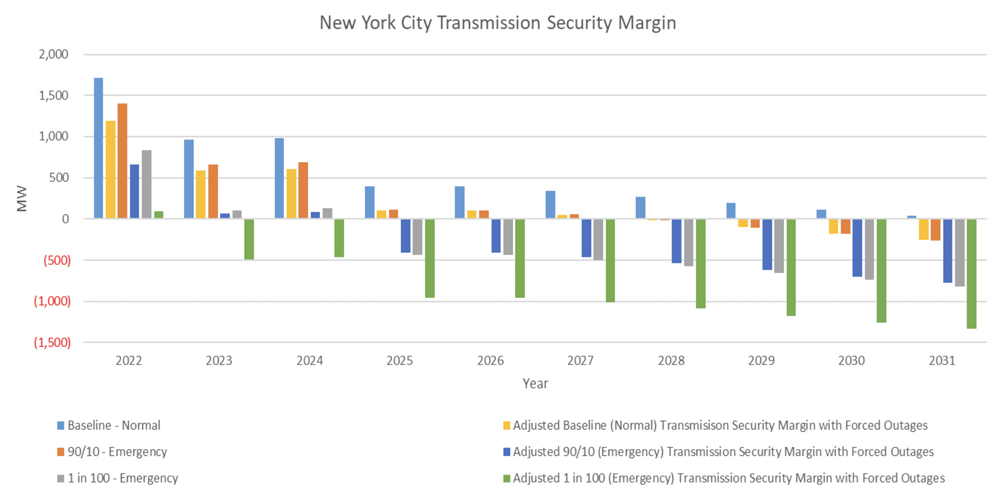
NYC transmission security margins are tight following peaker rule implementation, at 394 MW in 2025 and 115 MW in 2030. | NYISO
Phase 1 includes tariff changes for the proposed market design and will conclude with FERC acceptance; Phase 2 will discuss the procedures and details of capacity accreditation throughout 2022; and Phase 3 will focus on implementation of the capacity accreditation review.
NYISO intends to implement the updated capacity accreditation rules for the capability year that begins May 2024, said Michael DeSocio, director of market design.
In addition, assessment of financial risk of changes in future revenues is incorporated in the next demand curve reset process beginning in 2023.
The ISO is pursuing BSM reforms in time for the class year 2021 BSM evaluations. The class year study performs a detailed examination of the collective reliability impact of a group of projects, as well as a deliverability evaluation for requested capacity resource interconnection service and identifies and provides binding cost estimates for required upgrades.
2021-2030 Comprehensive Reliability Plan
The Management Committee unanimously recommended the board approve the 2021-2030 Comprehensive Reliability Plan (CRP) as presented by NYISO staff.
The ISO prepares a CRP in alternating years with the reliability needs assessment (RNA). Key updates to last year’s RNA include one to the load forecast — specifically a decrease in the Zone J peak load forecast by as much as 392 MW by 2030, said Kevin DePugh, senior manager of reliability planning.
Con Edison provided local transmission plan updates, including new 345/138 kV PAR-controlled 138 kV feeders for Rainey-Corona, Gowanus-Greenwood and Goethals–Fox Hills. A short-term reliability process solution for addressing a need arising in 2023 included changes to series reactor statuses from summer 2023 through 2030, DePugh said.
“In Zone J we actually had reliability violations until we did the updates, but that’s where we’re close to the margin right now,” DePugh said.
One stakeholder said the CRP report would look much different if it considered the more than 2,500 MW of solar, wind and hydro planned to be brought into New York City.
The state in September selected two transmission line projects to help decarbonize power in New York City, the 1,300 MW Clean Path New York project and the 1,250 MW Champlain Hudson Power Express project, from among seven projects submitted to the Clean Energy Standard Tier 4 solicitation issued in January. (See Two Transmission Projects Selected to Bring Low-carbon Power to NYC .)
“There are resources that we’re not accounting for here because they haven’t met our inclusion rules yet,” said Zachary Smith, the ISO’s vice president of system and resource planning. “There are some that could have a very positive impact, and that’s in the report itself. A lot of the conversation is around that there are a lot of unknowns, and in our opinion the unknowns tip more towards concern than optimism.”
The ISO added a “Road to 2040” section to the CRP to give long-term consideration to generation and transmission issues, DePugh said.
For generation, the study concluded that a grid with significant amounts of intermittent resources will need significant amounts of emissions-free, dispatchable resources that can run for multiple day periods, and that such resources are not yet available or currently in the NYISO interconnection queue.
In addition, more inter- and intra-zonal transmission capacity will be required to deliver a reliable system with a high level of renewables penetration. Transmission additions would not reduce the amount of dispatchable resource capacity but would decrease the volume of energy needed from them, the report said.
MMU Recommendations
The ISO’s Market Monitoring Unit, Potomac Economics, issued a memo on the CRP and presented its findings that NYISO’s markets “are well-designed and generally provide efficient investment signals,” but have room for improvement.
The first of three main recommendations concerns the locational signals provided in the capacity market.
“There are four zones in the capacity market, but naturally the details of the power system are more granular than that, so from time to time there are reliability issues at a smaller level,” said Pallas LeeVanSchaick of Potomac Economics.
To address possibly misleading market signals resulting from transmission constraints between Staten Island and New York City, for example, or between Zones G and H, the monitor recommends implementing capacity locational marginal pricing (C-LMP) to accurately reflect resource adequacy value at each location.
Other recommendations include implementing marginal capacity accreditation for all resource types; using reasonable assumptions for all resource types in transmission security analyses; and considering discounting capacity payments to resources that do not help address transmission security needs.
Asked by one stakeholder what the ISO thinks of C-LMP, Dewey said, “We’ve got concerns about how heavy a lift that is or how radical a change that is, and it just hasn’t bubbled up to meet the criteria of us thinking it’s a good idea moving forward based on the benefits.”
C-LMP is part of the set of recommendations that NYISO is considering and, while not specifically on the list for next year, it is something that the organization will include in the prioritization process going forward, Dewey said.