Search
April 18, 2026

PUC Spins its Wheels on New ERCOT Market Design

The clock continues to tick on the Texas Public Utility Commission’s self-imposed December deadline for the ERCOT market redesign, with the regulators no closer to consensus than they were during their last design work session.

During the PUC’s fifth work session on a new market design Thursday, PUC Chair Peter Lake again brought up a load-serving entity obligation as a means to provide firm dispatchable generation in a market flush with renewable resources. Again, he faced pushback from the other three commissioners concerned over the mechanism’s effect on ERCOT’s “crown jewel” of a retail market. (See Texas PUC Nears Market Redesign’s Finish Line.)

Lori Cobos, who was CEO of the consumer-oriented Office of Public Utility Counsel before being appointed to the PUC, reminded the commission that ERCOT’s market was deregulated more than 20 years ago to take investment risk away from consumers served by regulated utilities and place it on investors.

Peter-Lake-(Texas-PUC)-FI.jpgPUC Chair Peter Lake | Texas PUC

“I feel that we’re taking that risk and putting it right back on the consumers and steering away from the reliability principles of [the 1999 legislation],” she said. “We must be vigilant and ensure we’re not weakening the market and putting the risk back on consumers. I continue to believe we need to move in a strategic, targeted manner while we take the time to thoughtfully, deliberatively, holistically evaluate all long-term options that must be fully evaluated and considered before pulling the trigger.”

“I’m trigger happy. The grid is demanding we be trigger happy,” said Lake, who often refers to legislation passed earlier this year in the wake of February’s Winter Storm Uri and the compliance burden it places on the PUC.

The LSE obligation addresses resource adequacy concerns by introducing a formal reliability standard and a mechanism to ensure sufficient resources meet this standard. (See Study Suggests Texas LSEs Can Provide Reliability.)

In an October memo, Lake suggested parameters for the LSEs’ obligation. They would need to have firm resources to meet 50% of their forecast net peak load three years out, 70% two years out, 90% one year out and 100% one month out.

“I’m worried about suppressing the animal spirits of the real-time market,” Commissioner Will McAdams said, calling for market flexibility to price-responsive behavior.

“We’ve been asking for ideas and gotten a very narrow scope of ideas,” Lake said. “An LSE obligation is not a risk on consumers; it’s a risk on companies that have promised to provide power to those consumers. Those retail companies also have investors. In no way would an LSE obligation move risk to consumers.”

To back up his point, Lake recounted a recent meeting he had with a retailer, who said “we don’t provide power; we sell things,” Lake said. “Which is not, in my mind, providing reliable power to our consumers or businesses.”

“I have no problem adding some risk [on LSEs],” he said.

Capacity Market in Disguise

Attorney Catherine Webking, general counsel for the electric retailer lobbying group Texas Energy Association for Marketers, said her constituents have “very grave concerns” about the LSE obligation’s capacity requirements.

“That’s not to say that [retail electric providers] don’t hedge and buy firm power … they do, today,” she said. “It still looks to the LSE to demonstrate a capacity procurement, specific to a physical resource, which is not how it’s done today.”

Webking said that qualified scheduling entities (QSEs) procure resources on behalf of the retail electric providers (REPs) in ERCOT’s market.

“Ultimately, a physical obligation is there, but the individual REP does not necessarily have to demonstrate which unit and which megawatts at that resource are being procured,” she said. “As I understand the proposal, the LSE would have to say I understand these physical resources are where I’m buying power. It’s still tied to physical generation and physical capacity of that unit. There’s no revenue stream with that forward capacity purchase.”

Independent consultant Alison Silverstein, who advocates for demand response and energy efficiency measures, said the LSE obligation “looks pretty much like a capacity market” in disguise.

“It also requires both the commission and ERCOT do a significantly better job of planning and forecasting than either of them have shown the capability of doing to date,” she said.

Stoic Energy’s Doug Lewin, who has been live tweeting the PUC’s recent work sessions, lamented other solutions that have been sidelined in favor of the LSE obligation’s discussion.

“They’ve spent so much time talking about the [LSE obligation], which won’t make a difference for a couple of years anyway,” he told RTO Insider. “They could have implemented some of the other things that could have been implemented much faster, like demand response and targeted energy efficiency.”

In drawing the discussion to a close, Lake said, “It’s clear we still have a lot of work to do.”

He asked the commissioners to “put pen to paper” before the next work session and provide their thoughts on firming mechanisms, a reliability adder, and other market changes.

The PUC delayed decisions on revisions to the operating reserve demand curve and other changes until The Brattle Group completes an assessment of alternative ORDCs. An overview of the study dropped Friday.

Brattle suggested a $10/MWh adder to cover start-up costs of marginal resources could be imposed around 5,550 to 5,800 of online reserves to encourage self-commits and reduce the need for reliability unit commitments.

The commission tabled a rulemaking that will lower the high system-wide offer cap (HCAP) from its current $9,000/MWh to $4,500/MWh to time its publication with changes to the ORDC. The HCAP was dropped to $2,000/MWh after February’s winter storm and is set by rule to revert back to $9,000/MWh on Jan. 1 (52631).
PJM Operating Committee Briefs: Nov. 4, 2021

Stakeholders at last week’s Operating Committee meeting endorsed a PJM proposal seeking to improve the deployment of synchronized reserves during a spin event.

The proposal, which was developed from discussions in the Synchronized Reserve Deployment Task Force (SRDTF), was endorsed with 164 members voting in favor (72%). PJM first presented the proposal at last month’s OC meeting. (See “Synchronous Reserve Deployment Initiative,” PJM Operating Committee Briefs: Oct. 7, 2021.)

Ilyana Dropkin, an engineer in PJM’s performance compliance department, provided a review of the task force initiative endorsed at the March OC meeting. Stakeholders were educated about synchronized reserves and created a matrix to develop proposals through the task force. (See PJM OC Endorses Synchronized Reserve Discussion.)

Synchronized reserve events are emergency procedures triggered by PJM to maintain grid reliability in accordance with NERC’s Resource and Demand Balancing (BAL) standards. PJM invokes those procedures under conditions such as the simultaneous loss of multiple generating units or a sudden influx of load.

The SRDTF examined ways to secure controlled deployment of synchronized reserves throughout emergency events by using tools such as real-time security-constrained economic dispatch (RT SCED) to maintain consistent pricing and dispatch signals. The goal was to ensure BAL compliance during the recovery process and maintain a reliable transition in and out of emergency events and to define clear rules and expectations that address how PJM operators approve RT SCED cases around a synchronized reserve event.

The task force developed two different proposals: PJM’s intelligent reserve deployment (IRD) proposal, and another by the Independent Market Monitor. In a nonbinding poll taken by stakeholders, PJM’s proposal received 75% support, while the IMM’s received 9% support. Sixteen percent of stakeholders preferred the status quo.

Michael Zhang, senior lead engineer in PJM’s markets coordination department, reviewed the PJM proposal. Zhang said no changes were made to the proposal since it was first presented at the October OC meeting.

The IRD proposal is a SCED case that simulates the loss of the largest generation contingency on the system and for which approval of the case will trigger a spin event, Zhang said.

The PJM proposal calls for taking the megawatts of the largest generation contingency and adding them to the RTO forecast to simulate the unit loss, Zhang said. PJM would then be allowed to flip condensers and other inflexible synchronized resources cleared for reserves to energy megawatts and procure additional reserves to meet the next largest contingency.

Zhang said some of the significant changes over the status quo in the proposal include updating the economic basepoints to replace all-call instructions and having active constraints controlled by IRD so that deployed resources don’t have negative impacts on the constraints.

PJM is looking to conduct a phased approach of IRD with the initial phase of 6 to 12 months beginning in early 2022, Zhang said, possibly by March. The RTO will reconvene the SRDTF toward the conclusion of the initial phase to review performance metrics, solicit stakeholder feedback and adjust and finalize deployment approach and adapt to market changes.

“IRD is production ready,” Zhang said. “It’s been designed to be highly flexible and customizable so we can make changes on the fly as needed.”

Siva Josyula of Monitoring Analytics asked what changes could be made “on the fly” by PJM.

Zhang said one of the major changes is the use of the largest contingency, which was a major focus of the effort. Zhang said the development of using the largest contingency was driven by fears of both over- and under-deployment of resources.

Josyula reviewed the IMM proposal, saying the concept was to ensure reserves are deployed in proportion to the cause of the spin event. He said the resources deployed during a spin event would be those that clear and are being compensated for providing synchronized reserves.

The proposal called for using a reserve deployment tool that generates new dispatch signals, and the total megawatts to deploy would be equal to those lost or required for area control error recovery.

Stakeholders voted down the IMM proposal, with 159 votes against (76%).

Brock Ondayko of AEP Energy questioned the effectiveness of both the PJM and IMM proposals, saying it wasn’t clear what problems they solve. Ondayko said units will be forced into a market system that “doesn’t model things correctly” and that will ultimately have ramifications for other market products and systems, opening a “pandora’s box” of issues.

“You’re trying to fix a problem with solutions that don’t address the main issue while you’re trying to force people to update things in a system that’s not adequate for updating,” Ondayko said.

The PJM proposal will go on to the Nov. 17 Markets and Reliability Committee meeting for a first read and a final endorsement vote at the January Members Committee meeting.

Day-ahead Schedule Reserve Endorsed

Members unanimously endorsed changes to the 2022 Day-ahead Scheduling Reserve (DASR) requirement.

David Kimmel, senior engineer in PJM’s performance compliance department, reviewed the proposed changes to the DASR requirement, which is the sum of the requirements for all zones within the RTO and any additional reserves scheduled in response to a weather alert or other conservative operations. (See “Day-ahead Schedule Reserve (DASR),” PJM Operating Committee Briefs: Oct. 7, 2021.)

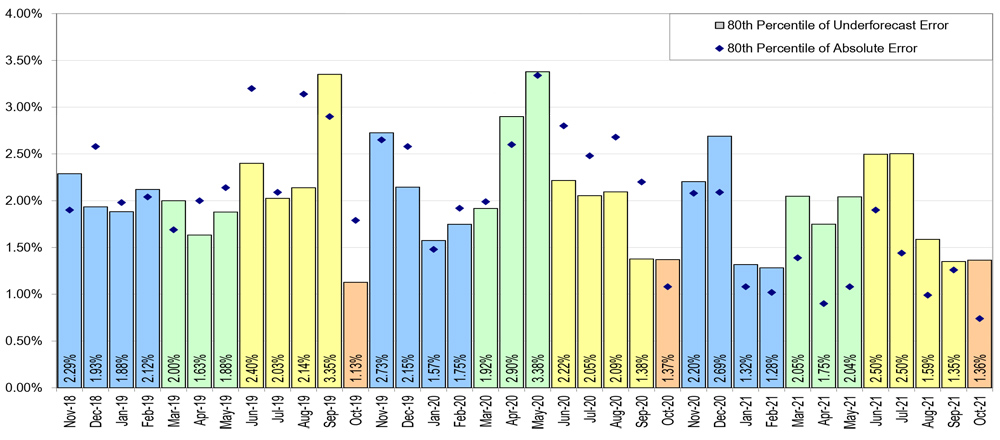
Under-forecasts-of-load-forecast-error-(PJM)-Content.jpgPJM chart of under-forecasts of load forecast error from November 2018 to the present. | PJM

DASR is the sum of the three-year averages of both the under-forecasted load forecast error (LFE) and eDART forced outage rate component.

The final endorsed 2022 DASR requirement was 4.43%, Kimmel said, slightly lower than the 2021 requirement of 4.78%. Kimmel said the number comes from the LFE component of 2.04%, which is down 0.14% from last year, and the forced outage component of 2.39%, down 0.21%.

The value is incorporated into Manual 13 changes and effective through Sept. 30, 2022, after which it will be replaced with the day-ahead secondary reserves. Kimmel said the change is dependent on FERC’s review and action on reserve price formation and PJM’s operating reserve demand curve (ORDC).

Manual Changes Endorsed

Several manual updates were unanimously endorsed. They included:

  • Manual 14D — Vince Stefanowicz, senior lead engineer with PJM’s generation department, reviewed updates to Manual 14D: Generator Operational Requirements as a part of the periodic review. The updates featured the addition of several new sections, including one describing eDART modeling requirements.
  • Manual 10 — Stefanowicz also reviewed updates to Manual 10: Pre-Scheduling Operations as a part of the periodic review. The updates resulted from FERC’s approval of changes to black start unit testing.
  • Manual 3 — Dean Manno of PJM’s transmissions operations department reviewed updates to Manual 3: Transmission Operations as a part of the periodic review. Updates included minor changes such as removing a reference to NERC standard PRC-001 because of its retirement.
  • Manual 13 — Brian Oakes of PJM’s dispatch department reviewed updates to Manual 13: Emergency Operations as part of the periodic review. Updates include notes to articulate the expectations of members’ load shed plans.

The manual changes will be voted on at the November MRC.

FERC Levies $242M in Fines on GreenHat, Owners

FERC on Friday said it had determined that GreenHat Energy and its owners violated the Federal Power Act by “engaging in a manipulative scheme” in PJM’s financial transmission rights market, issuing a total of $242 million in fines for the company’s 890 million MWh default in 2018 (IN18-9).

The commission assessed civil penalties of $179 million on the company and $25 million each on owners John Bartholomew and Kevin Ziegenhorn. FERC also directed GreenHat, Bartholomew, Ziegenhorn and the estate of Andrew Kittell to disgorge more than $13 million in unjust profits, plus applicable interest.

GreenHat acquired the largest FTR portfolio in PJM between 2015 and 2018 but defaulted on the portfolio in June 2018, leaving PJM stakeholders to cover more than $179 million in the market to the present. When the company defaulted, FERC said, GreenHat had only $559,447 in collateral on deposit with PJM. (See Doubling Down — with Other People’s Money.)

<img src=”//www.rtoinsider.com/wp-content/uploads/2023/06/140620231686783648.jpeg” data-first-key=”caption” data-second-key=”credit” data-caption=”

GreenHat’s significant growth in exposure and MTA loss

” data-credit=”PJM” style=”display: block; float: none; vertical-align: top; margin: 5px auto; text-align: center;” alt=”GreenHats-significant-growth-in-exposure-and-MTA-loss-PJM-Content-2-1″>GreenHat’s significant growth in exposure and MTA loss | PJM

“Respondents, over several years, deliberately carried out one of the largest frauds in the history of organized energy markets, leading to the largest default in the history of those markets, resulting in losses of more than $179 million,” FERC said in its ruling. “Staff notes that Bartholomew and Ziegenhorn showed no commitment to compliance, did not self-report their violations and provided limited cooperation.”

FERC Findings

The commission found that GreenHat and its owners violated the FPA in four different ways, calling it a “classic fraud,” similar to a “bust-out” scheme involving selling assets that one does not intend to pay for. The violations cited by the commission included:

  • engaging in a manipulative scheme in PJM’s FTR market to acquire a portfolio made up of primarily long-term FTRs with “virtually no supporting, upfront capital, planning not to pay for losses at settlement” and selling profitable FTRs to third parties at a discount to obtain cash for the owners;
  • buying FTRs not based on market considerations but to accumulate as many FTRs as possible “with minimal collateral, thereby engaging in a course of conduct for the purpose of impairing, obstructing or defeating a well functioning market”;
  • making false statements to PJM concerning money supposedly owed by Shell Energy North America with the intent to convince the RTO not to proceed with a planned margin call; and
  • submitting inflated bids into the PJM long-term FTR auction to “artificially raise the clearing price” of FTRs that Shell had purchased from GreenHat and offered for sale in the auction.

FERC said the Office of Enforcement found documents showing GreenHat’s “continued reliance” on the PJM Credit Calculator, instead of “traditional market fundamentals,” to purchase FTRs “despite multiple indications that such strategy was resulting in an increasingly negative portfolio for the firm.” The office said the owners failed to provide any “reasonable economic rationale” for using the calculator.

The commission said staff also discovered emails during the investigation “demonstrating that GreenHat sought to sell its profitable FTRs to third parties using other valuation methodologies” rather than the calculator, while “continuing to grow its negative portfolio using the PJM Credit Calculator.”

“Respondents intentionally misled PJM to enable GreenHat to buy FTRs that it otherwise would not have been able to afford to buy and extract profits from the PJM FTR market with the intent to default on their portfolio losses,” FERC said.

Kittell Estate

The decision is slightly complicated by an ongoing investigation by the Department of Energy’s Office of the Inspector General (OIG) into an email exchange between FERC Enforcement’s Division of Investigations (DOI) lawyers Thomas Olson and Steven Tabackman regarding the GreenHat case. FERC released the emails in October after Olson, who is part of the litigation staff in the GreenHat proceeding, disclosed them to Enforcement management.

The estate of Kittell, who killed himself by jumping off the San Diego-Coronado Bridge in California on Jan. 6, made a filing for FERC to drop its enforcement action and investigate the two employees. (See Estate of GreenHat’s Kittell Lobbies FERC to End Enforcement Action.)

The commission said the email exchange between Olson and Tabackman “addressed procedural matters that might arise under California probate law” in a proceeding addressing the Kittell estate, but it was not a conversation about the “issue currently before the commission in this proceeding.”

FERC said with the OIG investigating the matter, it was not ruling on the Kittell estate motion “at this time” and will instead “address the merits of the motion” in a separate order once the OIG rules on the case.

Danly Dissent

Danly dissented from the views of the commission, saying, “Enforcement failed to provide the proof necessary to meet its burden.”

Having reviewed GreenHat’s answer and Enforcement’s reply, Danly said he remained “deeply skeptical” of GreenHat’s explanations, but he said his skepticism is “irrelevant.” He said it was not necessary for GreenHat to prove its innocence, but it was for Enforcement to “prove its case to a preponderance of the evidence.”

Danly had harsh words for PJM, saying the RTO was partially to blame for the result of the default.

“While not the subject of the instant proceeding, we would do well to keep in mind the share of the blame that must rightly be assigned to PJM,” Danly said.

FERC Accepts Tri-State’s Exit Fee Calculation

Tri-State Generation and Transmission may finally have in place exit procedures for members leaving the cooperative, but regulatory roadblocks remain for the contract termination payment (CTP) methodology.

FERC issued an order Oct. 29 accepting the co-op’s proposed methodology effective Nov. 1, subject to refund, and rejecting nearly a dozen protests from members. However, the commission said its preliminary analysis indicates that the methodology has not been shown to be just and reasonable and established hearing procedures to address issues not in the record (ER21-2818).

The commission also opened a Federal Power Act Section 206 proceeding so it can establish a just and reasonable CTP-calculation methodology and just-and-reasonable procedures for Tri-State’s utility members to obtain the CTPs and withdraw in an orderly manner. It encouraged the hearing’s presiding judge to expedite the hearing where feasible “to facilitate the … resolution of these longstanding disputes.”

Tri-State’s first CTP methodology filing was submitted in April 2020. FERC accepted it subject to refund but also established hearing and settlement judge procedures. The process was repeated several times as the co-op filed policies and other calculation methods in response to member protests.

In May, FERC rejected the CTP methodology without prejudice, leading to Tri-State’s latest filing in September. Many of the complaints centered on members being able to see the calculations. (See FERC Rejects Tri-State Exit Fee Proposal.)

FERC said Tri-State’s newly proposed procedures allowing members’ access to the modified CTP methodology “appear to satisfy a number of the commission’s concerns.” The co-op proposed providing CTP calculations annually to all utility members at no charge by April 1, whether or not the member intended to withdraw from Tri-State.

Members seeking to terminate their wholesale electric service contracts (WESCs) and co-op membership must provide a two-year advance notice of their intention and pay its CTP to Tri-State on the withdrawal date.

“These procedures are clear and transparent,” the commission wrote.

FERC, however, disagreed with Tri-State’s claims that a CTP methodology must be based on a lost-revenues approach to be just and reasonable. It also said it shared protesters’ concerns that additional mitigation efforts could be used to decrease revenues that the co-op would otherwise be losing upon a member’s exit.

<img src="//www.rtoinsider.com/wp-content/uploads/2023/06/140620231686783650.jpeg" data-first-key="caption" data-second-key="credit" data-caption="

Tri-State CEO Duane Highley

” data-credit=”SPP” style=”display: block; float: none; vertical-align: top; margin: 5px auto; text-align: right; width: 200px;” alt=”Highley-Duane-SPP-Content” align=”right”>Tri-State CEO Duane Highley | SPP

“While we disagree with some of the positions being taken by select parties, we appreciate FERC providing the opportunity for broader participation by all interested members in the case,” Tri-State CEO Duane Highley said in a statement last week. “We welcome the continued engagement of our membership, and we will continue to work to ensure that all members, large or small, have a voice that is heard on these important matters.”

The co-op said the modified CTP tariff ensures remaining members are held harmless if another member decides to terminate its contract early and includes “clear, transparent and objective procedures.”

“At the same time, we are mindful of the questions and concerns expressed by the commission … and will do our best to address them through the hearing process,” Tri-State said.

Tri-State has 45 members, including 42 utility distribution cooperatives and public power district members in four states that supply power to more than 1 million electricity consumers across nearly 200,000 square miles of the West.

Overheard at ACORE Grid Forum 2021

The American Council on Renewable Energy held its annual Grid Forum over two days last week. As was the case last year, it was a completely virtual event because of the ongoing COVID-19 pandemic.

The first day of the event, Wednesday, focused on infrastructure policy, transmission planning and energy markets, while Thursday featured discussions on the Biden administration’s agenda.

RTO Insider had coverage of much of the first day last week. (See related stories, Castor: House Democrats ‘100% United’ on Clean Energy Transition and DERs and Clean, Firm Power Needed to Decarbonize Grid.) Here’s more of what we heard.

Christie: Tech Outpacing Regulatory Structures

FERC Commissioner Mark Christie on Wednesday compared the transition to clean resources in the electricity industry to the transition to mobile devices in telecommunications.

The former chair of the Virginia State Corporation Commission, Christie also taught regulatory law at the University of Virginia School of Law. Every year he would ask his students how many of them had a land-line telephone, and every year fewer of them would raise their hands, until the last couple of years, during which not one hand would go up.

But the very last year he taught, one student did raise their hand.

Mark-Christie-(ACORE)-Content.jpgFERC Commissioner Mark Christie | ACORE

“‘So you have a land line?’” Christie said he asked. “And the student said, ‘Well, what is a land line?’”

Regulating the telephone industry is very similar to regulating electric utilities, going by Christie’s description: Smaller companies would file complaints against the incumbent utilities because they were not interconnecting their services. Meanwhile, the utilities need to file rate cases with the state commission for approval.

By the end of his career at the SCC, however, the commission had not reviewed a telephone utility’s rate case in years. “The law hadn’t changed; the technology had changed,” he said. “Wireless technology eliminated” the natural, networked monopolies held by telephone utilities. “And it didn’t happen because of smart regulators. It happened because smart engineers in a lab figured out how to transmit [voice data] wirelessly on a mass scale at a cost that consumers could afford.”

Distributed energy resources — particularly battery storage combined with rooftop solar — could do the same thing in the electricity space. Disputes over net metering rates would “all go away,” Christie said.

“These are the kinds of technologies [that] I’m really optimistic will be transformative. And the challenge is to make sure the regulatory structures are either not behind or not ahead but try to get a rational connection to this transformational technology that I know we’re going to see.”

ANOPR

Rob Gramlich, president of Grid Strategies, moderated a panel on FERC’s Advance Notice of Proposed Rulemaking on transmission planning.

The panelists reiterated a consensus among many commenters in the ANOPR docket that transmission planning in the U.S. is reactive to generator interconnection requests, the queues for which are backlogged because transmission construction is not keeping up. The ANOPR presents an opportunity for FERC to create a forward-looking approach, they said. (See Transmission Industry Hoping for Landmark Order(s) out of FERC ANOPR.)

“We’re not really planning for the future now, which sort of raises [the question of] why do we even call it transmission ‘planning’ if it’s not about the future generation,” Gramlich said.

He asked Danielle Fidler, senior attorney with Earthjustice, how she would respond if the D.C. Circuit Court of Appeals questions FERC’s authority “to require these plans and allocate these costs so broadly” under a potential final rule. “Where does that come from?”

“Congress in 1935,” Fidler responded laughing. “The Federal Power Act gives FERC really broad authority … and not just authority but obligation to regulate the transmission system. … So in our view, FERC not only should act; it must act.”

An attendee asked about the timeline of the proceeding, specifically whether the commission would wait for the findings of a joint task force with the National Association of Regulatory Utility Commissioners.

Elizabeth Salerno, FERC’s lead for transmission and technology initiatives, could not say when the commission would act, but she did say that “there’s a sense of urgency to start chipping away at the block. The scope of the ANOPR is huge. I think it’s possible we can’t solve all this in one go. There is a consideration of [if we] try to break these up into pieces and tackle them in a logical order. I’m not sure that’s how we’ll go, but I think that option is on the table.”

Gramlich concluded the panel by speaking to the high expectations of the transmission industry for the proceeding. “I spent a couple years of my life on another major rulemaking that never got finalized, so the last thing I want is for all this work to go in” and nothing to come out of it, he said.

Western RTO, SEEM Face Headwinds

A panel Wednesday devoted to the expansion of wholesale markets in the West and the Southeast shared their thoughts on the possibility of future RTOs but had few answers.

Consultant Rebecca Wagner, a former member of the Nevada Public Utilities Commission, noted the alphabet soup of Western markets and organizations, including CAISO’s EIM and proposed EDAM, SPP’s WEIS market and RTO West, the Northwest Power Pool’s WRAP and the Western Markets Exploratory Group (WMEG). (See Western Utilities to Explore Market Options.)

“There’s always something going on in the West,” she said. “There’s a lot of places to plug in to.”

Rebecca-Wagner-(ACORE)-Content.jpgRebecca Wagner, Wagner Consultants | ACORE

Wagner said she hopes that, given Western states’ climate and clean-energy policies, a clean, reliable and affordable grid of the future can be built that unlocks resource diversity and maximizes customer benefits.

“There’s a lot of movement. I’m not sure how it’s going to shake out,” she said.

Colorado Public Utilities Commission Chair Eric Blank said an incremental approach makes the most sense for his state in the near term. The legislature has directed the state’s utilities to join an RTO by 2030 — similar to Nevada legislation — and a regulatory study found that participation in a regional market could yield a 5% cost reduction off $6 billion in revenues, or about $300 million a year, he said.

“There are significant unresolved concerns with RTOs: struggles to ration rare interconnects for resources; fights over cost allocation limiting new transmission; challenging governance structures,” Blank said, pointing to SPP’s four-year backlog in its generator interconnection queue. “For us, we need to see either CAISO’s governance improve or SPP solve its interconnection and cost allocation problems.”

Eric-Blank-(ACORE)-Content.jpgColorado PUC Chair Eric Blank | ACORE

The Southern Alliance for Clean Energy’s Maggie Shober said her organization has issues with the proposed Southeast Energy Exchange Market agreement, which went into effect after FERC deadlocked over its approval. (See SEEM to Move Ahead, Minus FERC Approval.)

She said SEEM is “closer to a bilateral market than anything else,” lacks transparency and is not open to independent power producers.

“It’s being pitched as a software upgrade, rather than physically calling people on the phone,” she said. “It’s not a stepping-stone to competition like we’re seeing in Nevada and Colorado.”

In a report on market design and the Southeast, ACORE said, “Absent many traditional market benefits, SEEM is not necessarily a step toward a wholesale power market, but its introduction provides a helpful lens through which to assess energy market design and the Southeast.”

Biden’s Agenda

On Thursday, Kelly Speakes-Backman, principal deputy assistant secretary for the U.S. Department of Energy’s Office of Energy Efficiency and Renewable Energy (EERE) spoke with ACORE CEO Gregory Wetstone about the Biden administration’s clean energy goals.

Kelly-Speakes-Backman-(ACORE)-Content.jpgKelly Speakes-Backman, DOE | ACORE

Speakes-Backman, previously CEO of the Energy Storage Association, oversees her office’s $2.8 billion portfolio of research and development, demonstration and deployment activities in energy efficiency, renewable energy, and sustainable transportation.

“We’re focused on supporting President Biden’s clean energy goals of … achieving a carbon-free electric sector by 2035 and [a] clean-energy economy with net-zero emissions no later than 2050. …

“President Biden placed this particular goal at the center of his agenda, and we know that we are kind of the tip of the spear, if you will, for that. So in order to really sort of support that, in driving research and development, but even more so the demonstration and the deployment of these technologies, we’re really underscoring the fact that this is going to create jobs and economic opportunity. Yes, the climate crisis is an enormous challenge. … But we also see this as a huge opportunity to create millions of good-paying, middle-class jobs, to ensure that there’s clean, affordable, reliable energy options for all Americans.”

Environmental Justice

Thursday’s first panel, “Centering Environmental Justice in the 21st Century Grid,” dealt with the impact of grid investments on low- and moderate-income communities.

Yvonne-McIntyre-(ACORE)-Content.jpgYvonne McIntyre, NRDC | ACORE

Yvonne McIntyre, director of federal electricity and utility policy for the Natural Resource Defense Council, moderated a panel that included Jahi Wise, senior adviser for climate policy and finance in the White House Office of Domestic Climate Policy.

McIntyre asked Wise about Biden’s executive orders to implement his Justice40 Initiative, intended to ensure federal agencies work with state and local governments to “make good on President Biden’s promise to deliver at least 40% of the overall benefits from federal investments in climate and clean energy to disadvantaged communities,” according to the White House.

“It’s historic in its scope and scale and trying to orient the federal government around equitable investment in climate and clean energy infrastructure,” Wise said. “Folks who are in this space for a while know that’s not the way that things have historically gone, so the intentionality there is unprecedented.”

Jahi-Wise-(ACORE)-Content.jpgJahi Wise, The White House | ACORE

About 20 federal government programs are covered by the initiative, he said, “and right now those programs are working through their stakeholder engagement plan, their initial implementation and kind of paving the way for the rest of the federal government to begin this investment process. And so we expect in the next few months to see even more programs join that cohort but also more from the initial set of programs.”

He said that Biden “directed a number of White House components and agencies to put out environmental justice scorecards, and so those scorecards are supposed to be like our first accounting of whether or not we’re actually meeting our targets on environmental justice as a component of climate policy. And that will look at everything from Justice40 to the different environmental justice offices at the agencies. So there’s kind of a really robust, whole-of-government effort on this topic.”

California PUC Applies New Safety Metrics to PG&E

The California Public Utilities Commission adopted criteria Thursday allowing it to hold Pacific Gas and Electric (NYSE:PCG) more accountable for starting wildfires or undermining reliability with public safety power shutoffs.

PG&E’s failure to meet the 32 new safety and operational metrics can serve as triggering events in the CPUC’s enhanced oversight and enforcement process. Established as a condition of the utility’s bankruptcy reorganization last year, the six-step process involves increasing oversight and penalties, potentially culminating in the revocation of PG&E’s operating license.

“Each step is triggered by a specific finding or specific events, and the triggering mechanisms include a failure to make specific, sufficient progress on the metrics that we’re adopting today,” Commissioner Clifford Rechtschaffen said of the plan. “It’s a very important part of making sure that we can implement this unique six-step enforcement framework, which we think is very important to holding PG&E accountable.”

PG&E is currently in the first step of the process for failing to prioritize vegetation management around power lines in high-risk fire areas. A tree falling on a PG&E line is suspected of this summer’s immense Dixie Fire. (See CPUC Applies Stricter Oversight to PG&E.)

In August, CPUC President Marybel Batjer warned PG&E it could face additional oversight.

“I have directed California Public Utilities Commission staff to conduct a fact-finding review regarding a pattern of self-reported missed inspections and other self-reported safety incidents to determine whether a recommendation to advance [PG&E] further within the [CPUC’s] enhanced oversight and enforcement process is warranted,” Batjer said in a letter to PG&E CEO Patti Poppe. (See CPUC, Judge Pressure PG&E to Clear High-Risk Lines.)

The new and updated metrics adopted Thursday include injuries and deaths among members of the public caused by PG&E operations, the frequency and duration of unplanned outages, and the number of fire ignitions in high-risk fire areas.

Another factor is the impact on reliability of PG&E’s public safety power shutoffs (PSPS). The intentional blackouts are meant to prevent fires, but PG&E has been criticized recently for using PSPS too often and without warning customers. (See PG&E Expects $1B in Costs from Dixie Fire.)

Starting in March, PG&E must file reports every six months with the CPUC that include data for each metric, a description of progress toward its safety targets and proposed methods for remedying deficiencies.

The measures are part of the CPUC’s Safety Model Assessment Proceeding (S-MAP), a means of applying risk-based, outcome-driven criteria to large investor-owned utilities through their general rate cases. The CPUC on Thursday added metrics for Southern California Edison, San Diego Gas & Electric and Southern California Gas to consider when investing in infrastructure and operations.

“Transparent, risk-based investment decision-making approaches better inform the CPUC and interested parties in evaluating how energy utilities assess, manage, mitigate and minimize safety risks,” the commission said in a statement.

FirstEnergy Announces $3.4 Billion in New Equity Financing

FirstEnergy (NYSE:FE) on Sunday announced $3.4 billion in new equity financing investments from two global investors that the company believes will position it for a long-term earnings-per-share growth rate of 6 to 8%.

The company announced that it will issue $1 billion in common equity to New York City-based Blackstone Infrastructure Partners (NYSE:BX) at $39.08/share and appoint a Blackstone representative to its board of directors no later than its next annual meeting.

FirstEnergy further announced that it had agreed to sell a 19.9% minority interest in its transmission subsidiary First Energy Transmission (FET) to Toronto-based Brookfield Super-Core Infrastructure Partners (NYSE:BAM) for $2.4 billion in cash.

FET is a holding company for FirstEnergy’s three FERC-regulated transmission subsidiaries that operate 24,000 miles of high-voltage power lines across six states. The sale of a minority interest in FET to raise cash has been under discussion for several months.

Under questioning from analysts at FirstEnergy’s third-quarter earnings call two weeks ago, CFO Jon Taylor described the interest in FET as “very strong, and preliminary indications are very supportive of our financial plan and targets.”

The sale, subject to FERC approval and review by the Committee on Foreign Investments in the U.S., is expected to close in the first half of 2022, FirstEnergy said.

The company believes the transactions will enhance its credit profile, which was recently returned to investment-grade, and provide enough cash to address all of its needs for new equity now and in the near future. The company is planning major grid upgrades.

In a statement accompanying the news of the equity sale and minority interest sale, FirstEnergy CEO Steven Strah called the two agreements “key catalysts to fulfill our long-term strategy and drive smart grid and clean energy initiatives for our customers and communities.”

Donald T. Misheff, non-executive chairman of FirstEnergy’s board, said, “The entire board, including our voting and non-voting members, unanimously supports these important actions.

“This represents a pivotal moment in the company’s trajectory and positions FirstEnergy to drive shareholder value.”

ERCOT Briefs: Week of Nov. 1, 2021

The Texas comptroller’s office said last week the financial fallout from February’s Winter Storm Uri could be as high as $130 billion, as earlier estimated by the Federal Reserve Bank of Dallas.

Texas Comptroller Glenn Hegar said in October’s Fiscal Notes report that the storm resulted in between $80 billion and $130 billion in financial losses to the state’s economy.

Glen-Hegar-(Texas-Comptroller)-FI.jpgGlen Hegar | Texas Comptroller

The Dallas Fed estimated the losses based on “a result of power loss, physical infrastructure damage and forgone economic opportunities.”

The storm knocked out power for nearly 70% percent of Texans and disrupted water utilities, leaving many Texans without heat or running water for extended periods. The state has also attributed 210 deaths to the storm.

“The exact impact on Texas energy customers is still difficult to discern,” the comptroller’s report said. “What we do know is that all major sources of energy in the state experienced failures.”

According to the report, the Texas A&M AgriLife Extension Service assessed agricultural losses at more than $608 million and ranchers’ economic losses at nearly $228 million. The service also estimated citrus farmers’ losses of at least $230 million.

500 MW to Depart Market

ERCOT will lose almost 500 MW of capacity if the cities of Austin and Garland suspend operations at two aging resources.

Austin Energy said last week it will retire its 44-year-old Decker Creek 2 natural gas-powered generator after the winter season. The utility said the unit has “aged past its useful life” and has become more expensive to operate. It submitted a notice of suspension of operations (NSO), effective March 31, 2022, to ERCOT on Nov. 1.

The Austin City Council in 2017 approved Decker 2’s retirement as part of a comprehensive resource plan and reaffirmed that decision in March 2020. The plant’s four 50-MW peaking gas turbines will continue to operate.

On Thursday, Garland Power & Light also filed an NSO notifying ERCOT that the utility will indefinitely suspend operations at a 78-MW gas turbine at its Ray Olinger power plant. The unit dates to 1967.

Market participants have until Nov. 29 to submit comments before the ISO makes a final decision on the NSOs.

Energy Groups Quick to Praise Infrastructure Bill Passage

The House of Representatives’ Friday night passage of the bipartisan Infrastructure Investment and Jobs Act (H.R. 3684) quickly set off a chorus of praise from clean energy groups and equally fervent calls for both of houses of Congress to finish the job by passing Democrats’ $1.75 trillion budget package, the Build Back Better budget bill.

Parsing the $1.2 trillion in the infrastructure bill, many of the groups zeroed in on the specific provisions and programs for which they had lobbied hard during negotiations in the House and Senate.

A statement from the Alliance to Save Energy (ASE), for example, included a fact sheet with a detailed listing of the bill’s energy efficiency provisions that it had supported, such as Section 40502’s allocation of $2.5 billion over five years for commercial and residential energy audits, with up to 25% going to low-income homeowners. Section 40503, also supported by the alliance, follows up with $40 million over five years for energy auditor training programs.

“While at times the Washington gridlock can feel insurmountable, [Friday’s] votes show that Congress still has the keys,” ASE President Paula Glover said. “This is a moment to celebrate: lawmakers saying ‘yes’ to a more efficient energy future, ‘yes’ to a more consumer-friendly energy system and ‘yes’ to a robust clean energy workforce.”

But Glover also pledged continued action on Build Back Better, to ensure “the final version fully recognizes that efficiency is the fastest, most cost-effective method to decarbonize our economy.” ASE is pushing for restoration of a tax credit to help homeowners pay for energy-efficiency upgrades, she said.

The final vote Friday was 228-206, with 13 Republicans joining all but six Democrats in support. The latter are progressives who had wanted a simultaneous vote on the budget. The trade-off to get the vote on the infrastructure bill was a subsequent procedural vote setting up the budget vote for mid-November, pending an analysis from the Congressional Budget Office that some moderate Democrats had held out for to ensure the bill is completely paid for.

Speaking on Saturday, Biden framed the infrastructure bill’s passage as a big step for the U.S. to deliver on its carbon reduction commitments made at the U.N.’s 26th Conference of the Parties (COP26) in Glasgow, Scotland, last week, and to assert its leadership in global clean energy markets.

“It will get America off the sidelines on manufacturing — manufacturing of solar panels, wind turbines, battery storage, energy and power for electric vehicles from school buses to automobiles,” he said.

Biden also noted he had not signed the bill immediately over the weekend because he wants to have the Democratic and Republican lawmakers who negotiated the package at the ceremony. It should occur “soon,” he said.

The top line figures for the bill, as reported by Axios’ Sarah Mucha and Andrew Solender, include $73 billion for grid infrastructure, and $7.5 for transportation electrification split evenly between EVs and chargers, low-emission buses and ferries.

A major portion of the bill’s spending covers more traditional infrastructure, for example, to fix the country’s aging roads and bridges ($110 billion), water infrastructure ($55 billion) and rail ($66 billion).

On the more nontraditional side, broadband gets $65 billion, while $47 billion in “resiliency” spending targets flooding, wildfires and coasts.

Getting ‘Steel Underwater’

While $73 billion in grid infrastructure spending looks impressive, Rob Gramlich, president of Grid Strategies, cautioned that the bill’s allocations for new transmission are considerably less, with most of the money going to upgrades and improvements on existing lines.

For new construction, the Department of Energy gets $2.5 billion to support new, non-federal transmission projects by entering into capacity contracts or providing loans to developers, according to Gramlich’s analysis of the bill. DOE’s Smart Grid Investment Matching Grant Program gets $3 billion, which can be used for the purchase and installation of grid-enhancing technologies.

Another key provision requires DOE to consider the integration of renewable energy resources and lower costs to consumers when designating transmission corridors of national interest. It also allows FERC to issue permits for construction or modification of certain interstate transmission facilities if a state commission denies or fails to process an application seeking approval for the siting of such transmission facilities.

The 30% transmission investment tax credit in the Build Back Better bill is probably going to be the main catalyst for new projects, Gramlich said. But he said the funding in the infrastructure bill is a strong signal to developers to begin planning for the buildout of transmission, including for offshore wind.

“With some of these loans and grants, we could go to … the states from Mid-Atlantic through New England and say, ‘Hey, you have 30 GW of offshore wind [planned], but nowhere near the transmission needed to collect it [and] bring it to shore. How about we use some of these new loans and grants?’” Gramlich said in a phone interview with RTO Insider. “We’ll pay for some of it through federal dollars if the states and RTOs can agree on allocating the rest of the costs.”

While getting to “steel underwater” might take a while, he said, the funding “might be the critical link needed to get everybody together to do what’s needed by the end of the decade.”

Urgency to Decarbonize

A sampling of other energy provisions in the 2,740-page bill includes:

  • $500 million through 2026 to help states develop energy conservation plans that incorporate transmission and distribution planning, as well as broad vehicle electrification to reduce carbon emissions in transportation sector.
  • $140 million for a demonstration project for the mining and refining of rare-earth minerals, using feedstock from mine wastes and drainage, and another $3 billion to be used for grants to support advanced battery manufacturing and recycling. This section also calls the departments of the Interior and Agriculture to work on streamlining permitting for the mining of rare-earth minerals on federal land.
  • more than $300 million through 2026 for grants to carbon-utilization projects, and another $100 million in the same time frame to support the design and development of carbon transport systems.
  • more than $3.2 billion for DOE’s advanced nuclear demonstration projects through 2027, and $6 billion, split over five years, to support continued operations at existing nuclear plants threatened with closure.

“As the urgency to decarbonize grows, the next generation of nuclear reactors is essential to reaching our ambitious climate goals,” said Maria Korsnick, president and CEO of the Nuclear Energy Institute. “Through continued support for nuclear energy innovation and funding of the Advanced Reactor Demonstration Program, Congress has signaled its commitment to accelerating the deployment of innovative reactor technologies over the next decade while bolstering U.S. technological leadership globally.”

Similarly, Madelyn Morrison, external affairs manager for the Carbon Capture Coalition, said the bill’s carbon capture provisions mark “a major step forward in fostering economywide deployment of carbon management technologies to achieve net-zero emissions by midcentury, while ensuring the long-term viability of key domestic industries and safeguarding high-wage jobs that sustain families and communities.”

The bill’s support for offshore wind is more indirect, according to Liz Burdock, CEO and president of the Business Network for Offshore Wind, pointing to its investments in the grid, ports and innovation research. But, Burdock said, “achieving the ambitious offshore wind goals set by the Biden administration requires accelerating the development of a local supply chain as explosive growth in global markets draws investors’ attention away from the American market.”

The next step is passage of Build Back Better, she said, “which includes mission-critical investments in U.S. manufacturing and component development, further port investment and expanded transmission funding. All elements are critical for the full deployment of offshore wind in the U.S.”

Despite the House vote on Friday setting up possible passage for mid-November, the budget bill must still navigate continued in-fighting among House Democrats and further trims and revisions by conservative Democrats in the Senate. But the Democrats’ electoral losses last week in Virginia and narrow gubernatorial victory in New Jersey have increased the pressure for action. (See related story, GOP Wins in Va. Raise Questions About State’s Climate Policy.)

Answering a reporter’s question Saturday on the elections, Biden said, “The one message that came across was: ‘Get something done. It’s time to get something done. You all stop talking. Get something done.’”

Dominion’s OSW Project to Cost $9.8B, up from $8B

Dominion Energy (NYSE:D) said Friday the projected cost of its 2.6-GW Coastal Virginia Offshore Wind (CVOW) project has increased by more than 20% to $9.8 billion, citing “commodity and general cost pressures.”

The company announced the projected cost increase on the day it reported a near doubling of third quarter profits and filed a request for approval and certification of the CVOW project with the Virginia State Corporation Commission.

In September 2019 Dominion announced a “pre-engineering” estimated cost of about $8 billion.

“Since that time through the process of detailed engineering and, most importantly, through competitive solicitations for all components and services, we’ve now developed a detailed budget of approximately $10 billion,” CEO Bob Blue told analysts during the third quarter earnings call. “The cost increase can be attributed to, among other things, commodity and general cost pressures — as seems to be the case across a number of industries right now — and the completion of the conceptual design phase for the onshore transmission route.”

Blue said the company has meet the three tests required for Dominion to qualify for cost recovery via a rider on customers’ bills: using competitive procurements; a projected levelized cost of energy (LCOE) below the $125/MWh maximum set in the Virginia Clean Economy Act (VCEA), and a projected start to construction before 2024.

Dominion asked the SCC to classify many of the details of its filing as “extraordinarily sensitive,” citing the commercial value of its negotiated contracts and terms with vendors. The filing includes information on “costs, contractor selection, project components, transmission routing, capacity factors and permitting.”

The company said the filing keeps it on its scheduled timeline to leap from its current two-turbine, 12-MW pilot project in federal waters off Virginia Beach to the planned 2.6 GW wind farm.

Last December, Dominion submitted the plans for the larger project to the Bureau of Ocean Energy Management, which is expected to complete an environmental study and reach a decision by June 2023. The company is also expecting a final order approving the project from the SCC in the third quarter of next year. If all goes as planned, onshore construction will begin in the third quarter of 2023, followed by offshore construction in the second quarter of 2024 with construction finished in late 2026.

The company says the project will create approximately 900 jobs and have $143 million in economic impact annually during construction, increasing to approximately 1,100 jobs and almost $210 million in economic impact annually during its operation. On Oct. 25, Siemens Gamesa held a ceremony at the Portsmouth Marine Terminal celebrating the launch of the first offshore wind turbine OEM blade manufacturing facility in the U.S. The plant’s initial output will go to the Dominion project. (See Virginia Builds out OSW Supply Chain with Turbine Blade Plant.)

News of CVOW’s $1.8 billion cost increase sparked criticism on social media. A ProPublica-Richmond Times-Dispatch investigation last year reported that Dominion lobbied for changes to the VCEA that increased the maximum cost of CVOW from $7.3 to $9.8 billion.

“Dominion lobbyists snuck in an extra $2 billion on the wind cost cap in the VCEA at the last minute. Now all of the sudden their costs include an extra $2 billion…?” tweeted Brennan Gilmore, executive director of Clean Virginia.

“Lo and behold: The ceiling for rate base is the price of the project,” responded former Montana regulator Travis Kavulla, now vice president of regulation for NRG Energy (NYSE:NRG).   

Blue said the LCOE of the offshore wind farm is estimated at $87/MWh but could be reduced to $80/MWh if Congress approved proposed OSW tax credits included in the $1.8 trillion spending bill pending before the House. (See related story, Energy Groups Quick to Praise Infrastructure Bill Passage.)

Although construction costs are higher than anticipated, Blue said that — based on data from the pilot turbines — the company now assumes a lifetime capacity factor of 41.5% for CVOW, up from an earlier estimate of 43.3%.

When asked about the potential impact of the Republican victory in last week’s Virginia elections on these plans, Blue said Dominion Energy “has maintained constructive relationships with members of both parties,” and that there is “a bipartisan commitment to jobs and economic growth.” Referring to the Siemens Gamesa announcement, he added: “Both parties deserve credit for that kind of job creation in Tidewater Virginia. We would expect that that’s going to continue going forward.”

Dominion Energy also recently filed a rider with the Virginia SCC that included about 1,000 MW of solar and battery storage, Blue said. The company expects a final order from the agency for this project, with its planned $1.4 billion capital investment, by the second quarter of next year.

Q3 Results

In addition to highlighting its offshore wind and solar projects during the earnings call, Dominion officials said that the utility company is nearing its pre-pandemic normal in electricity sales.

The company expects to see electric sales in its Virginia and South Carolina service territories rise by 1% to 1.5% per year, similar to growth rates before COVID-19 struck, CFO Jim Chapman said.

Dominion Energy reported $654 million ($0.79/share) in net income, nearly double the $356 million ($0.41/share) in the third quarter of 2020.

Chapman said the company expects to grow its earnings per share at a rate of at least 6.5% annually through 2025, thanks to a $32 billion, five-year growth capital plan, more than 80% of which is focused on decarbonization. Going forward, he added, investors should expect to see “compelling earnings and dividend growth combined with the largest regulated decarbonization opportunity in the industry, and an unyielding focus on extending our track record of successful projects, regulatory and financial performance.”

Assuming normal weather for the rest of 2021, the company says, it expects full-year results to be above the $3.85/ share midpoint of its 2021 estimated guidance.

The SCC is due to review a comprehensive settlement agreement in the company’s pending triennial base rate case, now that stakeholders have weighed in. Blue said a decision is expected by the end of the year. If the commission approves it, the agreement will resolve the ongoing review of the company’s earnings over the past four years, while generating $330 million in one-time refunds on customer bills, a $309 million offset as part of the Customer Credit Reinvestment Offset (CCRO) mechanism, and a $50 million rate reduction going forward. The CCRO “offsets the customer bill credit amount that the utility has invested or will invest in new solar or wind generation facilities or electric distribution grid transformation projects for the benefit of customers,” according to Virginia statute.